Minecraft And Forge: Try This Amazing Way To Visualize Logic

I’ve got virtual circuits on the mind lately. There are a myriad of tools out there that I could pick up to satisfy this compulsion. But the one I’m reaching for is Minecraft. I know what you’re thinking… a lot of people think Minecraft is getting long in the tooth. But chances are you never tried some of the really incredible things Minecraft can do when it comes to understanding logic structures. This goes way beyond simple circuits and easily hops back and forth over the divide between hardware logic and software logic.

Continue reading “Minecraft And Forge: Try This Amazing Way To Visualize Logic”

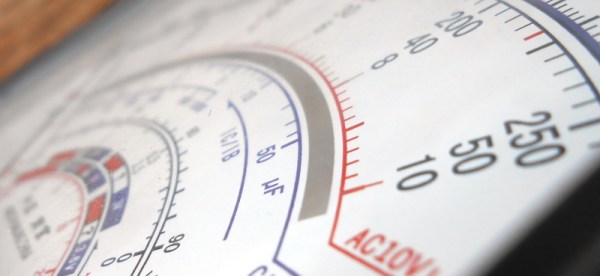
Why You Shouldn’t Quite Forget The Moving Coil Multimeter

Did any of you have an AWS multimeter? Was it the best? Radio-electronics magazine, August 1981.
Did any of you have an AWS multimeter? Was it the best? Radio-Electronics magazine, August 1981.

If you were to ask a random Hackaday reader what their most fundamental piece of electronic test equipment was, it’s likely that they would respond with “multimeter”. If you asked them to produce it, out would come a familiar item, a handheld brick with a 7-segment LCD at the top, a chunky rotary selector switch, and a pair of test probes. They can be had with varying quality and features for anything from a few dollars to a few hundred dollars, though they will nearly all share the same basic set of capabilities. Voltage in both AC and DC, DC current, resistance from ohms to mega ohms, and maybe a continuity tester. More expensive models have more features, may be autoranging, and will certainly have better electrical safety than the cheaper ones, but by and large they are a pretty standard item.

If Hackaday had been around forty years ago and you’d asked the same question, you’d have had a completely different set of multimeters pulled out for your inspection. Probably still a handheld brick with the big selector switch, but instead of that LCD you’d have seen a large moving-coil meter with a selection of scales for the different ranges. It would have done substantially the same job as the digital equivalent from today, but in those intervening decades it’s a piece of equipment that’s largely gone. So today I’m going to investigate moving coil multimeters, why you see them a lot less these days than you used to, and why you should still consider having one in your armoury. Continue reading “Why You Shouldn’t Quite Forget The Moving Coil Multimeter”

Peggy Whitson, Space Scientist

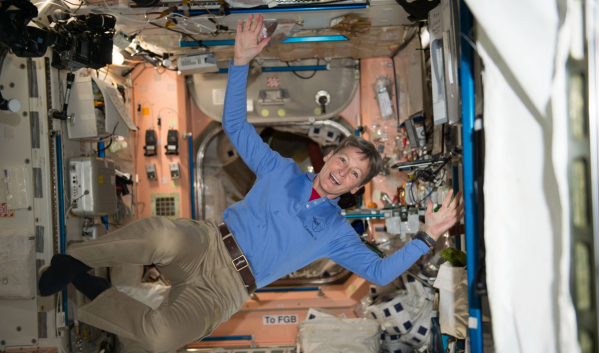
When astronaut Dr. Peggy Whitson returned from space earlier this year, it was a triumphant conclusion to a lifelong career as a scientist, explorer, and leader. Whitson is a biochemist who became one of the most experienced and distinguished astronauts ever to serve. She’s got more time logged in space than any other American. There’s a reason that she’s been called the Space Ninja.

Education and Early Life

Some people find their vocation late in life, but Peggy Whitson figured it out in her senior year of high school. It was 1979 and NASA had just accepted its first class of female astronauts, including Christa McAuliffe and Judith Resnik who ultimately died aboard the Challenger.

Born on a family farm in Iowa in 1960, Whitson began working on her plan, with the stereotypical Midwestern work ethic seeming to prime her for the hard slog ahead. She earned a BS in Biology/Chemistry, Summa, from Iowa Wesleyan, before earning a Ph.D. in biochemistry from Rice in 1985. A person can write about Whitson blazing through to a doctorate in a single sentence, but the truth is that it’s just a lot of hard work, and that’s one of the aspects of her career that stands out: she worked tirelessly.

Scientist Career

After getting her doctorate, Whitson worked as a research associate at Johnson Space Center as part of a post-doctoral fellowship. She put in a couple of years as a research biochemist, working on biochemical payloads
like the Bone Cell Research Experiment in STS-47, which was run in space by fellow badass Dr. Mae Jamison. Whitson hadn’t given up on her dream of becoming an astronaut herself, and the whole time she worked at Johnson she was applying to NASA. It took ten years and five applications before she made it in.

In the meantime, however, Whitson was given a lot of very cool projects and also began to establish her credentials as a leader, serving as Project Scientist of the Shuttle-Mir Program from 1992 till 1995. For three years she helped lead Medical Sciences Division at Johnson. The two years after that she co-chaired the NASA committee on US-Russian relations. And because she still had more time to crush it, she also worked as an adjunct professor at the University of Texas Medical Branch as well as at Rice.

Then, in April of 1996, she learned that her hard work had paid off and that she had been accepted into astronaut school. Peggy Whitson was going to space.

Ad Astra
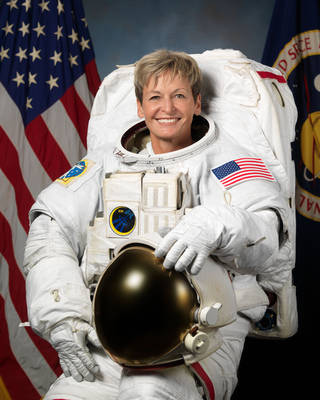
It would be eight more years before she made it to space, however. Two years of intense training was followed by ground-based technical duties, including two years spent in Russia in support of NASA crews there. However, in 2002 she got her chance, flying in a Soyuz up to the International Space Station as part of Expedition 5. There she conducted science experiments and helped install new components in the space station, logging 164 days in space.

Back on earth, Whitson continued to kick ass as a scientist, astronaut, and leader. In 2003 she commanded a 10-day underwater mission that helps trains astronauts for extended stays in space, preparing her for her signature accomplishments: two tours where she commanded the ISS.

In 2008 she led Expedition 16, in which three additional modules were added to the ISS. Because of the new construction, and despite her science focus, Whitson became one of NASA’s most prolific spacewalkers, making 10 EVAs in her career — second only to cosmonaut Anatoly Solovyev’s 16 and her cumulative EVA time of 60 hours is third best in the world.

The three years that followed she served as Chief Astronaut, before she returned to space in November 2016 as commander of Expedition 50. Compared to 16 it was much more mellow, albeit with hundreds of biochemistry experiments conducted. In April of 2017, Whitson surpassed the U.S. space endurance record, earning her a call from the President. She ended up with 665 days in space, returning September 2 as a hero.

Dr. Peggy Whitson’s brilliance and tireless drive have earned her innumerable awards and commendations. Her elementary school has a science lab named after her. This year Glamour named her one of their women of the year. She serves as an inspiration to anyone who aspires to a career in science, math, or space exploration: it won’t be easy, and it will take a really long time, but it’s the kind of work that makes the world a distinctly better place.

Photo Credit: NASA

Sferics, Whistlers, And The Dawn Chorus: Listening To Earth Music On VLF

We live in an electromagnetic soup, bombarded by wavelengths from DC to daylight and beyond. A lot of it is of our own making, especially further up the spectrum where wavelengths are short enough for the bandwidth needed for things like WiFi and cell phones. But long before humans figured out how to make their own electromagnetic ripples, the Earth was singing songs at the low end of the spectrum. The very low frequency (VLF) band abounds with interesting natural emissions, and listening to these Earth sounds can be quite a treat.

Continue reading “Sferics, Whistlers, And The Dawn Chorus: Listening To Earth Music On VLF”

Hackaday Links Column Banner

Hackaday Links: Remember, Remember

Buckle up, buttercup because this is the last weekly Hackaday Links post you’re getting for two weeks. Why? We have a thing next weekend. The Hackaday Superconference is November 11th and 12th (and also the 10th, because there’s a pre-game party), and it’s going to be the best hardware con you’ve ever seen. Don’t have a ticket? Too bad! But we’ll have something for our Internet denizens too.

So, you’re not going to the Hackaday Supercon but you’d like to hang out with like-minded people? GOOD NEWS! Barnes & Noble is having their third annual Mini Maker Faire on November 11th and 12th. Which Barnes & Noble? A lot of them. Our reports tell us this tends to be geared more towards the younger kids, but there are some cool people doing demonstrations. Worst case scenario? You can pick up a copy of 2600.

PoC || GTFO 0x16 is out! Pastor Laphroaig Races The Runtime Relinker And Other True Tales Of Cleverness And Craft! This PDF is a Shell Script That Runs a Python Webserver That Serves a Scala-Based JavaScript Compiler With an HTML5 Hex Viewer; or, Reverse Engineer Your Own Damn Polyglot.

In, ‘Oh, wow, this is going to be stupid’ news, I received an interesting product announcement this week. It’s a USB C power bank with an integrated hand warmer. Just think: you can recharge your phone on the go, warm your hands in the dead of winter, and hope your random battery pack from China doesn’t explode in your pocket. I’m not linking to this because it’s that dumb.

You can now cross-compile ARM with GCC in Visual Studio.

The iPhone X is out, and that means two things. There are far too many YouTube videos of people waiting in line for a phone (and not the good kind), and iFixit did a teardown. This thing is glorious. There are two batteries and a crazy double-milled PCB stack with strange and weird mezzanine connectors. The main board for the iPhone X is completely unrepairable, but it’s a work of engineering art. No word yet on reusing the mini-Kinect in the iPhone X.

Speaking of irreparable computers, the Commodore 64 is not. [Drygol] recently came across a C64 that was apparently the engine controller for a monster truck found on the bottom of the ocean. This thing was trashed, filled with rust and corrosion, and the power button just fell off. Prior to cleaning, [Drygol] soldered a new power button, bowered it up, and it worked. The crappiest C64 was repairable. A bit of cleaning, painting the case, and the installation of an SD2IEC brought this computer back to life, ready for another thirty years of retrogaming and BASIC.

The Zynq from Xilinx is one of the most interesting parts in recent memory. It’s a dual-core ARM Cortex A9 combined with an FPGA with a little more than a million reconfigurable gates. It’s been turned into a synth, a quadcopter, all of British radio, and it’s a Pynq dev board. Now there’s a new part in the Zynq family, an RFSoC that combines the general ARM/FPGA format with some RF wizardry. It’s designed for 5G wireless and radar (!), and one of those parts we can’t wait to see in use.

Do you keep blowing stuff up when attaching a USB to UART adapter to a board? Never fear, because here’s one with galvanic isolation. This is done with a neat digital isolator from Maxim

Books You Should Read: V-2 By Walter Dornberger

In an era where we can watch rockets land on their tails Buck Rogers-style live on YouTube, it’s difficult to imagine a time when even the most basic concepts of rocketry were hotly debated. At the time, many argued that the very concept of a liquid fueled rocket was impossible, and that any work towards designing practical rocket powered vehicles was a waste of time and money. Manned spacecraft, satellite communications, to say nothing of landing on other worlds; all considered nothing more than entertainment for children or particularly fanciful adults.

Walter Dornberger (Bundesarchiv, Bild 146-1980-009-33 / CC-BY-SA 3.0)

This is the world in which V-2, written by the head of the German rocket development program Walter Dornberger, takes place. The entire history of the A-4/V-2 rocket program is laid out in this book, from the very early days when Dornberger and his team were launching rockets with little more than matches, all the way up to Germany’s frantic attempts to mobilize the still incomplete V-2 rocket in face of increasingly certain defeat at the end of World War II.

For those fascinated with early space exploration and the development of the V-2 rocket like myself, this book is essentially unparalleled. It’s written completely in the first person, through Dornberger’s own eyes, and reads in most places like a personal tour of his rocket development site at the Peenemünde Army Research Center. Dornberger walks through the laboratories and factories of Peenemünde, describing the research being done and the engineers at work in a personal detail that you simply don’t get anywhere else.

But this book is not only a personal account of how the world’s first man-made object to reach space was created, it’s also a realistic case study of how engineers and the management that pays the bills often clash with disastrous results. Dornberger and his team wanted to create a vehicle to someday allow man to reach space, while the Nazi government had a much more nefarious and immediate goal. But this isn’t a book about the war — the only battles you’ll read about in V-2 take place in meeting rooms, where the engineers who understood the immense difficulty of their task tried in vain to explain why the timetables and production numbers the German military wanted simply couldn’t be met.

Continue reading “Books You Should Read: V-2 By Walter Dornberger”

What Is Entropy And How Do I Get More Of It?

Let’s start off with one of my favorite quotes from John von Neumann: “Any one who considers arithmetical methods of producing random digits is, of course, in a state of sin. For, as has been pointed out several times, there is no such thing as a random number — there are only methods to produce random numbers, and a strict arithmetic procedure of course is not such a method.”

What von Neumann is getting at is that the “pseudo” in pseudorandom number generator (PRNG) is really a synonym for “not at all”. Granted, if you come in the middle of a good PRNG sequence, guessing the next number is nearly impossible. But if you know, or can guess, the seed that started the PRNG off, you know all past and future values nearly instantly; it’s a purely deterministic mathematical function. This shouldn’t be taken as a rant against PRNGs, but merely as a reminder that when you use one, the un-guessability of the numbers that it spits out is only as un-guessable as the seed. And while “un-guessability” isn’t a well-defined mathematical concept, or even a real word, entropy is.

That’s why entropy matters to you. Almost anything that your computer wants to keep secret will require the generation of a secret random number at some point, and any series of “random” numbers that a computer generates will have only as much entropy, and thus un-guessability, as the seed used. So how does a computer, a deterministic machine, harvest entropy for that seed in the first place? And how can you make sure you’ve got enough? And did you know that your Raspberry Pi can be turned into a heavy-duty source of entropy? Read on!

Continue reading “What Is Entropy And How Do I Get More Of It?”