Fail Of The Week: Cheap Chips Cause Chaos

We all know the old saw: if it’s too good to be true, it probably is. But nowhere does this rule seem to break down as regularly as when we order parts. Banggood, AliExpress, and eBay are flooded with parts ready to be magically transported across the globe to our doorsteps, all at prices that seem to defy the laws of economics.

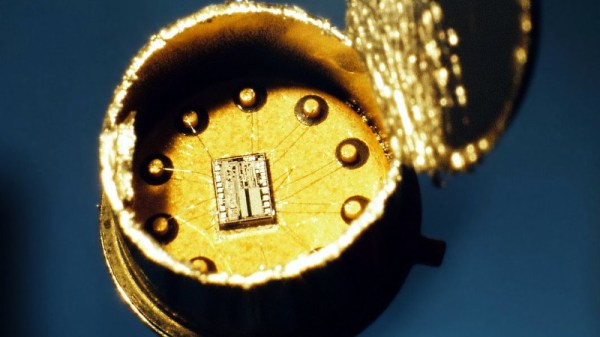
Most of these transactions go off without a hitch and we get exactly what we need to complete our Next Cool Thing. But it’s not always so smooth, as [Kerry Wong] recently discovered with an eBay order that resulted in some suspicious chips. [Kerry] ordered the AD633 analog multiplier chips as a follow-up to his recent Lorenz Attractor X-Y recorder project, where he used an Arduino to generate the chaotic butterfly’s data set as a demo for the vintage instrument. Challenged in the comments to do it again in analog, [Kerry] did his homework and found a circuit to make it happen. The needed multipliers were $10 a pop on DigiKey, so he sourced cheaper chips from eBay. The $2 chips seemed legit, with the Analog Devices logo and everything, but the circuit didn’t work. [Kerry]’s diagnosis in the video below is interesting, and it’s clear that the chips are fakes. Caveat emptor.

Here’s hoping that [Kerry] sources good chips soon and regales us with a successful build. Until then, what are your experiences with cheap chips? Have you been burned by overseas or domestic suppliers before? Does any single supplier seem like a better bet to you, or is it all hit or miss? Sound off in the comments below.

Continue reading “Fail Of The Week: Cheap Chips Cause Chaos”

Skin (Effect) In The Game

We love to pretend like our components are perfect. Resistors don’t have capacitance or inductance. Wires conduct electricity perfectly. The reality, though, is far from this. It is easy to realize that wire will have some small resistance. For the kind of wire lengths you usually encounter, ignoring it is acceptable. If you start running lots of wire or you are carrying a lot of current, you might need to worry about it. Really long wires also take some time to get a signal from one end to the other, but you have to have a very long wire to really worry about that. However, all wires behave strangely as frequency goes up.

Of course there’s the issue of the wire becoming a significant part of the signal’s wavelength and there’s always parasitic capacitance and inductance. But the odd effect I’m thinking of is the so-called skin effect, first described by [Horace Lamb] in 1883. [Lamb] was working with spherical conductors, but [Oliver Heaviside] generalized it in 1885.

Put simply, when a wire is carrying AC, the current will tend to avoid traveling in the center of the wire. At low frequencies, the effect is minimal, but as the frequency rises, the area in the center that isn’t carrying current gets larger. At 60 Hz, for example, the skin depth for copper wire — the depth where the current falls below 1/e of the value near the surface — is about 0.33 inches. Wire you are likely to use at that frequency has a diameter less than that, so the effect is minimal.

However, consider a 20 kHz signal — a little high for audio unless you are a kid with good ears. The depth becomes about 0.018 inches. So wire bigger than 0.036 inches in diameter will start losing effective wire size. For a 12-gauge wire with a diameter of 0.093 inches, that means about 25% of the current-handling capacity is lost. When you get to RF and microwave frequencies, only the thinnest skin is carrying significant current. At 6 MHz, for example, copper wire has a skin depth of about 0.001 inches. At 1 GHz, you are down to about 0.000081 inches. You can see this (not to scale) in the accompanying image. At DC, all three zones of the wire carry current. At a higher frequency, only the outer two zones carry significant current. At higher frequencies, only the outer zone is really carrying electrons.

Continue reading “Skin (Effect) In The Game”

Anouk Wipprecht: Robotic Dresses And Human Interfaces

Anouk Wipprecht‘s hackerly interests are hard to summarize, so bear with us. She works primarily on technological dresses, making fashion with themes inspired by nature, but making it interactive. If that sounds a little bit vague, consider that she’s made over 40 pieces of clothing, from a spider dress that attacks when someone enters your personal space too quickly to a suit with plasma balls that lets her get hit by Arc Attack’s giant musical Tesla coils in style. She gave an inspiring talk at the 2017 Hackaday Superconference, embedded below, that you should really go watch.

Anouk has some neat insights about how the world of fashion and technology interact. Technology, and her series of spider dresses in particular, tends to evolve over related versions, while fashion tends to seek the brand-new and the now. Managing these two impulses can’t be easy.

For instance, her first spider was made with servos and laser-cut acrylic, in a construction that probably seems familiar to most Hackaday readers. But hard edges, brittle plastic, and screws that work themselves slowly loose are no match for human-borne designs. Her most recent version is stunningly beautiful, made of 3D printed nylon for flexibility, and really nails the “bones of a human-spider hybrid” aesthetic that she’s going for.

The multiple iterations of her drink-dispensing “cocktail dress” (get it?!) show the same progression. We appreciate the simple, press-button-get-drink version that she designed for a fancy restaurant in Ibiza, but we really love the idea of being a human ice-breaker at parties that another version brings to the mix: to get a drink, you have to play “truth or dare” with questions randomly chosen and displayed on a screen on the wearer’s arm.

Playfulness runs through nearly everything that Anouk creates. She starts out with a “what if?” and runs with it. But she’s not just playing around. She’s also a very dedicated documenter of her projects, because she believes in paying the inspiration forward to the next generation. And her latest project does something really brilliant: merging fashion, technology, and medical diagnostics.

It’s a stripped-down EEG that kids with ADHD can wear around in their daily lives that triggers a camera when their brains get stimulated in particular ways. Instead of a full EEG that requires a child to have 30 gel electrodes installed, and which can only be run in a medical lab, stripping down the system allows the child to go about their normal life. This approach may collect limited data in comparison to the full setup, but since it’s collected under less intimidating circumstances, the little data that it does collect may be more “real”. This project is currently in progress, so we’ll just have to wait and see what comes out. We’re excited.

There’s so much more going on in Anouk’s presentation, but don’t take our word for it. Go watch Anouk’s talk right now and you’ll find she inspires you to adds a little bit more of the human element into your projects. Be playful, awkward, or experimental. But above all, be awesome!

Continue reading “Anouk Wipprecht: Robotic Dresses And Human Interfaces”

Joan Feynman Found Her Place In The Sun

Google ‘Joan Feynman’ and you can feel the search behemoth consider asking for clarification. Did you mean: Richard Feynman? Image search is even more biased toward Richard. After maybe seven pictures of Joan, there’s an endless scroll of Richard alone, Richard playing the bongos, Richard with Arline, the love of his life.

Yes, Joan was overshadowed by her older brother, but what physicist of the era wasn’t? Richard didn’t do it on purpose. In fact, no one supported Joan’s scientific dreams more than he did, not even their mother. Before Richard ever illuminated the world with his brilliance, he shined a light on his little sister, Joan.

Continue reading “Joan Feynman Found Her Place In The Sun”

Hackers Vs. Mold: Building A Humidistat Fan

Having a mold problem in your home is terrible, especially if you have an allergy to it. It can be toxic, aggravate asthma, and damage your possessions. But let’s be honest, before you even get to those listed issues, having mold where you live feels disgusting.

You can clean it with the regular use of unpleasant chemicals like bleach, although only with limited effectiveness. So I was not particularly happy to discover mold growing on the kitchen wall, and decided to do science at it. Happily, I managed to fix my mold problems with a little bit of hacker ingenuity.

Continue reading “Hackers Vs. Mold: Building A Humidistat Fan”

An Interview With Alex Williams, Grand Prize Winner

Alex Williams pulled off an incredible engineering project. He developed an Autonomous Underwater Vehicle (AUV) which uses a buoyancy engine rather than propellers as its propulsion mechanism and made the entire project Open Source and Open Hardware.

The design aims to make extended duration missions a possibility by using very little power to move the vessel. What’s as remarkable as the project itself is that Alex made a goal for himself to document the project to the level that it is fully reproducible. His success in both of these areas is what makes the Open Source Underwater Glider the perfect Grand Prize winner for the 2017 Hackaday Prize.

We got to sit down with Alex the morning after he won to talk about the project and the path he took to get here.

Continue reading “An Interview With Alex Williams, Grand Prize Winner”

Hackaday Links Column Banner

Hackaday Links: November 19, 2017

[Peter]’s homebuilt ultralight is actually flying now and not in ground effect, much to the chagrin of YouTube commenters. [Peter Sripol] built a Part 103 ultralight (no license required, any moron can jump in one and fly) in his basement out of foam board from Lowes. Now, he’s actually doing flight testing, and he managed to build a good plane. Someone gifted him a ballistic parachute so the GoFundMe for the parachute is unneeded right now, but this gift parachute is a bit too big for the airframe. Not a problem; he’ll just sell it and buy the smaller model.

Last week, rumors circulated of Broadcom acquiring Qualcomm for the sum of One… Hundred… Billion Dollars. It looks like that’s not happening now. Qualcomm rejected a deal for $103B, saying the offer, ‘undervalued the company and would face regulatory hurdles.’ Does this mean the deal is off? No, there are 80s guys out there who put the dollar signs in Busine$$, and there’s politicking going on.

A few links posts ago, I pointed out there were some very fancy LED panels available on eBay for very cheap. The Barco NX-4 LED panels are a 32×36 panels of RGB LEDs, driven very quickly by some FPGA goodness. The reverse engineering of these panels is well underway, and [Ian] and his team almost have everything figured out. Glad I got my ten panels…

TechShop is gone. With a heavy heart, we bid adieu to a business with a whole bunch of tools anyone can use. This leaves a lot of people with TechShop memberships out in the cold, and to ease the pain, Glowforge, Inventables, Formlabs, and littleBits are offering some discounts so you can build a hackerspace in your garage or basement. In other TechShop news, the question on everyone’s mind is, ‘what are they going to do with all the machines?’. Nobody knows, but the smart money is a liquidation/auction. Yes, in a few months, you’ll probably be renting a U-Haul and driving to TechShop one last time.

3D Hubs has come out with a 3D Printing Handbook. There’s a lot in the world of filament-based 3D printing that isn’t written down. It’s all based on experience, passed on from person to person. How much of an overhang can you really get away with? How do you orient a part correctly? God damned stringing. How do you design a friction-fit between two parts? All of these techniques are learned by experience. Is it possible to put this knowledge in a book? I have no idea, so look for that review in a week or two.

Like many of us, I’m sure, [Adam] is a collector of vintage computers. Instead of letting them sit in the attic, he’s taking gorgeous pictures of them. The collection includes most of the big-time Atari and Commodore 8-bitters, your requisite Apples, all of the case designs of the all-in-one Macs, some Pentium-era PCs, and even a few of the post-97 Macs. Is that Bondi Blue? Bonus points: all of these images are free to use with attribution.

Nvidia is blowing out their TX1 development kits. You can grab one for $200. What’s the TX1? It’s a really, really fast ARM computer stuffed into a heat sink that’s about the size of a deck of cards. You can attach it to a MiniITX breakout board that provides you with Ethernet, WiFi, and a bunch of other goodies. It’s a step above the Raspberry Pi for sure and is capable enough to run as a normal desktop computer.