An Easy Hack For Working With Your Hands On Video Calls

Video calls are okay. While some advocate for the benefit of body language over a standard phone call, they remain an imperfect substitute for in-person interaction. [Amos] wanted to be able to demonstrate things better when on a video chat, so devised this simple solution for when he’s working with his hands.

The hack consists of a mirror attached to a clothespeg with a flexible piece of wire. This simple device can then be clipped to the screen of a laptop, and the mirror adjusted to allow the webcam to view the user’s desk. By positioning it correctly, the user can both show their desk and their face together, in split screen. It’s a great way to explain something while giving viewers a clear shot of your face and your hands at the same time.

It’s not exactly complicated, but a nifty hack that could prove useful to anyone trying to teach without having to muck about with complicated digital handwriting setups or multiple webcams. There’s a shortage at the moment, anyway. If you’re looking for a way to chat with your less tech savvy relatives, consider repurposing an old Android tablet. Video after the break.

Continue reading “An Easy Hack For Working With Your Hands On Video Calls”
A French Cleat Twist On Electronics Bench Organization

For some of us, our workbench is where organization goes to die. Getting ready to tackle a new project means sweeping away a pile of old projects, exposing exactly as much bench space needed to plop down the new parts. On the other end of the spectrum lie those for whom organization isn’t a means to an end, but an end itself. Their benches are spotless, ready to take on a new project at a moment’s notice.

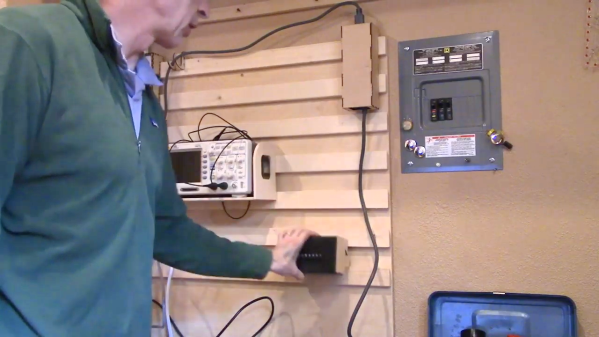
[Eric Gunnerson]’s new French-cleat electronics bench is somewhere in between those two extremes, although nowhere near as over-organized as the woodworking organizer that inspired it. If you’ve never heard of a French cleat, Google around a bit and you’ll see some amazing shops where the system of wall-mounted, mitered cleats with mating parts on everything from shelves to cabinets are put to great use. A properly built French cleat can support tremendous loads; [Eric]’s system is scaled down a bit in deference to the lighter loads typically found in the electronics shop. His cleats are 2″ x 3″ pieces of pine, attached to a sheet of plywood that was then screwed to the wall. His first pass at fixtures for the cleats used a Shaper Origin CNC router, but when that proved to be slow he turned to laser-cut plywood. The summary video below shows a few of the fixtures he’s come up with so far; we particularly like the oscilloscope caddy, and the cable hangers are a neat trick too.

What we like about this is the flexibility it offers, since you can change things around as workflows develop or new instruments get added. Chalk one up for [Eric] for organization without overcomplication.

Continue reading “A French Cleat Twist On Electronics Bench Organization”

Keyboard Switch Is Really A Transformer

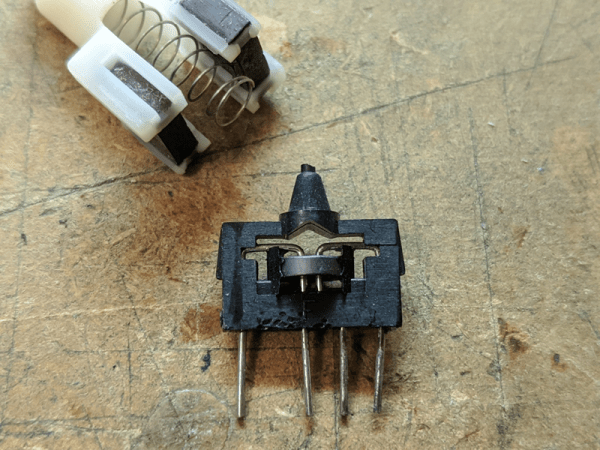
We don’t know why [TubeTime] decided to show off this oddball keyboard switch as a series of Twitter posts, but we were glad to see them somewhere. At first, the switch looks pretty conventional. But as the pictures reveal the insides, you’ll notice something unusual: a ferrite toroid! These switches operate as a transformer and are known as magnetic valve switches.

The switches have two sets of two pins — one set for the primary and one for the secondary of the transformer wound around the ferrite core. That transformer remains stationary, but a pair of permanent magnets move. When the key is up, the magnets are close to the core and cause the transformer to saturate, so there is little or no output at the secondary. When you depress the key, the magnet moves away from the core, allowing the signal to pass through the transformer. What that means is there is no mechanical contact, which is good for switch life. It is also important in environments where a small spark could cause an explosion. You can watch a video about a keyboard that used those switches, below.

Continue reading “Keyboard Switch Is Really A Transformer”

DIY Neuralyzer From Scrap Parts

Cosplay and prop making are near and dear to our hearts here at Hackaday. That’s why whenever we see sci-fi tech brought to life, we can’t help but pay close attention. Enter [How to make’s] DIY Neuralyzer, from the Men-in-Black franchise. Unfortunately, this won’t wipe your memories as the real-life Neuralyzer would, but it will make for a cool prop at your next cosplay event.

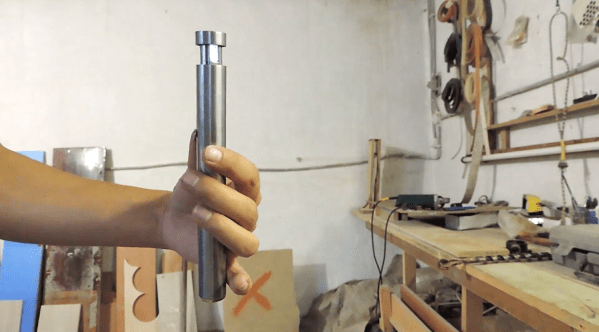
What makes this project worth sharing is its use of very simple home tools and a bit of scrap metal, some PVC, a single LED, a switch, and maybe a few more miscellaneous bits. The base of the design is composed of two pieces of hollow, rod-shaped scrap metal and a single spring that mechanizes the entire setup.

The video is a few months old at this point. It took a recent post on Reddit to send this across our feed, but we’re glad we came across it.

Great project [How to make]! May we suggest a few more LEDs?

Continue reading “DIY Neuralyzer From Scrap Parts”

How Much Is That Plotter In The Window?

We live in a strange time indeed. People who once eschewed direct interactions with fellow humans now crave it, but to limited avail. Almost every cashier at the few stores deigned essential enough to maintain operations are sealed away behind plastic shields, with the implication that the less time one spends lingering, the better. It’s enough to turn an introvert into an extrovert, at least until the barriers are gone.

We get the idea that the need to reach out and touch someone is behind [Niklas Roy]’s “Please Leave a Message”, an interactive art installation he set up in the front window of his Berlin shop. Conveniently located on a downtown street, his shop is perfectly positioned to attract foot traffic, and his display is designed to catch the eye and perhaps crack a smile. The device consists of a large wooden easel holding the guts from an old X-Y pen plotter, an Arduino and an ESP-8266, and a couple of drivers for the plotter’s steppers. Passers-by are encouraged to scan a QR code that accesses a web page served up by the ESP-8266, where they can type in a brief message. The plotter dutifully spells it out on a scroll of paper for all to see, using a very nice font that [Niklas] designed to be both readable and easily plotted. The video below shows it in action with real people; it seems to be a crowd-pleaser.

[Niklas] has been incredibly prolific, and we’ve covered many of his interactive art installations. Just search for his name and you’ll find everything from a pressure-washer dancing waters display to a plus-sized pinball machine.

Continue reading “How Much Is That Plotter In The Window?”

Printed Jig Is A Welding Rig

[NixieGuy] was scheming to build robots with cable-driven joints when the pandemic hit. Now that component sourcing is scarce, he’s had to get creative when it comes to continuous cables. These cables need to be as seamless as possible to avoid getting caught on the pulleys, so [Nixie] came up with a way to weld together something he already has on hand — lengths of .45mm steel cable.

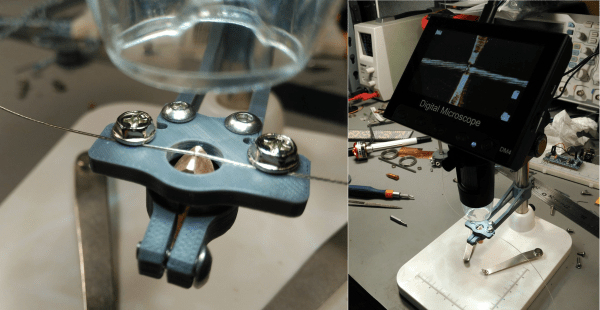
The 3D printed jig is designed to be used under a digital microscope, and even clamps to the pillar with screws. Another set of screws holds the two wires in place while they are butt welded between two pieces of copper.

[Nixie] adds a spot of solder paste for good measure, and then joins the wires by attaching his bench power supply set to 20V @ 3.5A to the copper electrodes. We love that [Nixie] took the time to streamline the jig design, because it looks great.

This just goes to show you that great things can happen with limited resources and a little bit of imagination. [Nixie] not only solved his own supply chain problem, he perfected a skill at the same time. If you don’t have a bench supply, you might be able to get away with a battery-powered spot welder, depending on your application.

512 Bytes Ought To Be Enough For Dinosaurs

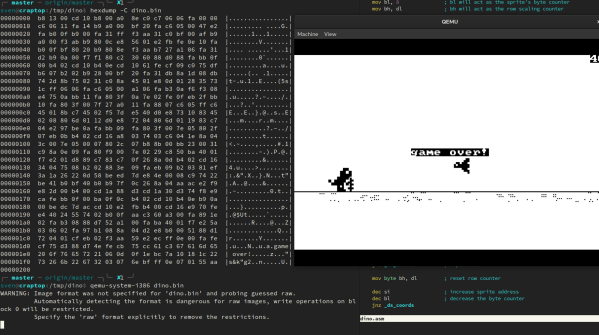
It’s said that slow internet is worse than no internet at all, which is mainly a matter of continuously crushing all hope and sanity vs. finding peace in accepting a fate out of your control. Plus, you can easily pass the time of being catapulted back to the prehistoric ages by navigating a jumpy little creature from that same age through a field of cacti — at least if you’re using Chrome or Chromium. But neither a browser nor actually an operating system are really necessary for that, as [franeklubi] shows with a boot sector implementation of the same game.

Sure, the graphics aren’t quite on par, but compared to the original’s 3000+ lines of JavaScript, [franeklubi] managed to implement it in a few hundred lines of assembly, and was of course constrained by the 512 bytes of the boot sector itself (well, 510 plus the signature). This constraint causes a few limitations, like a slight lack of randomness in the obstacle arrangements, and a constant running speed, but it also makes it the perfect playground and starting point to delve into the world of nifty knacks and hacks, trying to squeeze every last byte.

If you want to give it a try for yourself, all you need is NASM and QEMU — and while you’re at it, why not have some Tetris along the way? We could also see this nicely combined with the real-world jumping version from a few weeks back, and turn it into a standalone arcade game. Bounce Crouch Revolution anyone?