Be A Fire Bender With The Power Of Magnets

More often than you think, scientific progress starts with a simple statement: “Huh, that’s funny…” That’s the sign that someone has noticed something peculiar, and that’s the raw fuel of science because it often takes the scientist down interesting rabbit holes that sometimes lead to insights into the way the world works.

[Ben Krasnow] ended up falling down one of those rabbit holes recently with his experiments with magnets and flames. It started with his look at the Zeeman effect, which is the observation that magnetic fields can influence the spectral lines of light emitted by certain sources. In a previous video, [Ben] showed that light from a sodium lamp could be dimmed by a powerful electromagnet. Some of his viewers took exception to his setup, which used an oxy-acetylene flame doped with sodium passing through the poles of the magnet; they thought the effect observed was a simple magnetohydrodynamic effect, and not the Zeeman effect he was supposed to be testing. That led to the experiments in the video below, which started with a candle flame being strongly deflected by the magnet. [Ben] methodically worked through the problem, eliminating variables by going so far as to blow soap bubbles of various gasses within the magnet’s poles to rule out the diamagnetism of oxygen as a cause of the phenomenon. He finally showed that even hot air by itself is deflected, using a simple light bulb and a FLIR camera. It’s good stuff, and well worth a watch.

Spoiler alert: [Ben] is still scratching his head about what’s going on, and we’re looking forward to his conclusions. This isn’t his first rabbit hole expedition, of course; his experiments with creating plasma with high-pressure water were fascinating, as were his DIY superconducting ceramics. Continue reading “Be A Fire Bender With The Power Of Magnets”

Wire Wound Resistors On Your Own

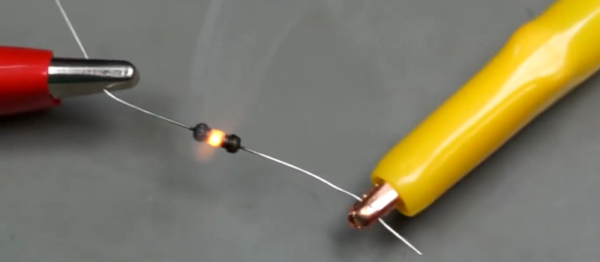
In all kinds of engineering, we build on abstractions in a kind of inverted pyramid. Lots of people can, for example, design a system using ready-made building blocks on printed circuit boards. Fewer people can do the same design using ICs. Fewer still can design with components. But who designs the components? Even fewer people. Then there are the people designing the constituent elements of those components. [Learnelectronics] wanted to break one of those abstraction layers so he shows how to make your own wire-wound resistors.

Wire-wound resistors are often used when you need resistance with a higher power dissipation than a common film or composition resistor. Using nichrome wire makes this more practical since a meter of it has nearly 20 ohms of resistance. A regular wire has much less resistance.  The video shows a drill winding a coil of wire neatly, but this also highlights one of the problems with wire wound resistors.

Continue reading “Wire Wound Resistors On Your Own”

Sharpies And Glue Sticks Fight The Gummy Metal Machining Blues

“Gummy” might not be an adjective that springs to mind when describing metals, but anyone who has had the flutes of a drill bit or end mill jammed with aluminum will tell you that certain metals do indeed behave in unhelpful ways. But a new research paper seeks to shed light on the gummy metal phenomenon, and may just have machinists stocking up on office supplies.

It’s a bit counterintuitive that harder metals like steel are often easier to cut than softer metals; especially aluminum but also copper, nickel alloys, and some stainless steel alloys. But it happens, and [Srinivasan Chandrasekar] and his colleagues at Purdue University wanted to find out why, and what can be done about it. So the first job was to get up close and personal with the interface between a cutting tool and metal stock, to observe the dynamics of cutting. In a fascinating bit of video, they saw that softer metals tend to fold in sinuous patterns rather than breaking on defined shear planes.

Source: American Physical Society.

Having previously noted that cutting through Dykem, a common machinist’s marking fluid, changes chip formation in soft metals, the researchers tested everything from Sharpies to adhesive tape and even correction fluid, and found that they all helped to reduce the gumming action to some degree. Under their microscope they can clearly see that chips form differently once the cutting edge hits the treated surface, tending to act more brittle and ejecting rather than folding. They also noted a marked decrease in cutting force for the treated metal, and much-improved surface finish to boot.

Will Sharpies and glue sticks enter the book of old machinist’s tricks like gauge-block wringing? Only time will tell. But for now, this is a pretty fascinating bit of research that you might be able to put to the test in your shop. Let us know what you find in the comments.

Continue reading “Sharpies And Glue Sticks Fight The Gummy Metal Machining Blues”

Understanding Math Vs Understanding Math

One of the things hard about engineering — electrical engineering, in particular — is that you can’t really visualize what’s important. Sure, you can see a resistor and an LED in your hands, but the real stuff that we care about — electron flow, space charge, and all that — is totally abstract. If you just tinker, you might avoid a lot of the inherent math (or maths for our UK friends), but if you decide to get serious, you’ll quickly find yourself in a numerical quicksand. The problem is, there’s mechanically understanding math, and intuitively understanding math. We recently came across a simple site that tries to help with the latter that deserves a look.

If you don’t know what we mean by that, consider a simple example. You can teach a kid that 5×3 is 15. But, hopefully, a teacher at some point in your academic career pointed out to you what the meaning of it was. That if you had five packages of three items, you have 15 items total. Or that if you have a room that is five feet on one side and three feet on the other, the square footage is 15 square feet.

Continue reading “Understanding Math Vs Understanding Math”

Custom Circuit Makes For Better Battery Level Display

Isn’t it always the way? There’s a circuit right out of the textbooks, or even a chip designed to do exactly what you want — almost exactly. It’s 80% perfect for your application, and rather than accept that 20%, you decide to start from scratch and design your own solution.

That’s the position [Great Scott!] found himself in with this custom LED battery level indicator. As the video below unfolds we learn that he didn’t start exactly from scratch, though. His first pass was the entirely sensible use of the LM3914 10-LED bar graph driver chip, a device that’s been running VU meters and the like for the better part of four decades. With an internal ladder of comparators and 1-kilohm resistors, the chip lights up the 10 LEDs according to an input voltage relative to an upper and lower limit set by external resistors. Unfortunately, the fixed internal resistors make that a linear scale, which does not match the discharge curve of the battery pack he’s monitoring. So, taking design elements from the LM3914 datasheet, [Great Scott!] rolled his own six-LED display from LM324 quad-op amps. Rather than a fixed resistance for each stage, trimmers let him tweak the curve to match the battery, and now he knows the remaining battery life with greater confidence.

Perhaps the 18650 battery pack [Great Scott!] is building is for the e-bike he has been working on lately. If it is, we’re glad to see that he spot-welded the terminals, unlike a recent e-bike battery pack build that may have some problems down the road.

Continue reading “Custom Circuit Makes For Better Battery Level Display”

Replace Your Calipers With A Microscope And Image Analysis

Getting a good measurement is a matter of using the right tool for the job. A tape measure and a caliper are both useful tools, but they’re hardly interchangeable for every task. Some jobs call for a hands-off, indirect way to measure small distances, which is where this image analysis measuring technique can come in handy.

Although it appears [Saulius Lukse] purpose-built this rig, which consists of a microscopic lens on a digital camera mounted to the Z-axis of a small CNC machine, we suspect that anything capable of accurately and smoothly transitioning a camera vertically could be used. The idea is simple: the height of the camera over the object to be measured is increased in fine increments, with an image acquired in OpenCV at each stop. A Laplace transformation is performed to assess the sharpness of each image, which when plotted against the frame number shows peaks where the image is most in focus. If you know the distance the lens traveled between peaks, you can estimate the height of the object. [Salius] measured a coin using this technique and it was spot on compared to a caliper. We could see this method being useful for getting an accurate vertical profile of a more complex object.

From home-brew lidar to detecting lightning in video, [Saulius] has an interesting skill set at the intersection of optics and electronics. We’re looking forward to what he comes up with next.

On The Right Tracks: Electric Wheelchair Guts Find New Life As Tank

Every hacker has dreamt of building their own tank at some point. Or maybe that’s just us. [Peter Sripol] and [Sam Foskuhl] have built one at a scale which is big enough to be rideable, but small enough that neighbors don’t get concerned.

An electric wheelchair is at the heart of the build. After ripping out its internals, the two motors with gearboxes are directly connected to the two tracks, allowing differential steering. Holding everything together is a solid welded steel frame – essential for years of reliable sieging.

The tracks themselves are simple strips of wood, cut and assembled by hand onto a nylon belt. Meanwhile the track wheels and drive assembly are designed in CAD and cut with a CNC router from some plywood, a great choice for adding some precision to the most mechanically challenging part of the build. As always in [Peter]’s videos, a large portion is dedicated to testing – in this case with a rather large array of fireworks. We certainly wouldn’t want to be in his bad books considering his other souped-up weapons.

A small, hacked, novelty electric vehicle? Sounds like it would find some good friends at EMF Camp, especially at the Hacky Racers event.

Continue reading “On The Right Tracks: Electric Wheelchair Guts Find New Life As Tank”