“Norman, Coordinate!”

If Star Trek taught us anything, it’s clearly that we’re not quite in the future yet. Case in point: androids are not supposed to be little flecks of printed circuits with wires and jacks sprouting off them. Androids are supposed to be gorgeous fembots in polyester kimonos with beehive hairdos, designed to do our bidding and controlled by flashing, beeping, serial number necklaces.

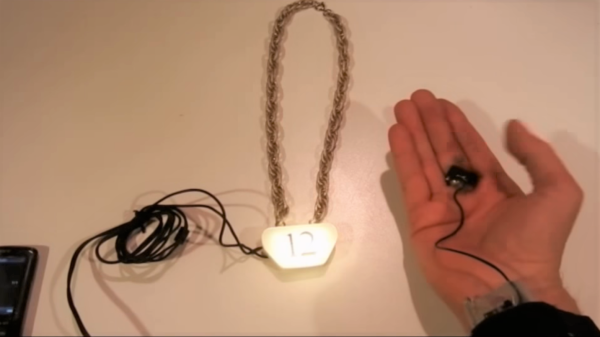
Not willing to wait till the 23rd century for this glorious day, [Peter Walsh] designed and built his own android amulet prop from the original series episode “I, Mudd.” There’s a clip below if you need a refresher on this particularly notable 1967 episode, but the gist is that the Enterprise crew is kidnapped by advanced yet simple-minded androids that can be defeated by liberal doses of illogic and overacting.

The androids’ amulets indicate when they BSOD by flashing and beeping. [Peter]’s amulet is a faithful reproduction done up in laser-cut acrylic with LEDs and a driver from a headphone. The leads for the amulet go to a small control box with a battery pack and the disappointing kind of Android, and a palmed microswitch allows you to indicate your current state of confusion.

You’ll be sure to be the hit of any con with this one, although how to make smoke come out of your head is left as an exercise for the reader. Or if you’d prefer a more sophisticated wearable from The Next Generation, check out this polished and professional communicator badge. Both the amulet and the communicator were entries in the Hackaday Sci-Fi contest.


Continue reading ““Norman, Coordinate!””

Welcome… To Resin Cast Park

From animatronic dinosaurs to [Jeff Goldblum]’s prosthetic chest hair, Jurassic Park is known for its practical effects and props. While it’s not as fancy as a breathing triceratops, YouTube’s god of resin casting has recreated one of the more endearing props from this movie. [Peter Brown] and [Pocket83] made a replica of the amber-topped cane carried by John Hammond, and it took him two years to do it.

The ‘mosquito in amber’ walking cane prop from Jurassic Park is just what you think it is – a large mosquito-looking bug trapped in 100 million year old amber. Of course, finding such a chunk of amber with the included mosquito would cost a fortune, so [Peter] turned to polyurethane resin. This block of resin was cast in two halves, with a ‘mosquito eater’ (or a crane fly) embedded in the middle. It took two years for [Peter] to cast this block of amber, but really all but two weeks of that was waiting for a few adult crane flys to appear.

With a bug encased in resin, the project went over to [Pocket83] who turned the walking cane on his lathe. There’s not much to this part of the build except for drilling a three-foot long hole down the center of a piece of wood, although the finish does make this cane look spectacular.

The long wait for crane fly breeding season was worth it. This is one of the best looking functional props from Jurassic Park. You can check out the videos for this build below.

Continue reading “Welcome… To Resin Cast Park”

Soda Bottles Used As Heat-Shrink For Wood Joinery

Nobody is likely to confuse it with the beautiful joinery that makes fine furniture so desirable. But as a practical technique, using plastic bottles as heat-shrink tubing for composite joints is pretty nifty, and the pieces produced are not without their charm.

Undertaken as an art project to show people what can be done with recycled materials, [Micaella Pedros]’ project isn’t a hack per se. She started with bottles collected around London and experimented with ways to use them in furniture. The plastic used in soda and water bottles, polyethylene terephthalate (PET), turns out to shrink quite a bit when heated. Rings cut from bottles act much like large pieces of heat-shrink tubing, but with more longitudinal shrinkage and much more rigidity. That makes for a great structural component, and [Micaella] explored several ways to leverage the material to join wood. Notches and ridges help the plastic grip smoother pieces of wood, and of course the correct size bottle needs to be used. But the joints are remarkably strong – witness the classic leaning-back-in-a-chair test in the video below.

Its aesthetic value aside, this is a good technique to file away for more practical applications. Of course, there are plenty of ways to recycle soda bottles, including turning them into cordage or even using them as light-pipes to brighten a dark room.

Continue reading “Soda Bottles Used As Heat-Shrink For Wood Joinery”

Mood Lamp Also Warns Of Nuclear Catastrophe

[Michal Zalewski] has radiation on the brain. Why else would he gut a perfectly-horrible floor lamp, rebuild the entire thing with high-power RGB LEDs, and then drive it with a microcontroller that is connected up to a Geiger-Müller tube? Oh right, because it also looks very cool, and Geiger tubes are awesome.

If you’ve been putting off your own Geiger tube project, and we know you have, [Michal]’s detailed explanation of the driver circuit and building one from scratch should help get you off the couch. Since a Geiger tube needs 400 volts DC, some precautions are necessary here, and [Michal] builds a relatively safe inverter and also details a relatively safe way to test it.

The result is a nice piece of decor that simultaneously warns you of a nuclear disaster by flashing lights like crazy, or (hopefully) just makes a nice conversation piece. This is one of the cooler Geiger tube hacks we’ve seen since [Robert Hart] connected up eighteen Geiger tubes, and used them to detect the direction of incoming cosmic rays and use that to compose random music (YouTube, embedded below).

[Michal] is also author of the most excellent Guerrilla Guide to CNC Machining and keeps good tabs on his background radiation.

Continue reading “Mood Lamp Also Warns Of Nuclear Catastrophe”

Dartboard Watches Your Throw; Catches Perfect Bullseyes

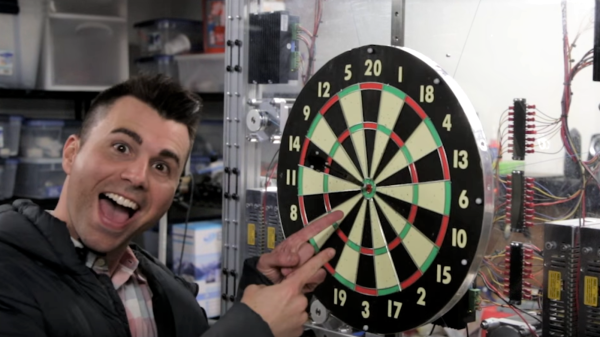
Some people really put a lot of effort into rigging the system. Why spend years practicing a skill and honing your technique to hit a perfect bullseye in darts when you can spend the time building an incredibly complicated auto-bullseye dartboard that’ll do it for you?

In fairness, what [Mark Rober] started three years ago seemed like a pretty simple task. He wanted to build a rig to move the dartboard’s bullseye to meet the predicted impact of any throw. Seems simple, but it turns out to be rather difficult, especially when you choose to roll your own motion capture system.



That system, built around the Nvidia Jetson TX1, never quite gelled, a fact which unfortunately burned through the first two years of the project. [Mark] eventually turned to the not inexpensive Vicon Vantage motion capture system with six IR cameras. A retroreflector on the non-regulation dart is tracked by the system and the resulting XY data is fed into MATLAB to calculate the parabolic path of the dart. An XY-gantry using six steppers quickly shifts the board so the bullseye is in the right place to catch the incoming dart.

It’s a huge amount of work and a lot of money to spend, but the group down at the local bar seemed to enjoy it. We wonder if it can be simplified, though. Perhaps tracking just the thrower’s motions with an IMU-based motion capture system and extrapolating the impact point would work.

Continue reading “Dartboard Watches Your Throw; Catches Perfect Bullseyes”

Creepy Speaking Neural Networks

Tech artist [Alexander Reben] has shared some work in progress with us. It’s a neural network trained on various famous peoples’ speech (YouTube, embedded below). [Alexander]’s artistic goal is to capture the “soul” of a person’s voice, in much the same way as death masks of centuries past. Of course, listening to [Alexander]’s Rob Boss is no substitute for actually watching an old Bob Ross tape — indeed it never even manages to say “happy little trees” — but it is certainly recognizable as the man himself, and now we can generate an infinite amount of his patter.

Behind the scenes, he’s using WaveNet to train the networks. Basically, the algorithm splits up an audio stream into chunks and tries to predict the next chunk based on the previous state. Some pre-editing of the training audio data was necessary — removing the laughter and applause from the Colbert track for instance — but it was basically just plugged right in.

The network seems to over-emphasize sibilants; we’ve never heard Barack Obama hiss quite like that in real life. Feeding noise into machines that are set up as pattern-recognizers tends to push them to the limits. But in keeping with the name of this series of projects, the “unreasonable humanity of algorithms”, it does pretty well.

He’s also done the same thing with multiple speakers (also YouTube), in this case 110 people with different genders and accents. The variation across people leads to a smoother, more human sound, but it’s also not clearly anyone in particular. It’s meant to be continuously running out of a speaker inside a sculpture’s mouth. We’re a bit creeped out, in a good way.

We’ve covered some of [Alexander]’s work before, from the wince-inducing “Robot Bites Man” to the intellectual-conceptual “All Prior Art“. Keep it coming, [Alexander]!

Continue reading “Creepy Speaking Neural Networks”

Tiny Electric Motor Runs On Power From An LED

If you were not aware, LEDs can also work in reverse: they deliver tiny amounts of current, in the microamp range, when illuminated. If you look on YouTube you can find several videos of solar panels built with arrays of LEDs, but powering an electric motor with a single 3 mm LED is something that we’ve never seen before. [Slider2732] built a small electric motor that happily runs from a green LED in sunlight.

The motor uses four coils of 1,000 ohms each. Using coils with many turns of very fine wire helps to draw less current while keeping an appropriate magnetic field for the motor to run. To keep friction at a minimum, the rotor uses a needle that hangs from a magnet. Four neodymium magnets around the rotor are periodically pushed by the coils, generating rotation. A simple two-transistor circuit takes care of the synchronization and yes, the motor does run on the four microamps provided by the LED, and runs pretty well.

Building motors is definitely an enjoyable activity, these small pulse motors can be built in just a couple of hours. You can use coils with just a few tens of turns which are much more easy to make but of course you will need something more than four microamps! The nice part of making an ultralow current motor like this is that it can run for a very long time on a tiny battery or even a capacitor, we invite you to try building one.

Continue reading “Tiny Electric Motor Runs On Power From An LED”