Making The Case For Open Source Medical Devices

Engineering for medical, automotive, and aerospace is highly regulated. It’s not difficult to see why: lives are often at stake when devices in these fields fail. The cost of certifying and working within established regulations is not insignificant and this is likely the main reason we don’t see a lot of work on Open Hardware in these areas.

Ashwin K. Whitchurch wants to change this and see the introduction of simple but important Open Source medical devices for those who will benefit the most from them. His talk at the Hackaday Superconference explores the possible benefits of Open Medical devices and the challenges that need to be solved for success.

Continue reading “Making The Case For Open Source Medical Devices”

Chasing The Electron Beam At 380,000 FPS

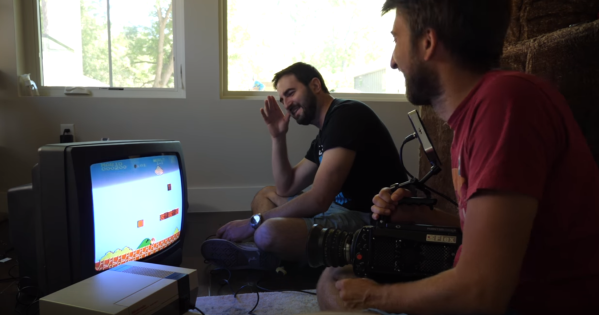
Analog TV is dead, but that doesn’t make it any less awesome. [Gavin and Dan], aka The Slow Mo Guys recently posted a video about television screens. Since they have some incredible high-speed cameras at their disposal, we get to see the screens being drawn, both on CRT and more modern LCD televisions.

Now we all know that CRTs draw one pixel at a time, drawing from left to right, top to bottom. You can capture this with a regular still camera at a high shutter speed. The light from a TV screen comes from a phosphor coating painted on the inside of the glass screen. Phosphor glows for some time after it is excited, but how long exactly? [Gavin and Dan’s] high framerate camera let them observe the phosphor staying illuminated for only about 6 lines before it started to fade away. You can see this effect at a relatively mundane 2500 FPS.

Cranking things up to 380,117 FPS, the highest speed ever recorded by the duo, we see even more amazing results. Even at this speed, quite a few “pixels” are drawn each frame. [Gavin] illustrates that by showing how Super Mario’s mustache is drawn in less than one frame of slow-mo footage. You would have to go several times faster to actually freeze the electron beam. We think it’s amazing that such high-speed analog electronics were invented and perfected decades ago.

Continue reading “Chasing The Electron Beam At 380,000 FPS”

Opt-Out Fitness Data Sharing Leads To Massive Military Locations Leak

People who exercise with fitness trackers have a digital record of their workouts. They do it for a wide range of reasons, from gathering serious medical data to simply satisfying curiosity. When fitness data includes GPS coordinates, it raises personal privacy concerns. But even with individual data removed, such data was still informative enough to spill the beans on secretive facilities around the world.

Strava is a fitness tracking service that gathers data from several different brands of fitness tracker — think Fitbit. It gives athletes a social media experience built around their fitness data: track progress against personal goals and challenge friends to keep each other fit. As expected of companies with personal data, their privacy policy promised to keep personal data secret. In the same privacy policy, they also reserved the right to use the data shared by users in an “aggregated and de-identified” form, a common practice for social media companies. One such use was to plot the GPS data of all their users in a global heatmap. These visualizations use over 6 trillion data points and can be compiled into a fascinating gallery, but there’s a downside.

This past weekend, [Nathan Ruser] announced on Twitter that Strava’s heatmap also managed to highlight exercise activity by military/intelligence personnel around the world, including some suspected but unannounced facilities. More worryingly, some of the mapped paths imply patrol and supply routes, knowledge security officers would prefer not to be shared with the entire world.

This is an extraordinary blunder which very succinctly illustrates a folly of Internet of Things. Strava’s anonymized data sharing obsfucated individuals, but didn’t manage to do the same for groups of individuals… like the fitness-minded active duty military personnel whose workout habits are clearly defined on these heat maps. The biggest contributor (besides wearing a tracking device in general) to this situation is that the data sharing is enabled by default and must be opted-out:

“You can opt-out of contributing your anonymized public activity data to Strava Metro and the Heatmap by unchecking the box in this section.” —Strava Blog, July 2017

We’ve seen individual fitness trackers hacked and we’ve seen people tracked through controlled domains before, but the global scope of [Nathan]’s discovery puts it in an entirely different class.

[via Washington Post]

Biologic Additive May Lead To Self-Healing Concrete

If you get a cut or break a bone, your body heals itself. This everyday miracle is what inspired [Congrui Jin] to try to find a way to make concrete self-healing. The answer she and her colleagues are working on might surprise you. They are adding fungus to concrete to enable self-repair.

It isn’t just any fungus. The conditions in concrete are very harsh, and after testing twenty different kinds, they found that one kind — trichoderma reesei — could survive inside concrete as spores. This fungus is widespread in tropical soil and doesn’t pose any threat to humans or the ecology. Mixing nutrients and spores into concrete is easy enough. When cracks form in the concrete, water and oxygen get in and the spores grow. The spores act as a catalyst for calcium carbonate crystals which fill the cracks. When the water is gone, the fungi go back to spores, ready to repair future cracking.

Continue reading “Biologic Additive May Lead To Self-Healing Concrete”

Drink Lots Of Beer To Raise Your Monopole

When we published a piece about an ADS-B antenna using a Coke can as a groundplane, Hackaday reader [2ftg] got in contact with us about something with a bit more… stature.

A monopole groundplane antenna is a single vertical conductor mounted on an insulator and rising up above a conductive groundplane. In radio terms the groundplane is supposed to look as something of a mirror, to provide a reflection of what would come from the other half of a dipole were there to be two conductors. You can use anything conductive as your monopole, a piece of wire, (in radio amateur humour) a piece of wet string, or even beer cans. “Beer cans?” you ask incredulously, expecting this to be another joke. Yes, beer cans, and [2ftg] has been good enough to supply us with a few examples. The first is a 57-foot stack of them welded together in the 1950s for use on the 80 metre band ( we suspect steel cans may have been more common than aluminum back then), the second is a more modest erection for the 2 metre band, and the final one consists of photographs only of an HF version that looks a little wavy and whose cans are a little less beery.

The reporting in the 1950s piece is rather cheesy, but does give a reasonable description of it requiring welding rods as reinforcement. It also gives evidence of the antenna’s effectiveness, showing that it could work the world. Hardly surprising, given that a decent monopole is a decent monopole no matter how many pints of ale you have dispatched in its making.

The Coke can ADSB can be seen in all its glory here, and if all this amateur radio business sounds interesting, here’s an introduction.

Beer cans picture: Visitor7 [CC BY-SA 3.0].

Search For Military Satellite Finds One NASA Lost Instead

[Scott Tilley] was searching for radio signals from the Air Force’s top-secret ZUMA satellite. He found something that is — we think — much more interesting. He found NASA’s lost satellite called IMAGE. You are probably wondering why it is interesting that someone listening for one satellite found another one. You see, NASA declared IMAGE dead in 2005. It went silent unexpectedly and did not complete its mission to image the magnetosphere.

NASA did a failure review and concluded that in all likelihood a single event upset caused a power controller to trip. A single event upset, or SEU, is a radiation event and should have been automatically recovered. However, there was a design flaw that failed to report certain types of power controller failures, including this one.

The report mentioned that it might be possible to reset the controller at a specific time in 2007, but given that NASA thought the satellite was out of commission that either never occurred or didn’t work. However, something apparently woke the satellite up from its sleep.

[Scott] did a lot of number crunching to determine that the satellite’s spin rate had only decreased a little from its operational value and that the doppler data matched what he expected. [Scott] can’t read or command the telemetry, so he doesn’t know how healthy the satellite is, but it is at least operational to some degree. It’s really neat to see members of the team that worked on IMAGE leaving comments congratulating [Scott] on the find. They are working to get him data formatting information to see if more sense can be made of the incoming transmissions.

Who knew listening to satellites could be so exciting? If you want to build your own ground station, you might be interested in this antenna mount. If you need to know what’s overhead, this can help.

Hackaday Belgrade Call For Proposals Now Open!

Prepare yourself for the return of Hackaday Belgrade! Our premier European conference — Hackaday Belgrade — is on 26 May and we want to hear what you’ve been working on. The Call for Proposals is now open. We seek talks and workshops exploring the most interesting uses of technology and the culture that goes along with it. This includes design, prototyping, research, manufacturing, and the stories of people and progress that move hardware hacking forward.

We’ve booked Dom Omladine for the event because it was perfect for our previous Belgrade conference in 2016. The sold-out conference became a living organism of excitement when the Hackaday community from across Europe came together. A spectacular slate of speakers presented topics like designing computing clusters for use in University research programs, combining projection mapping with high powered lasers, building hardware for advertising campaigns, uncovering forgotten projector technology called Eidophor, fully embracing Open Hardware during product development, and so much more. All of this while hundreds in attendance joined forces for some of the best hardware badge hacking we’ve ever seen.

Hackaday Belgrade is the rare kind of opportunity that is worth reorganizing your life to attend. Want to guarantee yourself a ticket? They’re not available yet, but you can hack your way into the conference: submit a proposal! In addition to the adoration of the Hackaday community, accepted speakers will receive free admission. Everyone who submits a quality talk proposal will be given priority when tickets do go on sale. This event will sell out!

For updates, keep an eye on the conference page and pop into the chat on the project page by clicking “Join this project’s team”. Do you know someone who should be a speaker at this conference? Reach out to them personally, share this CFP on social media, or let us know in the comments below so we can make it happen.