Stealing 3D Prints By Sound

In the open hardware world, we like to share 3D design files so that our friends and (global) neighbors can use and improve them. But we’ve all printed things from time to time that we’d like to keep secret. At least this is the premise behind this article in Science which proposes a novel method of 3D-printer-based industrial espionage: by recording the sound of the stepper motors and re-creating the toolpath.

Unfortunately, the article is behind a paywall so we’re short on the details, but everyone who’s played the Imperial March on their steppers has probably got the basic outline in their mind. Detecting the audio peak corresponding to a step pulse should be fairly easy. Disentangling the motions of two axes would be a bit harder, but presumably can be done based on different room-acoustic filtering of the two motors. Direction is the biggest question mark for us, but a stepper probably has a slightly audible glitch when reversing. Keeping track of these reversals could do the trick.

What do you think? Anyone know how they did it? Does someone with access to the full article want to write us up a summary in the comments?

[Thanks LVfire via Ars Technica]

[Edit: We were sent a copy of the full article (thanks [PersonUnknown]!) and it doesn’t explain any technical details at all. Save yourself the effort, and have fun speculating, because reading the article won’t help.]

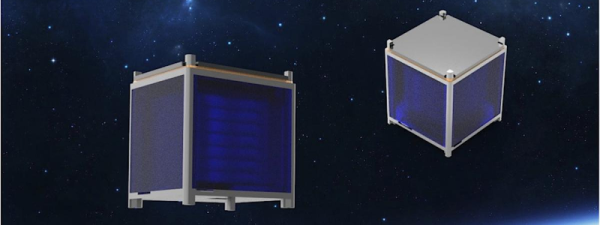
A $1000 Tiny Personal Satellite

If you ever read any old magazines, you might be surprised at how inexpensive things used to be. A U.S. postage stamp was six cents, a gallon of gas was $0.34, and the same amount of milk was $1.07. Everything is relative, though. The average household income back then was under $8,000 a year (compared to over $53,000 a year in 2014). So as a percentage of income, that milk actually cost about seven bucks.

The same is true of getting into orbit. Typical costs today just to get something into orbit has gone from–no pun intended–astronomical, to pretty reasonable. Lifting a pound of mass on the Space Shuttle cost about $10,000. On an Atlas V, it costs about $6,000. A Falcon Heavy (when it launches) will drop the cost to around $1,000 or so. Of course, that’s just the launch costs. You still have to pay for whatever you want to put up there. Developing a satellite can be expensive. Very expensive.

Continue reading “A $1000 Tiny Personal Satellite”

Apple Aftermath: Senate Entertains A New Encryption Bill

If you recall, there was a recent standoff between Apple and the U. S. Government regarding unlocking an iPhone. Senators Richard Burr and Dianne Feinstein have a “discussion draft” of a bill that appears to require companies to allow the government to court order decryption.

Here at Hackaday, we aren’t lawyers, so maybe we aren’t the best source of legislative commentary. However, on the face of it, this seems a bit overreaching. The first part of the proposed bill is simple enough: any “covered entity” that receives a court order for information must provide it in intelligible form or provide the technical assistance necessary to get the information in intelligible form. The problem, of course, is what if you can’t? A covered entity, by the way, is anyone from a manufacturer, to a software developer, a communications service, or a provider of remote computing or storage.

There are dozens of services (backup comes to mind) where only you have the decryption keys and there is nothing reasonable the provider can do to get your data if you lose your keys. That’s actually a selling point for their service. You might not be anxious to backup your hard drive if you knew the vendor could browse your data when they wanted to do so.

The proposed bill has some other issues, too. One section states that nothing in the document is meant to require or prohibit a specific design or operating system. However, another clause requires that covered entities provide products and services that are capable of complying with the rule.

A broad reading of this is troubling. If this were law, entire systems that don’t allow the provider or vendor to decrypt your data could be illegal in the U. S. Whole classes of cybersecurity techniques could become illegal, too. For example, many cryptography systems use the property of forward secrecy by generating unrecorded session keys. For example, consider an SSH session. If someone learns your SSH key, they can listen in or interfere with your SSH sessions. However, they can’t take recordings of your previous sessions and decode them. The mechanism is a little different between SSHv1 (which you shouldn’t be using) and SSHv2. If you are interested in the gory details for SSHv2, have a look at section 9.3.7 of RFC 4251.

In all fairness, this isn’t a bill yet. It is a draft and given some of the definitions in section 4, perhaps they plan to expand it so that it makes more sense, or – at least – is more practical. If not, then it seems to be an indication that we need legislators that understand our increasingly technical world and have some understanding of how the new economy works. After all, we’ve seen this before, right? Many countries are all too happy to enact and enforce tight banking privacy laws to encourage deposits from people who want to hide their money. What makes you think that if the U. S. weakens the ability of domestic companies to make data private, that the business of concealing data won’t just move offshore, too?

If you were living under a rock and missed the whole Apple and FBI controversy, [Elliot] can catch you up. Or, you can see what [Brian] thought about Apple’s response to the FBI’s demand.


Small And Inexpensive MEMS Gravimeter

A gravimeter, as the name suggests, measures gravity. These specialized accelerometers can find underground resources and measure volcanic activity. Unfortunately, traditional instruments are relatively large and expensive (nearly 20 pounds and $100,000). Of course, MEMS accelerometers are old hat, but none of them have been stable enough to be called gravimeters. Until now.

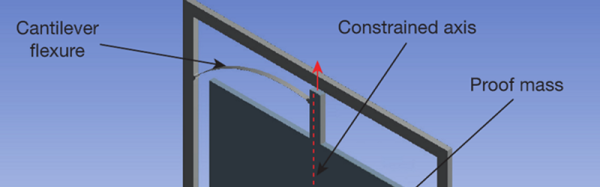
In a recent edition of Nature (pdf), researchers at the University of Glasgow have built a MEMS device that has the stability to work as a gravimeter. To demonstrate this, they used it to measure the tides over six days.

The device functions as a relative gravimeter. Essentially a tiny weight hangs from a tiny spring, and the device measures the pull of gravity on the spring. The design of the Glasgow device has a low resonate frequency (2.3 Hz).

Small and inexpensive devices could monitor volcanoes or fly on drones to find tunnels or buried oil and gas (a job currently done by low altitude aircraft). We’ve covered MEMS accelerometers before, although not at this stability level.  We’ve even seen an explanation from the Engineer Guy.

This TARDIS Is An Infrasonic Subwoofer

If you’re a fan of action movies or dance music, you’ll probably be familiar with sub-bass. The moment in those James Bond explosions that thuds through your chest in the movie theatre? That’s the product of a large subwoofer, a tuned pipe housing a speaker working somewhere just above the lower limit of human hearing, in the tens of Hz.

[Mike's] TARDIS final build
[Mike’s] TARDIS final build
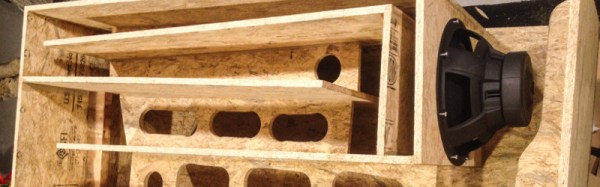
But what about sound below the range of human hearing, below 20Hz? You can’t directly hear infrasound, but its presence can have a significant effect on the experience of the listener. [Mike Michaud] was interested in this phenomenon for his home movie setup so built himself an infrasonic subwoofer tuned to 17Hz. Since the resulting cabinet was rather large he disguised it as a vintage UK police telephone box that you’d hardly notice in his basement theater. 

A resonant 17Hz speaker horn is a rather inconvenient size for a home theatre, at about 25 feet long. Fortunately there is no need for the horm to be straight, it can be folded into a more convenient enclosure, and that is what [Mike] has done. He used a design published by [lilmike], which folds the horn three times into a more manageable size.

Speaker cabinet construction requires attention to the choice of materials as well as to the driver unit itself, so [Mike] goes into detail on the materials he rejected and his selection of a particular brand of subfloor ply.

He rates the resulting speaker as incredible. His driver is rated for 500 watts but he only has an amplifier capable of serving 100, even with that power he fears for his basement windows. He describes the noise made by the feet of the robots in War Of The Worlds as “little earthquakes” and the general effect as very menacing.

We’ve featured quite a few subwoofers on Hackaday over the years, though with the exception of this rotary device they have mostly been for more conventional sub-bass applications. Here for example is another folded horn. So if sub has become rather run-of-the-mill for you all, how about using it to be entertained by this vortex cannon?

Get Your Game On: Troy’s TVCoG Hosts VR And Gaming Hackathon

Troy New York’s Tech Valley Center of Gravity is following up their January IoT Hackathon with another installment. The April 16-17 event promises to be a doozy, and anyone close to the area with even a passing interest in gaming and AR/VR should really make an effort to be there.

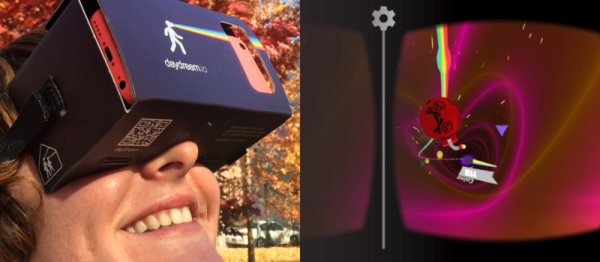
Not content to just be a caffeine-fueled creative burst, TVCoG is raising the bar in a couple ways. First, they’re teaming up with some corporate sponsors with a strong presence in the VR and AR fields. unspecifiedDaydream.io, a new company based in the same building as the CoG, is contributing a bunch of its Daydream.VR smartphone headsets to hackathon attendees, as well as mentors to get your project up and running. Other sponsors include 1st Playable Productions and Vicarious Visions, game studios both located in the Troy area. And to draw in the hardcore game programmers, a concurrent Ludum Dare game jam will be run by the Tech Valley Game Space, with interaction and collaboration between the AR/VR hackers and the programmers encouraged. Teams will compete for $1000 in prizes and other giveaways.

This sounds like it’s going to be an amazing chance to hack, to collaborate, and to make connections in the growing AR/VR field. And did we mention the food? There was a ton of it last time, so much they were begging us to take it home on Sunday night. Go, hack, create, mingle, and eat. TVCoG knows how to hackathon, and you won’t be disappointed.

Thanks to [Duncan Crary] for the heads up on this.


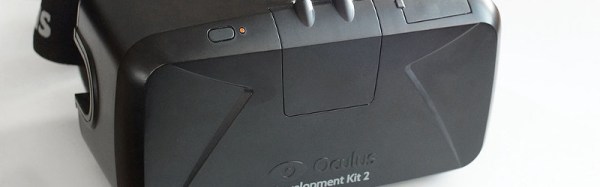
Facebook To Slurp Oculus Rift Users’ Every Move

The web is abuzz with the news that the Facebook-owned Oculus Rift has buried in its terms of service a clause allowing the social media giant access to the “physical movements and dimensions” of its users. This is likely to be used for the purposes of directing advertising to those users and most importantly for the advertisers, measuring the degree of interaction between user and advert. It’s a dream come true for the advertising business, instead of relying on eye-tracking or other engagement studies on limited subsets of users they can take these metrics from their entire user base and hone their offering on an even more targeted basis for peak interaction to maximize their revenue.

Hardly a surprise you might say, given that Facebook is no stranger to criticism on privacy matters. It does however represent a hitherto unseen level of intrusion into a user’s personal space, even to guess the nature of their activities from their movements, and this opens up fresh potential for nefarious uses of the data.

Fortunately for us there is a choice even if our community doesn’t circumvent the data-slurping powers of their headsets; a rash of other virtual reality products are in the offing at the moment from Samsung, HTC, and Sony among others, and of course there is Google’s budget offering. Sadly though it is likely that privacy concerns will not touch the non-tech-savvy end-user, so competition alone will not stop the relentless desire from big business to get this close to you. Instead vigilance is the key, to spot such attempts when they make their way into the small print, and to shine a light on them even when the organisations in question would prefer that they remained incognito.

Oculus Rift development kit 2 image: By Ats Kurvet – Own work, CC BY-SA 4.0, via Wikimedia Commons.