Mini Robot Wars Looks Fun And Only Slightly Scary

“Ahhhh! They’re so cute! Wait a second, does that little robot have a spinning blade of death?!?!?”  Yes, yes it does.

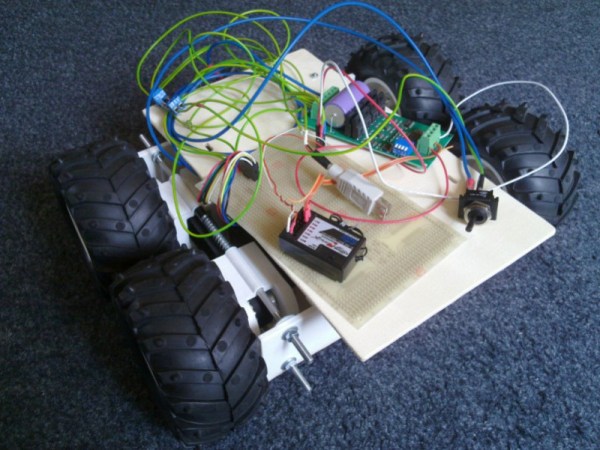
Welcome to Bristol University 2nd Annual Robot Wars Tournament. It’s loosely based on the old BBC show Robot Wars, where contestants would design and build fighting robots. This pint-sized version is just down right fun to watch. But don’t let their size fool you, some of these little bots pack a mean punch.

This competition follows the “Antweight World Series Rules” and must fit inside a 4 inch cube with a max weight of 150 grams. There are some not-so-fun rules attached to that, such as “No flame based weapons” and “no use of electricity as a weapon.” But hey, it still looks like a blast.

We can’t help but to think that a contest like this would be an amazing thing for local hacker spaces to set up and organize. The playing field seems to be a reasonable size, such that it could be set-up and torn-down without too much hassle. And with RC transmitters/receivers available so inexpensively these days, and ebay flooded with little robot parts from China, now seems like a perfect time to start a local robot competition. It might be a great way to draw people into making and hacking. You can watch the video of the competition and meet the makers after the break.

Continue reading “Mini Robot Wars Looks Fun And Only Slightly Scary”

Terra Spider Repairs And Resurfaces New Frontiers

Is your landscape congested with toxic waste, parched, or otherwise abandoned? The Terra Spider may be your answer to new life in otherwise barren wastelands.

Bred in the Digital Craft Lab at the California College of the Arts, the current progress demonstrates the principle of deploying multiple eight-legged drones that can drill and deploy their liquid payload, intended to “repair or maintain” the landing site.

To deliver their project, students [Manali Chitre], [Anh Vu], and [Mallory Van Ness] designed and assembled a laser-cut octopod chassis, an actuated drilling mechanism, and a liquid deployment system all from easily available stock components and raw materials. While project details are sparse, the comprehensive bill-of-materials gives us a window into the process of putting together the pieces of a Terra Spider. The kinematics for movement are actuated by servos, a Sparkfun gear-reduced motor enables drilling, and a peristaltic pump handles the payload deployment.

It’s not every day that flying robots deploy drill-wielding spider drones. Keep in mind, though, that the Terra Spider is a performance piece, a hardware-based demonstration of a bigger idea, in our case: remote coverage and sample deployments in a barren wasteland. While, this project is still a work-in-progress, the bill-of-materials and successful deployment demos both testify towards this project’s extensive development.

With the earnest intent of repairing withering environments, perhaps this project has a future as an entry into this year’s Earth-saving Hackaday Prize….

Coming soon to a galaxy near you!

Continue reading “Terra Spider Repairs And Resurfaces New Frontiers”

Open-Source Robotic Arm Now Within Reach

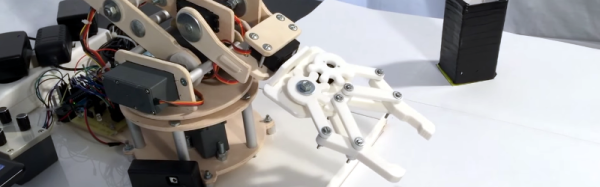
For anyone looking for a capable robotic arm for automation of an industrial process, education, or just a giant helping hand for a really big soldering project, most options available can easily break the bank. [Mads Hobye] and the rest of the folks at FabLab RUC have tackled this problem, and have come up with a very capable, inexpensive, and open-source industrial arm robot that can easily be made by anyone.

The robot itself is Arduino-based and has the option to attach any end effector that might be needed for a wide range of processes. The schematics for all of the parts are available on the project site along with all of the Arduino source code. [Mads Hobye] notes that they made this robot during a three-day sprint, so it shouldn’t take very long to get your own up and running. There’s even a virtual robot that can be downloaded and used with the regular robot code, which can be used for testing or for simply getting the feel for the robot without having to build it.

This is a great project, and since it’s open source it will be great for students, small businesses, and hobbyists alike. The option to attach any end effector is also a perk, and we might suggest trying out [Yale]’s tendon-driven robotic hand. Check after the break for a video of this awesome robot in action.

Continue reading “Open-Source Robotic Arm Now Within Reach”

ROBOCHOP! It Slices, Dices, But Wait! There’s More…

You’re gunna love my cuts. 

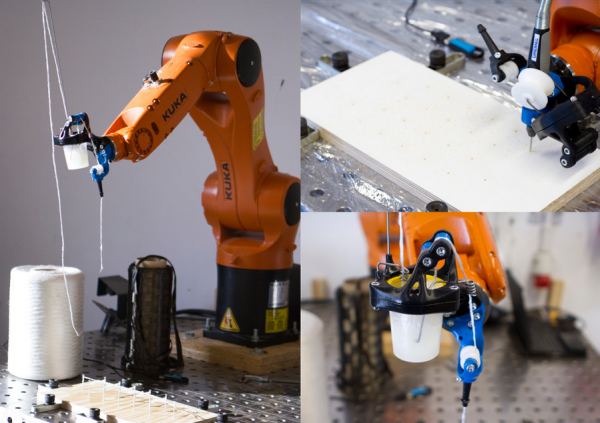
KUKA robots are cool. They’re both elegant and terrifying to watch in action as they move unyieldingly to preform tasks. Not many of us get to use industrial tools like this because they aren’t exactly trivial to wield (or cheap!). Artists [Clemens Weisshaar] and [Reed Kram] however created an installation that allows anyone to potentially control one of these orange beauties to do their bidding… all from the safety and comfort of a computer chair.

For their piece, “ROBOCHOP”, the artists developed a web app that allows you to easily manipulate the surface of a virtual cube. You can rotate for positioning and then use a straight or curved line tool to draw vectors through its surface and subtract material. Once you’re finished sculpting your desired masterpiece, one of the four KUKA robots in the installation will retrieve a 40 x 40 x 40 cm block of foam and shape it into a real-life version of whatever you created in the app.

Screen Shot 2015-03-06 at 1.03.39 PMStarting today you can visit the project’s website and upload your own mutilated cube designs. If your design is selected by the artists, it will be among the 2000 pieces carved by the robots throughout their installation during CeBit in Hanover. After the show, your cube spawn will then be mailed to you free of charge! The only way I could see this being cooler, is if they filmed the process so you could watch your shape being born.

Anyhow, I personally couldn’t resist the invitation to sculpt Styrofoam remotely with an industrial grade robot arm and came up with this gem.

You can go to their page if you want to give the app a go, and really… why wouldn’t you?

Continue reading “ROBOCHOP! It Slices, Dices, But Wait! There’s More…”

Ro-Bow, The Violin Playing Robot

There are robots that will vacuum your house, mow your lawn, and keep their unblinking electronic eyes on you at all times while hovering hundreds of feet in the air. How about a robot that plays a violin? That’s what [Seth Goldstein] built. He calls it a ‘kinetic sculpture’, but there more than enough electronics and mechatronics to keep even the most discerning tinkerer interested.

There are three main parts of [Seth]’s violin-playing kinetic sculpture. The first is a bow carriage that draws the bow across the strings using an electromagnet to press the bow against the strings. The individual strings are fingered with four rubber disks, and a tilting mechanism rotates the violin so the desired string is always underneath the bow and mechanical fingers.

As far as software goes, the Ro-Bow transforms MIDI files into robotic mechanization that make the violin sing. From what we can tell, it’s not quite as good as a human player; only one string at a time can be played. It is, however, great at what it does and is an amazing mechanical sculpture.

Video Below.

Continue reading “Ro-Bow, The Violin Playing Robot”

Openhand Combines 3D Printing With Urethane Casting

Yale University brings us quite a treat with their Openhand Project.

If you’ve ever operated a robotic arm, you know that one of the most cumbersome parts is always the end effector. It will quickly make you realize what an amazing work of engineering the human hand really is, and what a poor intimation a simple open-close gripper ends up being.

[Yale] is working to bring tendon-driven robotic hands to the masses with an interesting technique of combining 3D printing and resin/urethane casting. Known as Hybrid Deposition Manufacturing (HDM), it allows the team to 3D print robotic fingers that also contain the mold for finger pads and joints, all built right into the 3D part.  The tendon-driven fingers allow for a very simple design that are not only easy to make, but have a low parts count as well. Because of the human-like tendons, the fingers naturally curl around the object, distributing it’s force much more evenly and naturally, much like a human hand would. In the videos after the break, you can see the building process, as well as the hand in action.

Best news is that it’s all open source. They also include some python libraries so you can customize the CAD files fit your needs.

Continue reading “Openhand Combines 3D Printing With Urethane Casting”

EddiePlus, The Edison Based Balancing Robot

[Renee] dropped a tip to let us know about EddiePlus, her balancing robot creation. As its name might imply, EddiePlus is controlled by an Intel Edison processor. More specifically, [Renee] is using several of Sparkfun’s Edison Blocks to create Eddie’s brain. EddiePlus’ body is 3D printed, while his movement comes from two Pololu DC motors with wheels and encoders. The full build instructions are available as a PDF from [Renee’s] Google drive.

Eddie is able to balance and drive around on two wheels, much like a Segway. Sensor data for balance comes from Sparkfun’s LSM9DS0 based Inertial Measurement Unit (IMU) block. In this new “plus” version of Eddie, [Renee] has added encoders to the robot’s wheels. This makes it easier for him to adapt to changing loads – such as pumping iron (or banana plugs as the case may be). The encoders also help with varying terrain, as [Renee] demonstrates by tilting a board as Eddie drives on it. Eddie’s code is written in C, and available on Github.  Controlling Eddie is as easy as sending simple commands via UDP.

As you might imagine, the Intel Edison still has plenty of cycles left over after computing Eddie’s balance. [Renee] uses some of these with a webcam based teleoperation mode.

Click past the break to see Eddie in action!

Continue reading “EddiePlus, The Edison Based Balancing Robot”