Shocking Tinnitus Therapy Is Music To Sufferers’ Ears

Do you suffer from tinnitus? We were surprised to learn that 15-20% of people have this condition that amounts to constant ringing in the ears. Science doesn’t fully understand the ringing part, but one possible explanation is that the brain is compensating for the frequencies it can’t hear any more.
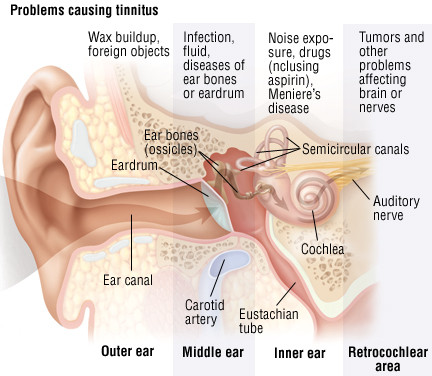
Causes of tinnitus. Image via Drugs.com

[Hubert Lim], a biomedical engineer at the University of Minnesota discovered that the brain can be stimulated to the point of suppressing tinnitus for as long as one year. [Lim] discovered this by accident while doing deep brain stimulation on a patient with tinnitus. The electrode strayed a bit, touching other areas of the brain and the patient suddenly exclaimed that they couldn’t hear their tinnitus anymore.

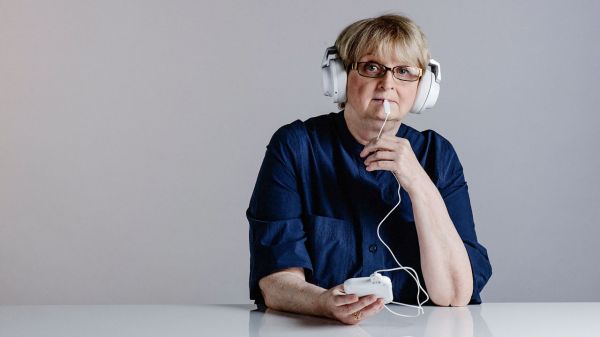
Then [Lim] and his team tested guinea pigs, searching here, there, and under the armpits for the best place to suppress tinnitus. As it turns out, the tongue is one of the best places when used along with a specific soundscape. So then they did a human trial with 326 people. Each person had a small paddle electrode on their tongue and headphones on their ears.

As the electrodes sparkled like Pop Rocks against their tongues, the trial participants listened to pure frequencies played over a background of sound resembling vaporwave music. The combination of the two overstimulates the brain, forcing it to suppress the tinnitus reaction. This discovery certainly seems like a game changer for tinnitus sufferers. If we had tinnitus, we would be first in line to try this out given the chance. Armed with the soundscape, we’re left to wonder how many 9V batteries we’d have to lick to approximate the paddle.

Speaking of taste, have you ever experienced all five at once? Here’s a device that simulates them all.

Room Temperature Superconductor? Yes, But Not So Fast…

There’s good news and there’s bad news in what we’re about to tell you. The good news is that a team of physicists has found a blend of hydrogen, carbon, and sulfur that exhibit superconductivity at 59F. Exciting, right? The bad news is that it only works when being crushed between two diamonds at pressures approaching that of the Earth’s core. For perspective, the bottom of the Marianas trench is about 1,000 atmospheres, while the superconductor needs 2.6 million atmospheres of pressure.

Granted, 59F is a bit chilly, but it is easy to imagine cooling something down that much if you could harness superconductivity. We cool off CPUs all the time. However, unless there’s a breakthrough that allows the material to operate under at least reasonable pressures, this isn’t going to change much outside of a laboratory.

Continue reading “Room Temperature Superconductor? Yes, But Not So Fast…”

Getting Rid Of All The Space Junk In Earth’s Backyard

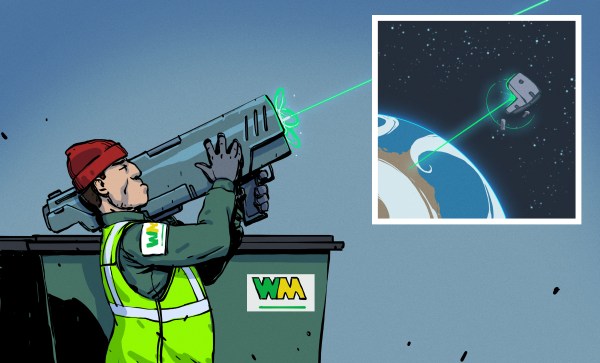
Space, as the name suggests, is mostly empty. However, since the first satellite launch in 1957, mankind began to populate the Earth orbit with all kinds of spacecraft. On the downside, space also became more and more cluttered with trash from defunct or broken up rocket stages and satellites. Moving at speeds of nearly 30,000 km/h, even the tiniest object can pierce a hole through your spacecraft. Therefore, space junk poses a real threat for both manned and unmanned spacecraft and that is why space agencies are increasing their efforts into tracking, avoiding, and getting rid of it.
Continue reading “Getting Rid Of All The Space Junk In Earth’s Backyard”

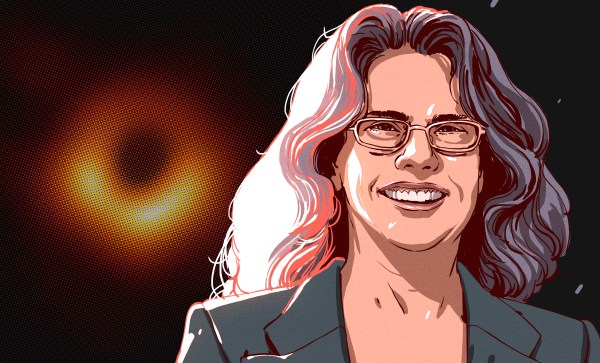
Andrea Ghez Gazes Into Our Galaxy’s Black Hole

Decades ago, Einstein predicted the existence of something he didn’t believe in — black holes. Ever since then, people have been trying to get a glimpse of these collapsed stars that represent the limits of our understanding of physics.

For the last 25 years, Andrea Ghez has had her sights set on the black hole at the center of our galaxy known as Sagittarius A*, trying to conclusively prove it exists. In the early days, her proposal was dismissed entirely. Then she started getting lauded for it. Andrea earned a MacArthur Fellowship in 2008. In 2012, she was the first woman to receive the Crafoord Prize from the Royal Swedish Academy of Sciences.

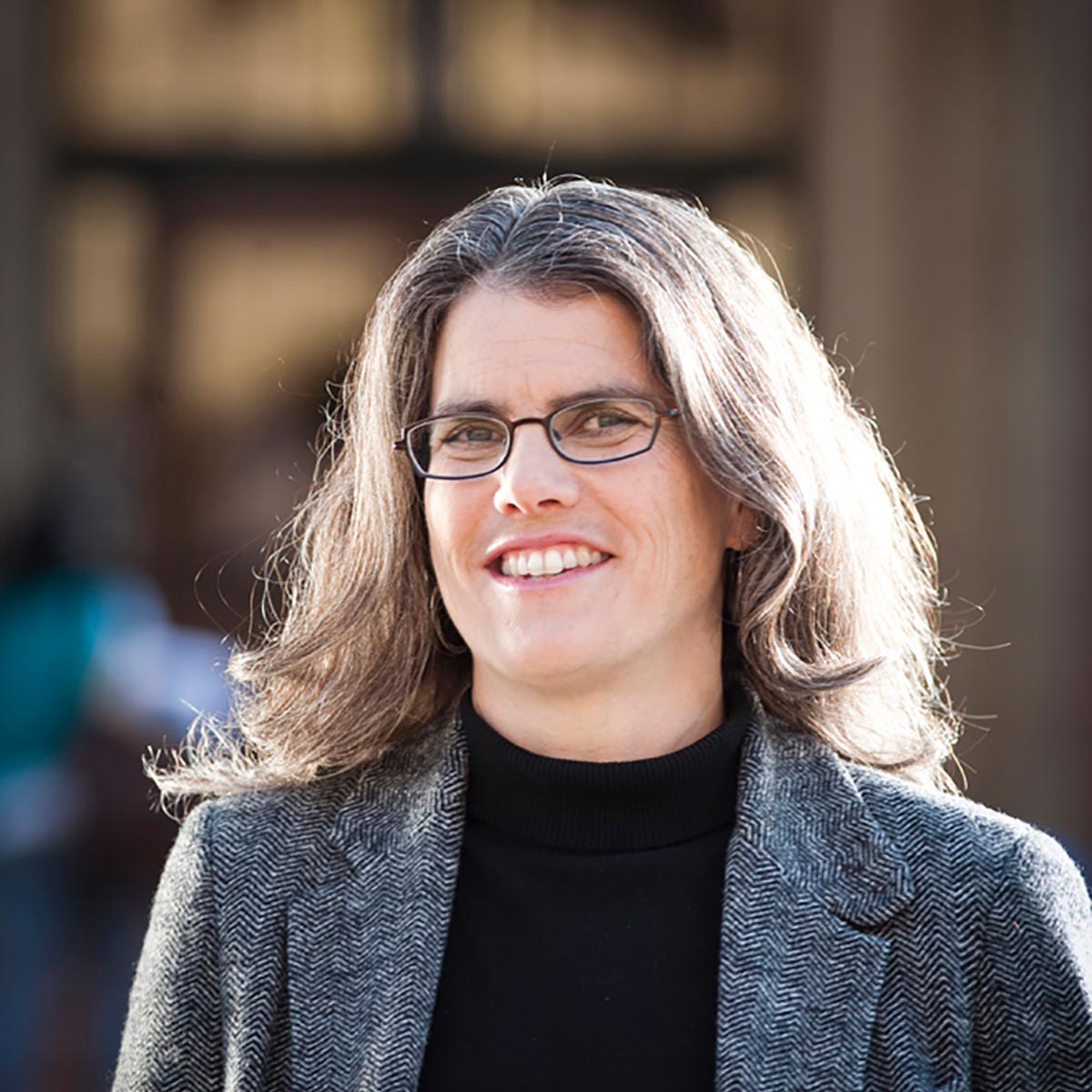
Image via SciTech Daily

Now Andrea has become the fourth woman ever to receive a Nobel Prize in Physics for her discovery. She shares the prize with Roger Penrose and Reinhard Genzel for discoveries relating to black holes. UCLA posted her gracious reaction to becoming a Nobel Laureate.

A Star is Born

Andrea Mia Ghez was born June 16th, 1965 in New York City, but grew up in the Hyde Park area of Chicago. Her love of astronomy was launched right along with Apollo program. Once she saw the moon landing, she told her parents that she wanted to be the first female astronaut. They bought her a telescope, and she’s had her eye on the stars ever since. Now Andrea visits the Keck telescopes — the world’s largest — six times a year.

Andrea was always interested in math and science growing up, and could usually be found asking big questions about the universe. She earned a BS from MIT in 1987 and a PhD from Caltech in 1992. While she was still in graduate school, she made a major discovery concerning star formation — that most stars are born with companion star. After graduating from Caltech, Andrea became a professor of physics and astronomy at UCLA so she could get access to the Keck telescope in Mauna Kea, Hawaii.

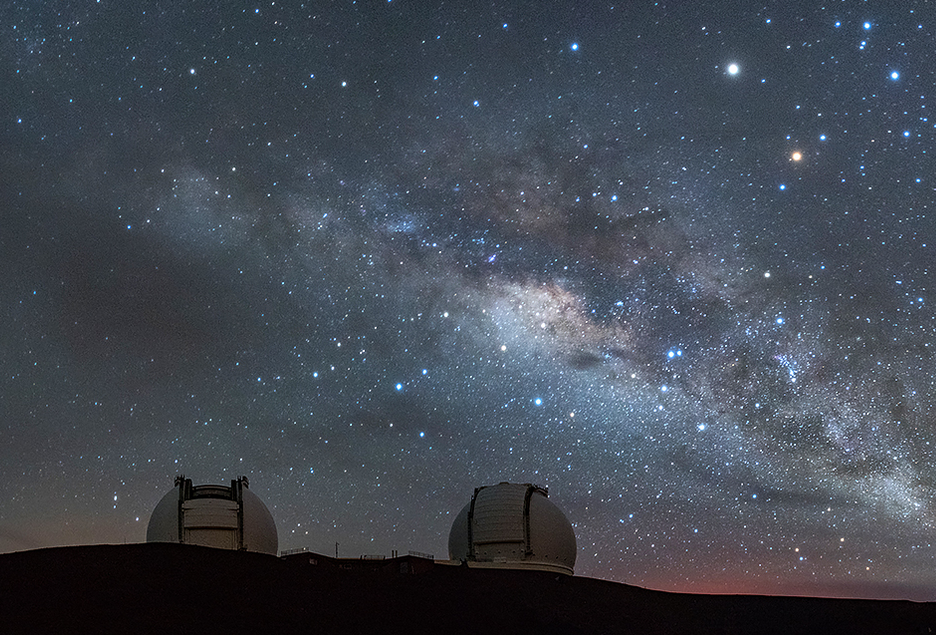
The Keck telescopes and the Milky Way. Image via Flickr

The Center of the Galaxy

Since 1995, Andrea has pointed the Keck telescopes toward the center of our galaxy, some 25,000 light years away. There’s a lot of gas and dust clouding the view, so she and her team had to get creative with something called adaptive optics. This method works by deforming the telescope’s mirror in real time in order to overcome fluctuations in the atmosphere.

Thanks to adaptive optics, Andrea and her team were able to capture images that were 10-30 times clearer than what was previously possible. By studying the orbits of stars that hang out near the center, she was able to determine that a supermassive black hole with four millions times the mass of the sun must lie there. Thanks to this telescope hack, Andrea and other scientists will be able to study the effects of black holes on gravity and galaxies right here at home. You can watch her explain her work briefly in the video after the break. Congratulations, Dr. Ghez, and here’s to another 25 years of fruitful research.

Sensing The Earth’s Wobble In Time

In the 1850s British railway companies started introducing a single standard time to make their timetables consistent. Before that, every city would set its own clock based on the observation of the position of the sun. Nowadays, precise time standards are not only needed so people don’t miss their trains but also make modern communication technologies and satellite navigation work.

Generally, there are two methods of defining time, one is based on the local passage of time as measured by atomic clocks, while the other relies on the exact measurement of Earth’s rotation. The latter is not an easy exercise that involves extragalactic radio sources or huge laser-based gyroscopes. The constant survey of the Earth’s spin tells us that days are constantly getting longer, but surprisingly, severe earthquakes and weather phenomena can also take little discrete bites out of the planet’s supply of rotational kinetic energy.

How do we keep our ultra precisely measured time, the rotation of the Earth, and our position in the heavens in line?

Continue reading “Sensing The Earth’s Wobble In Time”

Aruna: An Open Source ROV For Affordable Research

Underwater exploration and research can be exceedingly dangerous, which is why remotely operated vehicles (ROVs) are so commonly used. Operators can remotely command these small submersibles to capture images or collect samples at depths which would otherwise be unreachable. Unfortunately, such technology comes at a considerable price.

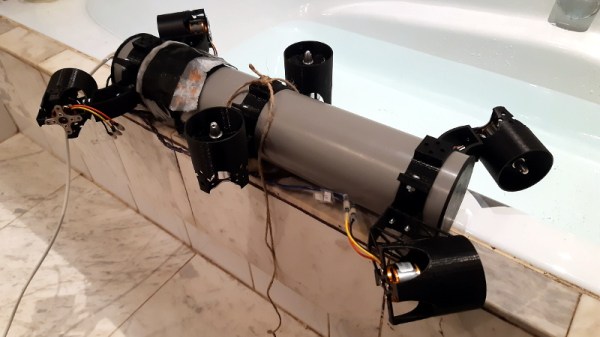
Believing that the high cost of commercial ROVs is a hindrance to aquatic conservation efforts, [Noeël Moeskops] has been developing an open source modular ROV he calls Aruna. Constructed largely from off-the-shelf components and 3D-printed parts, the Aruna promises to be far more affordable than anything currently on the market. Hopefully cheap enough to allow local governments and even citizens to conduct their own underwater research and observations.

More than just the ROV itself, Aruna represents an entire system for developing modular underwater vehicles. Whether you decide to build the boilerplate ROV documented and tested by [Noeël], or implement individual components into your own design, the project is a valuable source of hardware and software information for anyone interested in DIY underwater robotics.

Continue reading “Aruna: An Open Source ROV For Affordable Research”

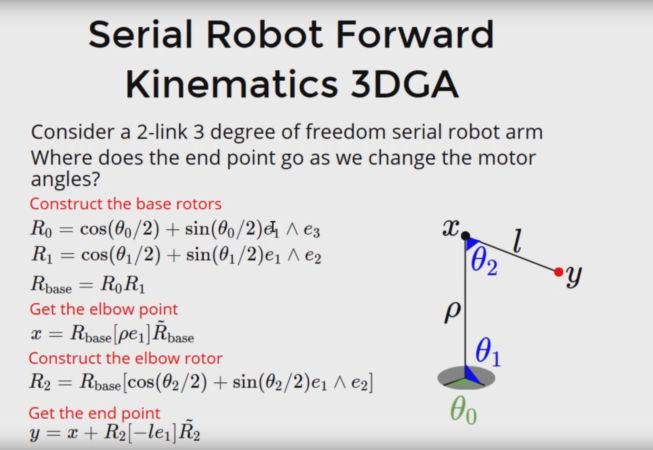
Getting Started With Geometric Algebra For Robotics, Computer Vision And More

[Hugo Hadfield] wrote to let us know about an intriguing series of talks that took place in February of this year at GAME2020, on the many applications of geometric algebra. The video playlist of these talks can be found here along with the first video embedded after the break. For those of us who did not take advanced algebra during university, one can picture geometric algebra (GA) as an extension of vector algebra, adding more algebraic structures.

The essential difference is that GA adds a new vectors product, called the ‘geometric product’. The Cliff’s Notes version is that this is very useful for doing for example transformations, like in 3D spaces. For a quick algebraic introduction to GA for those familiar with vector algebra, the associated biVector website is helpful, from where one can also find additional information, software and other resources on getting started with GA.

These talks will take the viewer through the use of GA with robot kinematics (co-presented by [Hugo]), in astrophysics and AI. Definitely worth a watch, even algebra isn’t one’s strongest points.

Continue reading “Getting Started With Geometric Algebra For Robotics, Computer Vision And More”