An All-Iron Battery Isn’t Light, But It’s Cheap

Rechargeable batteries are a technology that has been with us for well over a century, and which is undergoing a huge quantity of research into improved energy density for both mobile and alternative energy projects. But the commonly used chemistries all come with their own hazards, be they chemical contamination, fire risk, or even cost due to finite resources. A HardwareX paper from a team at the University of Idaho attempts to address some of those concerns, with an open-source rechargeable battery featuring electrode chemistry involving iron on both of its sides. This has the promise of a much cheaper construction without the poisonous heavy metal of a lead-acid cell or the expense and fire hazard of a lithium one.
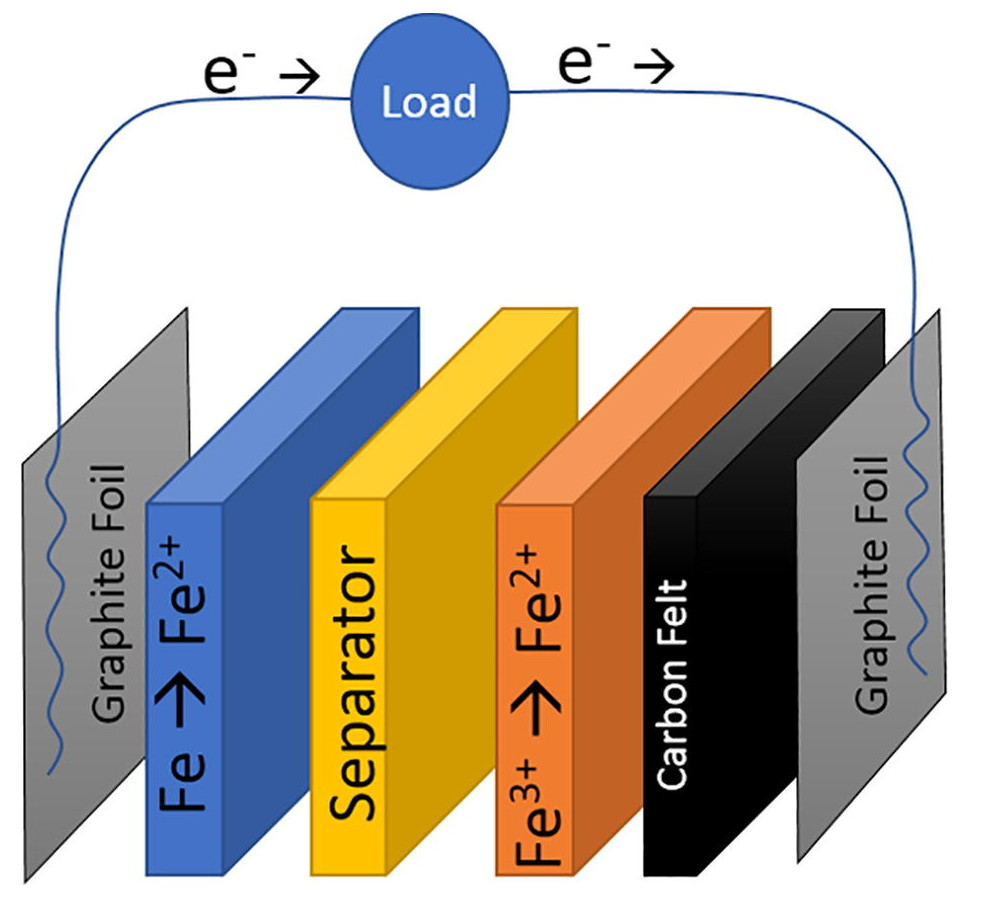
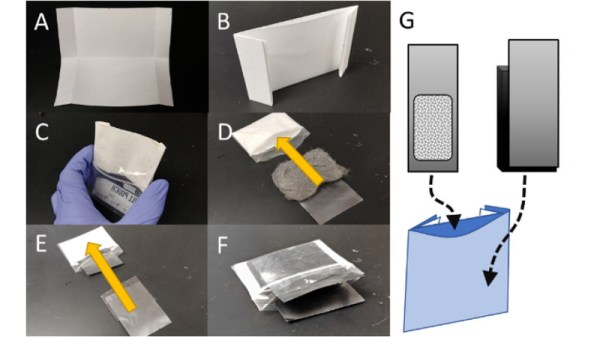
A diagram of the all-iron cell.

The chemistry of this cell is split into two by an ion-exchange membrane, iron (II) chloride is the electrolyte on the anode side where iron is oxidised to iron 2+ ions, and Iron (III) chloride on the cathode where iron is reduced to iron hydroxide. The result is a cell with a low potential of only abut 0.6V, but at a claimed material cost of only $0.10 per kWh Wh of stored energy. The cells will never compete on storage capacity or weight, but this cost makes them attractive for fixed installations.

It’s encouraging to see open-source projects coming through from HardwareX, we noted its launch back in 2016.

Thanks [Julien] for the tip.
Memristor Computing On A Chip

Memristors have been — so far — mostly a solution looking for a problem. However, researchers at the University of Michigan are claiming the first memristor-based programmable computer that has the potential to make AI applications more efficient and faster.

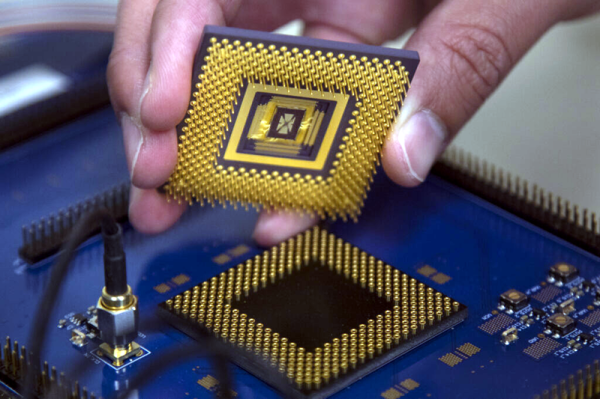
Because memristors have a memory, they can accumulate data in a way that is common for — among other things — neural networks. The chip has both an array of nearly 6,000 memristors, a crossbar array, along with analog to digital and digital to analog converters. In fact, there are 486 DACs and 162 ADCs along with an OpenRISC processor.

Continue reading “Memristor Computing On A Chip”

A PKE Meter That Actually Detects Radiation

Fans of Ghostbusters will remember the PKE meter, a winged handheld device capable of detecting supernatural activity. Precious little technical data on the device remains, leaving us unable to replicate its functionality. However, the flashing, spreading wings serve as a strong visual indicator of danger, and [mosivers] decided this would be perfect for a Geiger counter build.

An SBM20 Geiger tube serves as the detection device, hooked up to an Arduino Nano. An OLED display is used to display the numerical data to the user. The enclosure and folding wings are 3D printed, and fitted with 80s-style yellow LEDs as per the original movie prop.

The device is quite intuitive in its use – if the wings flare out and the lights are flashing faster, you’re detecting an increased level of radiation. In a very real sense, it makes using a Geiger counter much more straightforward for the inexperienced or the hearing impaired. Naturally, there’s also a buzzer generating the foreboding clicks as you’d expect, too.

Geiger counters are a popular project, though we hope they don’t become common household items in the near future. Here’s a Fallout-inspired build for fans of the game. Video after the break.

Continue reading “A PKE Meter That Actually Detects Radiation”

Brain-Computer Interfaces: Separating Fact From Fiction On Musk’s Brain Implant Claims

When it comes to something as futuristic-sounding as brain-computer interfaces (BCI), our collective minds tend to zip straight to scenes from countless movies, comics, and other works of science-fiction (including more dystopian scenarios). Our mind’s eye fills with everything from the Borg and neural interfaces of Star Trek, to the neural recording devices with parent-controlled blocking features from Black Mirror, and of course the enslavement of the human race by machines in The Matrix.

And now there’s this Elon Musk guy, proclaiming that he’ll be wiring up people’s brains to computers starting next year, as part of this other company of his: Neuralink. Here the promises and imaginings are truly straight from the realm of sci-fi, ranging from ‘reading and writing’ to the brain, curing brain diseases and merging human minds with artificial intelligence. How much of this is just investor speak? Please join us as we take a look at BCIs, neuroprosthetics and what we can expect of these technologies in the coming years.

Continue reading “Brain-Computer Interfaces: Separating Fact From Fiction On Musk’s Brain Implant Claims”

Watch Earthquake Roll Across A Continent In Seismograph Visualization Video

If your only exposure to seismologists at work is through film and television, you can be forgiven for thinking they still lay out rolls of paper to examine lines of ink under a magnifying glass. The reality is far more interesting in a field that has eagerly adopted all available technology. A dramatic demonstration of modern earthquake data gathering, processing, and visualization was Tweeted by @IRIS_EPO following a central California quake on July 4th, 2019. In this video can see the quake’s energy propagate across the continental United States in multiple waves of varying speed and intensity. The video is embedded below, but click through to the Twitter thread too as it has a lot more explanation.

The acronym IRIS EPO expands out to Incorporated Research Institutions for Seismology, Education and Public Outreach. We agree with their publicity mission; more people need to know how cool modern seismology is. By combining information from thousands of seismometers, we could see forces that we could not see from any individual location. IRIS makes seismic data available to researchers (or curious data science hackers) in a vast historical database or a real time data stream. Data compilations are presented in several different forms, this particular video is a GMV or Ground Motion Visualization. Significant events like the 4th of July earthquake get their own GMV page where we can see additional details, like the fact this visualization compiled data from 2,132 stations.

If this stirred up interest in seismology, you can join in the fun of networked seismic data. A simple seismograph can be built from quite humble components, but of course there are specially designed chips for the task as well.

Continue reading “Watch Earthquake Roll Across A Continent In Seismograph Visualization Video”

Building A Bigger Cloud Chamber

Cloud chambers are an exciting and highly visual science experiment. They’re fascinating to watch as you can see the passage of subatomic particles from radioactive decay with your very own eyes. Many elect to build small chambers based on thermoelectric Peltier elements, but [Cloudylabs] decided to do something on a grander scale.

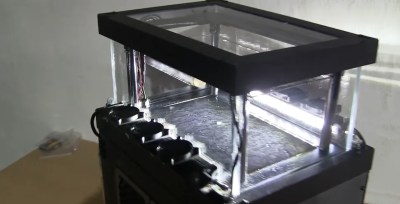
It’s a hefty chamber, and a very clean build.

[Cloudylabs] started building cloud chambers after first seeing one in a museum back in 2010. The first prototype was an air-cooled Peltier device, with a cooled area of just 4x4cm. Over the years, and after building many more Peltier-based chambers, it became apparent that the thermoelectric modules were somewhat less than robust, often failing after many thermal cycles. Wanting to take things up a notch, [Cloudylabs] elected to build a much larger unit based on phase-change technology, akin to the way a refrigerator works.

The final product is astounding, consisting of a 32x18cm actively cooled area mounted within a large glass viewing case. A magnet is mounted underneath which causes certain particles to curve in relation to the field, as well as an electrically charged grid up top. The chamber is capable of operating for up to 12 hours without requiring any user intervention.

Cloud chambers are always beautiful, and even moreso at this larger scale. When radioactive materials are introduced into the chamber the trails generated are long and easily visible. It’s a daunting build however, and the final product weighs over 30 kilograms. You might want to start with something a little smaller for your first build. Video after the break.

Continue reading “Building A Bigger Cloud Chamber”

Another Take On Harvesting Energy While Walking

Harvesting energy from the human body may sound scary, but fortunately a Matrix-style setup exists only as a cinematic fiction. Instead a typical path lies in external contraptions that use the body’s natural motions to drive a small generator, a bit of flexible piezo material, and so on. A popular target for harvesting the body’s kinetic energy is the knee joint, as this has a comparatively large range of motion and is fairly easy to use.

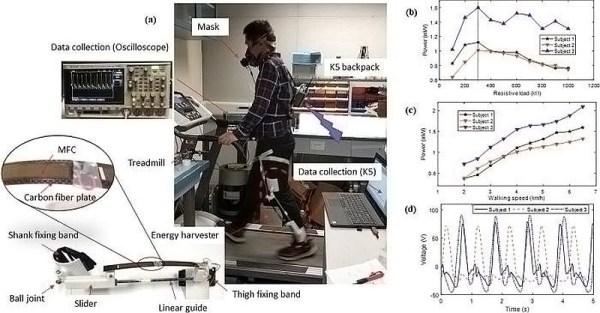
Thus a team from Hong Kong university opted to pick this part of the human anatomy for their experiment as well. While at first glance their results do not seem particularly impressive, with up to 1.6 mW of power generated, a look at their published results in the Applied Physics Letters journal showed their reasoning behind this setup. While one generator-based setup referenced produces on average 4.8 Watt of power, the device itself weighs 1.6 kg and increases the rate at which the person wearing it burns calories by a significant amount.

The goal for this device was to have a way to generate significant amounts of power without having the user exerting themselves more than usual. This led to them using flexible piezoelectric composites, resulting in a weight of just 307 grams, based upon two M8514-P2 pieces (Smart Materials Corp. manufacturer). Tests with volunteers on a treadmill show that users do not burn more calories than without.

As with all piezo materials, they can flex a bit, but not too much, so a lot of time and effort went into calculating the optimal bend radius in different usage scenarios. While around 1 mW of power is not massive, it is a reliable source of power for individuals who do any amount of walking during the day and doesn’t require any effort beyond strapping the device onto one’s legs.