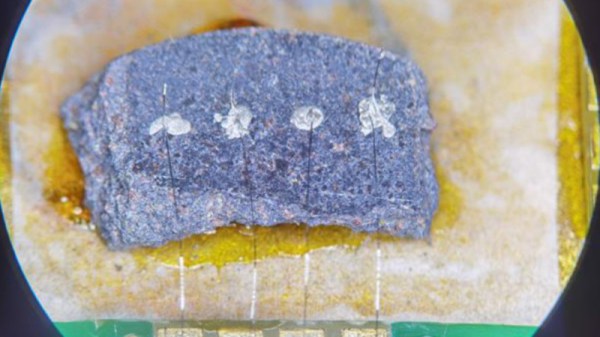
Mapping of the displacement of a tympanum of the lesser wax moth (Achroia grisella). (Credit: Andrew Reid)

3D Printing Bio-Inspired Microphone Designs Based On Moth Ears

If many millions of years of evolution is good for anything, it is to develop microscopic structures that perform astounding tasks, such as the marvelous biology of insects. One of these structures are the ears of the lesser wax moth (Achroia grisella), whose mating behavior involves ultrasonic mating calls. These can attract the bats which hunt them, leading to these moths having evolved directional hearing that can pinpoint not only a potential mate, but also bat calling sound.

What’s most astounding about this is that these moths that only live about a week as an adult can perform auditory feats that we generally require an entire microphone array for, along with a lot of audio processing. The key that enables these moths to perform these feats lies in their eardrum, or tympanum. Rather than the taut, flat surface as with mammals, these feature intricate 3D structures along with pores that seem to perform much of the directional processing, and this is what researchers have been trying to replicate for a while, including a team of researchers at the University of Strathclyde.

To create these artificial tympanums, the researchers used a flexible hydrogel, with a piezoelectric material that converts the acoustic energy into electric signals, connected to electrical traces. The 3D features are printed on this, mixed with methanol that forms droplets inside the curing resin, before being expelled and leaving the desired pores. One limitation is that currently used printers have a limited resolution of about 200 micrometers, which doesn’t cover the full features of the insect’s tympanum.

Assuming this can be made to work, it could be used for everything from cochlear implants to anywhere else that has a great deal of audio processing that needs downsizing.

(Heading image: Mapping of the displacement of a tympanum of the lesser wax moth (Achroia grisella). (Credit: Andrew Reid) )

Simulated ET To Phone Home From Mars This Afternoon

In science fiction movies, communicating with aliens is easy. In real life, though, we think it will be tough. Today, you’ll get your chance to see how tough when a SETI project uses the European Space Agency’s ExoMars Trace Gas Orbiter to send a simulated alien message to the Earth. The transmission is scheduled to happen at 1900 UTC and, of course, the signal will take about 16 minutes to arrive here on planet Earth. You can see a video about the project, A Sign in Space, below.

You don’t need to receive the message yourself. That will be the job of observatories at the SETI Institute, the Green Bank Observatory, and the Italian National Institute for Astrophysics. They’ll make the signal available to everyone, and you can join others on Discord or work solo and submit your interpretation of the message.

Drake’s message properly arranged

There are a host of issues involved in alien communication. What communication medium will they use? How will they encode their message? Will the message even make sense? Imagine an engineer from 1910 trying to find, decode, and understand an ad on FM radio station 107.9. First, they’d have to find the signal. Then figure out FM modulation. Then they’d probably wonder what the phrase “smartphone” could possibly mean.

When [Frank Drake] created a test message to send to aliens via the Arecibo dish, almost no one could decode it unless they already knew how it worked. But even looking at the message in the accompanying image, you probably can only puzzle out some of it. Don’t forget; this message was created by another human.

If you want a foreshadowing of how hard this is, you can try decoding the bitstream yourself. Of course, that page assumes you already figured out that the stream of bits is, in fact, a stream of bits and that it should be set in an image pattern. You also have the advantage of knowing what the right answer looks like. It could easily become an extraterrestrial Rorschach test where you find patterns and meaning in every permutation of bits.

Speaking of the Drake message, it saddens us to think that Arecibo is gone. The closest we think we’ve come to intercepting alien messages is the Wow signal.

Continue reading “Simulated ET To Phone Home From Mars This Afternoon”

A pinwheel sits in an aquarium to simulate an offshore wind turbine. Bubbles come up from the "seabed" to encircle it to demonstrate a bubble curtain with an image of a sound waveform overlaid with the video to show the sound confined to the area within the bubble curtain.

Keeping The Noise Down Under The Sea

Since sound is the primary sense used by most ocean life, disruptions to the natural noise levels in the ocean from human activities can be particularly problematic for marine life. [DW Planet A] has a video describing some of the ways we can mitigate these disruptions to our friends under the sea.

Being noisy neighbors isn’t just a problem for whales but for everything down to the plankton at the base of the food web. Underwater construction like offshore wind installations get flak for being noisy, but technologies like bubble curtains can reduce noise output by up to 90% to the surrounding waters while still getting those nice low carbon energy benefits that prevent further ocean acidification and warming. Continue reading “Keeping The Noise Down Under The Sea”

The Thousand Year (Radioactive) Diamond Battery

The Holy Grail of battery technology is a cell which lasts forever, a fit-and-forget device that never needs replacing. It may seem a pipe-dream, but University of Bristol researchers have come pretty close. The catch? Their battery lasts a very long time, but it generates micropower, and it’s radioactive.

They’re using a thin layer of vapour-deposited carbon-14 diamond both as a source of beta radiation, and as a semiconductor material which harvests those electrons. They’re expected to be used for applications such as intermittent sensors, where they would slowly charge a supercapacitor which could release useful amounts of power in short bursts.

It’s being touted as an environmental win because the carbon-14 is sourced from radioactive waste, but against that it’s not unreasonable to have a concern about the things being radioactive. The company commercializing the tech leads with the bold question: “What would you do with a power-cell that outlasts the device it powers?“, to which we would hope the answer won’t be “Throw it away to be a piece of orphaned radioactive waste in the environment when the device it powers is outlasted”. We’ll have to wait and see whether devices containing these things turn up on the surplus market in a couple of decades.

Fortunately the carbon-14 lives not in cartoonish vats of radioactive green slime but safely locked away in diamond, about the safest medium for it to be in. The prototype devices are also tiny, so we’re guessing that the quantity of carbon-14 involved is also small enough to not be a problem. We’re curious though whether they could become a valuable enough commodity to be reused and recycled in themselves, after all something that supplies energy for decades could power several different devices over its lifetime. Either way, it’s a major improvement over a tritium cell.

Faster Glacier Melting Mechanism Could Cause Huge Sea Level Rises

When it comes to the issue of climate change, naysayers often contend that we have an incomplete understanding of the Earth’s systems. While humanity is yet to uncover all the secrets of the world, that doesn’t mean we can’t act on what we know. In many cases, as climate scientists delve deeper, they find yet more supporting evidence of the potential turmoil to come.

In the stark landscapes of Greenland, a team of intrepid researchers from the University of California, Irvine, and NASA’s Jet Propulsion Laboratory have unearthed a hidden facet of ice-ocean interaction. Their discovery could potentially flip our understanding of sea level rise on its head.

Continue reading “Faster Glacier Melting Mechanism Could Cause Huge Sea Level Rises”

Custom Glove Guides Wearers’ Dreams

For as much advancement as humanity has made in modern medicine even in the last century alone, there’s still plenty we don’t understand about the human body. That’s particularly true of the brain, where something as common as dreams are the subject of active debate about their fundamental nature, if they serve any purpose, and where they originate. One research team is hoping to probe a little further into this mystery, and has designed a special glove to help reach a little deeper into the subconscious brain.

The glove, called Dormio, has a number of sensors and feedback mechanisms which researchers hope will help explore the connection between dreaming and creativity. Volunteers were allowed to take a nap while wearing the glove, which can detect the moment they began entering a specific stage of sleep. At that point, the device would provide an audio cue to seed an idea into the dreams, in this case specifically prompting the sleeper to think about trees. Upon awakening, all reported dreaming about trees specifically, and also demonstrated increased creativity in tests compared to control groups.

While this might not have the most obvious of implications, opening the brain up to being receptive of more creative ideas can have practical effects beyond the production of art or music. For example, the researchers are also investigating whether the glove can help individuals with post-traumatic stress disorder manage nightmares. From a technical perspective this glove isn’t much different from some other devices we’ve seen before, and replicating one to perform similar functions might be possible for most of us willing to experiment on ourselves.

Revisiting Folk Wisdom For Modern Chronic Wound Care

In the constant pursuit of innovation, it’s easy to overlook the wisdom of the past. The scientific method and modern research techniques have brought us much innovation, which can often lead us to dismiss traditional cultural beliefs.

However, sometimes, there are still valuable kernels of truth in the folklore of yesteryear. This holds true in a medical study from Finland, which focused on the traditional use of spruce resin to treat chronic wounds, breathing new life into an age-old therapy.

Continue reading “Revisiting Folk Wisdom For Modern Chronic Wound Care”