Editor in Chief Elliot Williams is spending the week communing with nature, which under normal circumstances would mean no podcast — after all, he’s the one who puts each episode together. But since your weekend would obviously be ruined without a dose of lo-fi Hackaday beats to kick things off, Managing Editor Tom Nardi made a valiant attempt to go it alone and produce…something.
This shortened episode will briefly go over the news, including updates about Hackaday’s various ongoing contests and the recent unearthly conditions in the US Northeast due to the Canadian wildfires, before diving into the results of last week’s What’s that Sound challenge. Listeners will then be treated to a special Quick Hacks segment from Jenny List, before settling in for the main event: a pair of fascinating interviews recorded during the 2023 Vintage Computer Festival East in Wall, NJ.
Check out the links below if you want to follow along, and as always, tell us what you think about this episode in the comments!
Modded Minecraft is having a security moment, to match what we’ve seen in the Python and JavaScript repositories over the last few months. It looks like things started when a handful of burner accounts uploaded malicious mods to Curseforge and Bukkit. Those mods looked interesting enough, that a developer for Luna Pixel Studios (LPS) downloaded one of them to test-run. After the test didn’t pan out, he removed the mod, but the malicious code had already run.
Where this gets ugly is in how much damage that one infection caused. The virus, now named fractureiser, installs itself into every other Minecraft-related .jar on the compromised system. It also grabs credentials, cookies, cryptocurrency addresses, and the clipboard contents. Once that information was exfiltrated from the LPS developer, the attacker seems to have taken manual actions, using the purloined permissions to upload similarly infected mod files, and then marking them archived. This managed to hide the trapped files from view on the web interface, while still leaving them exposed when grabbed by the API. Once the malware hit a popular developer, it began to really take off.
It looks like the first of the malicious .jar files actually goes all the way back to mid-April, so it may take a while to discover all the places this malware has spread. It was first noticed on June 1, and investigation was started, but the story didn’t become public until the 7th. Things have developed rapidly, and the malware fingerprints has been added to Windows Defender among other scanners. This helps tremendously, but the safe move is to avoid downloading anything Minecraft related for a couple days, while the whole toolchain is inspected. If it’s too late and you’ve recently scratched that voxel itch, it might be worth it to take a quick look for Indicators of Compromise (IoCs).
There once was a time when to make a PCB in our community was to use CadSoft EAGLE, a PCB design package which neatly filled the entry level of that category with a free version for non-commercial designs. Upgrading it to the commercial version was fairly inexpensive, and indeed that was a path which quite a few designers making the step from hobby project to small production would take.
Over the years, I’ve been curious to dig deeper into the world of the manufacturing in China. But what I’ve found is that Western anecdotes often felt surface-level, distanced, literally and figuratively from the people living there. Like many hackers in the west, the allure of low-volume custom PCBs and mechanical prototypes has me enchanted. But the appeal of these places for their low costs and quick turnarounds makes me wonder: how is this possible? So I’m left wondering: who are the people and the forces at play that, combined, make the gears turn?
Enter Prototype Nation: China and the Contested Promise of Innovation, by Silvia Lindtner. Published in 2020, this book is the hallmark of ten years of research, five of which the author spent in Shenzhen recording field notes, conducting interviews, and participating in the startup and prototyping scene that the city offers.
This book digs deep into the forces at play, unraveling threads between politics, culture, and ripe circumstances to position China as a rising figure in global manufacturing. This book is a must-read for the manufacturing history we just lived through in the last decade and the intermingling relationship of the maker movement between the west and east.
If you’ve been car shopping lately, or even if you’ve just been paying attention to the news, you’ll probably be at least somewhat familiar with the kerfuffle over AM radio. The idea is that in these days of podcasts and streaming music, plain-old amplitude modulated radio is becoming increasingly irrelevant as a medium of mass communication, to the point that automakers are dropping support for it from their infotainment systems.
The threat of federal legislation seems to have tapped the brakes on the anti-AM bandwagon, at least for now. One can debate the pros and cons, but the most interesting tidbit to fall out of this whole thing is one of the strongest arguments for keeping the ability to receive AM in cars: emergency communications. It turns out that about 75 stations, most of them in the AM band, cover about 90% of the US population. This makes AM such a vital tool during times of emergency that the federal government has embarked on a serious program to ensure its survivability in the face of disaster.
If you were to scratch any random hacker from the last 100 years, chances are pretty good you’d find an amateur radio operator just beneath the surface. Radio is the first and foremost discipline where hacking was not only welcomed, but required. If you wanted to get on the air, you sat down with some coils of wire, a few random parts — as often as not themselves homemade — and a piece of an old breadboard, and you got to work. Build it yourself or do without, and when it broke down or you wanted to change bands or add features, that was all on you too.
Like everything else, amateur radio has changed dramatically over the decades, and rolling your own radio isn’t exactly a prerequisite for entry into the ham radio club anymore. Cheap but capable handheld radios are available for a pittance, better quality radios are well within most people’s budget, and commercially available antennas have reduced the need to dabble in that particular black art. The barrier to entry for amateur radio has never been lower; you don’t even have to learn Morse anymore! So why haven’t you gotten a license?
Whatever your reason for putting off joining the club of licensed amateur radio operators, we’re going to do our best to change your mind. And to help us do that, we’ve asked Mark Hughes (KE6WOB) and Beau Ambur (K6EAU) to swing by the Chat and share their experiences with getting on the air. Both are relatively recent licensees, and they’ll do their best to answer your questions about getting on the air for the first time, to get on your way to building that first radio.
Click that speech bubble to the right, and you’ll be taken directly to the Hack Chat group on Hackaday.io. You don’t have to wait until Wednesday; join whenever you want and you can see what the community is talking about.
The future, as seen in the popular culture of half a century or more ago, was usually depicted as quite rosy. Technology would have rendered every possible convenience at our fingertips, and we’d all live in futuristic automated homes — no doubt while wearing silver clothing and dreaming about our next vacation on Mars.
Of course, it’s not quite worked out this way. A family from 1965 whisked here in a time machine would miss a few things such as a printed newspaper, the landline telephone, or receiving a handwritten letter; they would probably marvel at the possibilities of the Internet, but they’d recognise most of the familiar things around us. We still sit on a sofa in front of a television for relaxation even if the TV is now a large LCD that plays a streaming service, we still drive cars to the supermarket, and we still cook our food much the way they did. George Jetson has not yet even entered the building.
The Future is Here, and it Responds to “Alexa”
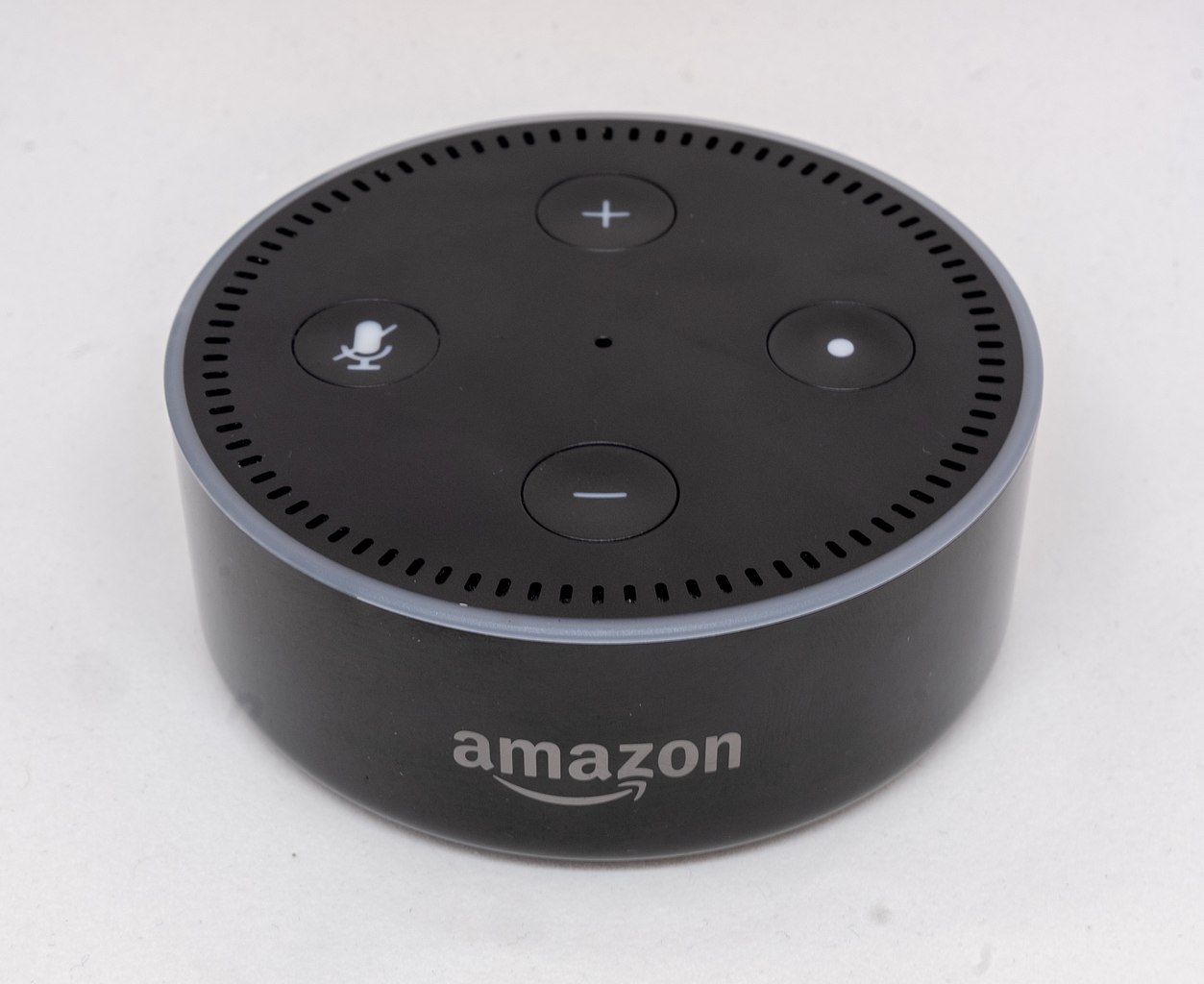
“Alexa, why haven’t you been a commercial success?” Gregory Varnum, CC BY-SA 4.0
There’s one aspect of the Jetsons future that has begun to happen though. It’s not the futuristic automation of projects such as Disneyland’s Monsanto house Of The Future, but instead it’s our current stuttering home automation efforts. We’re not having domestic robots in pinnies hand us rolled-up newspapers, but we’re installing smart lightbulbs and thermostats, and we’re voice-controlling them through a variety of home hub devices. The future is here, and it responds to “Alexa”.
But for all the success that Alexa and other devices like it have had in conquering the living rooms of gadget fans, they’ve done a poor job of generating a profit. It was supposed to be a gateway into Amazon services alongside their Fire devices, a convenient household companion that would help find all those little things for sale on Amazon’s website, and of course, enable you to buy them. Then, Alexa was supposed to move beyond your Echo and into other devices, as your appliances could come pre-equipped with Alexa-on-a-chip. Your microwave oven would no longer have a dial on the front, instead you would talk to it, it would recognise the food you’d brought from Amazon, and order more for you.
Instead of all that, Alexa has become an interface for connected home hardware, a way to turn on the light, view your Ring doorbell on models with screens, catch the weather forecast, and listen to music. It’s a novelty timepiece with that pod bay doors joke built-in, and worse that that for the retailer it remains by its very nature unseen. Amazon have got their shopping cart into your living room, but you’re not using it and it hardly reminds you that it’s part of the Amazon empire at all.
But it wasn’t supposed to be that way. The idea was that you might look up from your work and say “Alexa, order me a six-pack of beer!”, and while it might not come immediately, your six-pack would duly arrive. It was supposed to be a friendly gateway to commerce on the website that has everything, and now they can’t even persuade enough people to give it a celebrity voice for a few bucks.
The Gadget You Love to Hate
In the first few days after the Echo’s UK launch, a member of my hackerspace installed his one in the space. He soon became exasperated as members learned that “Alexa, add butt plug to my wish list” would do just that. But it was in that joke we could see the problem with the whole idea of Alexa as an interface for commerce. He had locked down all purchasing options, but as it turns out, many people in San Diego hadn’t done the same thing. As the stories rolled in of kids spending hundreds of their parents’ hard-earned on toys, it would be a foolhardy owner who would leave left purchasing enabled. Worse still, while the public remained largely in ignorance the potential of the device for data gathering and unauthorized access hadn’t evaded researchers. It’s fair to say that our community has loved the idea of a device like the Echo, but many of us wouldn’t let one into our own homes under any circumstances.
So Alexa hasn’t been a success, but conversely it’s been a huge sales success in itself. The devices have sold like hot cakes, but since they’ve been sold at close to cost, they haven’t been the commercial bonanza they might have hoped for. But what can be learned from this, other than that the world isn’t ready for a voice activated shopping trolley?
Sadly for most Alexa users it seems that a device piping your actions back to a large company’s data centres is not enough of a concern for them. It’s an easy prediction that Alexa and other services like it will continue to evolve, with inevitable AI pixie dust sprinked on them. A bet could be on the killer app being not a personal assistant but a virtual friend with some connections across a group of people, perhaps a family or a group of friends. In due course we’ll also see locally hosted and open source equivalents appearing on yet-to-be-released hardware that will condense what takes a data centre of today’s GPUs into a single board computer. It’s not often that our community rejoices in being late to a technological party, but I for one want an Alexa equivalent that I control rather than one that invades my privacy for a third party.