Love AI, But Don’t Love It Too Much

The up-and-coming Wonder of the World in software and  information circles , and particularly in those circles who talk about them, is AI. Give a magic machine a lot of stuff, ask it a question, and it will give you a meaningful and useful answer. It will create art, write books, compose music, and generally Change The World As We Know It. All this is genuinely impressive stuff, as anyone who has played with DALL-E will tell you. But it’s important to think about what the technology can and can’t do that’s new so as to not become caught up in the hype, and in doing that I’m immediately drawn to a previous career of mine. Continue reading “Love AI, But Don’t Love It Too Much”

Review: Inkplate 2 Shrinks Down, Adds Color

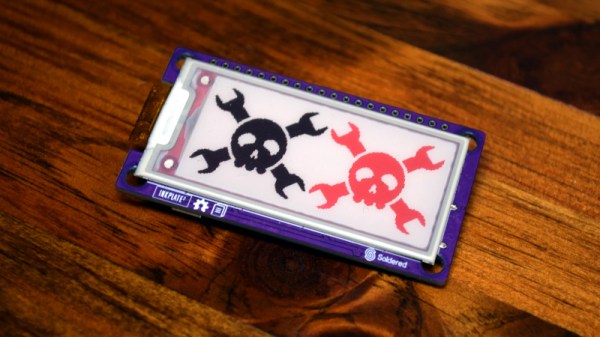
Regular Hackaday readers may recall the Inkplate family of devices: open source all-in-one development boards that combine the power and versatility of the ESP32 with electronic paper displays salvaged from commercial e-readers. By taking the sharp, high-speed, displays intended for readers such as Amazon’s Kindle and bundling it together with all the hardware and software you need to make it work, the Inkplate provided a turn-key platform for anyone looking to get serious with e-paper.

Given the fact that their screens were pulled from recycled readers, it’s no surprise the previous Inkplate entries came in familiar 6 and 10 inch variants. There was even an upgraded 6 inch model that benefited from newer reader technology by adopting a touch-sensitive backlit panel, which we took a close look at last year. Their large displays make them excellent for wall mounted applications, such as a household notification center or constantly-changing art display. Plus, as you might expect, the Inkplate is an ideal choice for anyone looking to roll their own custom e-reader.

But of course, not every application needs so much screen real estate. In fact, for some tasks, such a large display could be considered a liability. Seeing a void in their existing product lineup, the folks at Soldered Electronics (previously e-radionica) have recently unveiled the diminutive Inkplate 2. This new miniature Inkplate uses the same software library as its larger predecessors, but thanks to its 2.13 inch three-color display, lends itself to a wider array of potential projects. Plus it’s considerably cheaper than the larger Inkplate models, at just $35 USD.

Considering the crowd sourced funding campaign for the Inkplate 2 blew past its goal in just 72 hours, it seems clear there’s plenty of interest in this new smaller model. But if you’re still not sure if it’s the e-paper solution you’ve been waiting for, maybe we can help — the folks at Soldered sent along a pre-production version of the Inkplate 2 for us to play around with, so let’s take it for a test drive and see what all the fuss is about.

Continue reading “Review: Inkplate 2 Shrinks Down, Adds Color”

All About USB-C: Introduction For Hackers

We’ve now had at least five years of USB-C ports in our devices. It’s a standard that many manufacturers and hackers can get behind. Initially, there was plenty of confusion about what we’d actually encounter out there, and manufacturer-induced aberrations have put some people off. However, USB-C is here to stay, and I’d like to show you how USB-C actually gets used out there, what you can expect out of it as a power user, and what you can get out of it as a hobbyist.

Modern devices have a set of common needs – they need a power input, or a power output, sometimes both, typically a USB2 connection, and often some higher-speed connectivity like a display output/input or USB 3. USB-C is an interface that aims to be able to take care of all of those. Everything aforementioned is optional, which is a blessing and a curse, but you can quickly learn to distinguish what to expect out of a device based on how it looks; if ever in doubt, I’d like to show you how to check.

Continue reading “All About USB-C: Introduction For Hackers”

Gift Idea From 1969: A Kitchen Computer

The end of the year is often a time for people to exchange presents and — of course — the rich want to buy each other the best presents. The Neiman Marcus company was famous for having a catalog of gift ideas. Many were what you’d consider normal gifts, but there were usually extreme ones, like a tank trunk filled with 100,000 gallons of cologne. One year, the strange gift was an authentic Chinese junk complete with sails and teak decks. They apparently sold three at $11,500 (in 1962 money, no less). Over the top? In 1969, they featured a kitchen computer.

Wait a minute! In 1969, computers were the purview of big companies, universities, and NASA, right? Well, not really. By that time, some industrial minicomputers were not millions of dollars but were still many thousands of dollars. The price in the catalog for the kitchen computer was $10,600. That’s about $86,000 in today’s money. The actual machine was a Honeywell 316, based on one of the computers that helped run the early Internet.

Continue reading “Gift Idea From 1969: A Kitchen Computer”

Perhaps It’s Time To Talk About All Those Fakes And Clones

A while back, I bought a cheap spectrum analyser via AliExpress. I come from the age when a spectrum analyser was an extremely expensive item with a built-in CRT display, so there’s still a minor thrill to buying one for a few tens of dollars even if it’s obvious to all and sundry that the march of technology has brought within reach the previously unattainable. My AliExpress spectrum analyser is a clone of a design that first appeared in a German amateur radio magazine, and in my review at the time I found it to be worth the small outlay but a bit deaf and wide compared to its more expensive brethren. Continue reading “Perhaps It’s Time To Talk About All Those Fakes And Clones”

Asbestos: The Miracle Mineral Of Our Worst Nightmares

For much of the 19th and 20th century, the mining and use of asbestos saw near-constant growth, with virtually every material used in the construction of homes, offices, ships, road networks and industries featuring this miraculous mineral in some fashion. Some of these materials would contain only a few percent asbestos mineral as a binder, while others would be mostly or entirely composed out of asbestos.

What had begun as mostly a curiosity thousands of years prior was now turning into the material that was helping propel humanity into an era of hitherto unknown levels of prosperity and technological progress. It seemed as if the addition of even just a bit of asbestos would make houses weather- and fireproof, make concrete and asphalt nearly indestructible and add just that little bit of zing to tiling and interior decorations, as well as rigidity to the predecessor to today’s plastics: bakelite. Continue reading “Asbestos: The Miracle Mineral Of Our Worst Nightmares”

Hackaday Links Column Banner

Hackaday Links: December 4, 2022

Well, this is embarrassing! Imagine sending a multibillion-dollar rover to an ancient lakebed on Mars only to discover after a year of poking around at the rocks that it might not actually have been a lake after all. That seems to be the impression of Jezero Crater that planetary scientists are forming after looking at the data coming back from Perseverance since it nailed the landing in what sure as heck looked like a dried-up lake, complete with a river delta system. A closer look at the sediments Perseverance has been sampling reveals a lot of the mineral olivine, which on Earth is rare near the surface because it readily reacts with water. Finding lots of olivine close below the surface of Jezero suggests that it either wasn’t all that watery once upon a time, or that what water was there was basically ice cold. The results are limited to where the rover has visited, of course, and the nice thing about having wheels is that you can go somewhere else. But if you were hoping for clear signs that Jezero was once a lake teeming with life, you might have to keep waiting.

In other space news, we have to admit to taking NASA to task a bit in the podcast a couple of weeks back for not being quite up to SpaceX’s zazzle standards with regard to instrumenting the SLS launch. Yeah, a night launch is spectacular, but not having all those internal cameras like the Falcon has just sort of left us flat. But we should have been more patient, because the images coming back from Artemis 1 are simply spectacular. We had no idea that NASA attached cameras to the solar panels of the Orion spacecraft, which act a little like selfie sticks and allow the spacecraft to be in the foreground with Earth and the Moon in the background. Seeing Earth from lunar distance again for the first time in 50 years has been a real treat, and getting our satellite in the frame at the same time is a huge bonus.

Continue reading “Hackaday Links: December 4, 2022”