NASA Continues Slow And Steady Pace Towards Moon

It’s often said that the wheels of government turn slowly, and perhaps nowhere is this on better display than at NASA. While it seems like every week we hear about another commercial space launch or venture, projects helmed by the national space agency are often mired by budget cuts and indecisiveness from above. It takes a lot of political will to earmark tens or even hundreds of billions of dollars on a project that could take decades to complete, and not every occupant of the White House has been willing to stake their reputation on such bold ambitions.

In 2019, when Vice President Mike Pence told a cheering crowd at the U.S. Space & Rocket Center that the White House was officially tasking NASA with returning American astronauts to the surface of the Moon by 2024, everyone knew it was an ambitious timeline. But not one without precedent. The speech was a not-so-subtle allusion to President Kennedy’s famous 1962 declaration at Rice University that America would safely land a man on the Moon before the end of the decade, a challenge NASA was able to meet with fewer than six months to spare.

Unfortunately, a rousing speech will only get you so far. Without a significant boost to the agency’s budget, progress on the new Artemis lunar program was limited. To further complicate matters, less than a year after Pence took the stage in Huntsville, there was a new President in the White House. While there was initially some concern that the Biden administration would axe the Artemis program as part of a general “house cleaning”, it was allowed to continue under newly installed NASA Administrator Bill Nelson. The original 2024 deadline, at this point all but unattainable due to delays stemming from the COVID-19 pandemic, has quietly been abandoned.

So where are we now? Is NASA in 2022 any closer to returning humanity to the Moon than they were in 2020 or even 2010? While it might not seem like it from an outsider’s perspective, a close look at some of the recent Artemis program milestones and developments show that the agency is at least moving in the right direction.

Continue reading “NASA Continues Slow And Steady Pace Towards Moon”

Hackaday Links Column Banner

Hackaday Links: March 27, 2022

Remember that time back in 2021 when a huge container ship blocked the Suez Canal and disrupted world shipping for a week? Well, something a little like that is playing out again, this time in the Chesapeake Bay outside of the Port of Baltimore, where the MV Ever Forward ran aground over a week ago as it was headed out to sea. Luckily, the mammoth container ship isn’t in quite as narrow a space as her canal-occluding sister ship Ever Given was last year, so traffic isn’t nearly as impacted. But the recovery operation is causing a stir, and refloating a ship that was drawing 13 meters when it strayed from the shipping channel into a muddy-bottomed area that’s only about 6 meters deep is going to be quite a feat of marine engineering. Merchant Marine YouTuber Chief MAKOi has a good rundown of what’s going on, and what will be required to get the ship moving again.

With the pace of deep-space exploration increasing dramatically of late, and with a full slate of missions planned for the future, it was good news to hear that NASA added another antenna to its Deep Space Network. The huge dish antenna, dubbed DSS-53, is the fourteenth dish in the DSN network, which spans three sites: Goldstone in California; outside of Canberra in Australia; and in Madrid, where the new dish was installed. The 34-meter dish will add 8% more capacity to the network; that may not sound like much, but with the DSN currently supporting 40 missions and with close to that number of missions planned, every little bit counts. We find the DSN fascinating, enough so that we did an article on the system a few years ago. We also love the insider’s scoop on DSN operations that @Richard Stephenson, one of the Canberra operators, provides.

Does anybody know what’s up with Benchy? We got a tip the other day that the trusty benchmarking tugboat model has gone missing from several sites. It sure looks like Sketchfab and Thingiverse have deleted their Benchy files, while other sites still seem to allow access. We poked around a bit but couldn’t get a clear picture of what’s going on, if anything. If anyone has information, let us know in the comments. We sure hope this isn’t some kind of intellectual property thing, where you’re going to have to cough up money to print a Benchy.

Speaking of IP protections, if you’ve ever wondered how far a company will go to enforce its position, look no further than Andrew Zonenberg’s “teardown” of an anti-counterfeiting label that Hewlett Packard uses on their ink cartridges. There’s a dizzying array of technologies embedded inside what appears to be a simple label. In addition to the standard stuff, like the little cuts that make it difficult to peel a tag off one item and place it on another — commonly used to thwart “price swapping” retail thefts — there’s an almost holographic area of the label. Zooming in with a microscope, the color-shifting image appears to be made from tiny hexagonal cells that almost look like the pixels in an e-ink display. Zooming in even further, the pixels offer an even bigger (smaller) surprise. Take a look, and marvel at the effort involved in making sure you pay top dollar for printer ink.

And finally, we got a tip a couple of weeks ago on a video about jerry cans. If that sounds boring, stop reading right now — this one won’t reach you. But if you’re even marginally interested in engineering design and military history, make sure you watch this video. What is now known to the US military as “Can, Gasoline, Military 5-Gallon (S/S by MIL-C-53109)” and colloquially known as the NATO jerry can, started life as the Wehrmacht-Einheitskanister, a 20-liter jug whose design addresses a long list of specifications, from the amount of liquid it could contain to how the cans would be carried. The original could serve as a master class in good design, and some of the jugs that were built in the 1940s are still in service and actively sought by collectors of militaria. Cheap knockoffs are out there, of course, but after watching this video, we’ve developed a taste for jerry cans that only the original will sate.

REMOTICON 2021 // Jay Doscher Proves Tinkercad Isn’t Just For Kids

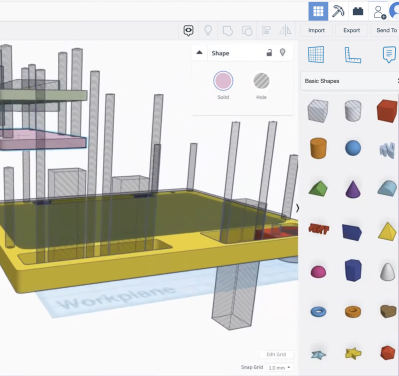
We invited [Jay Doscher] to give us a view into his process designing 3D printed parts for the impressive array of cyberdecks we’ve covered since 2019.

[Jay] got his start as a maker through woodworking in high school, getting satisfaction from bringing something from idea to reality. After a more recent class in blacksmithing and ax-making showed him what he could do when really focused, his hardware hacking really took off and his line of cyberdecks and other portable computers was born.

If you’ve heard of Tinkercad, you probably think it’s just for kids. While designed as an educational tool, [Jay] found that Autodesk’s younger sibling to the professionally powered (and priced) Fusion 360 had everything needed for making cyberdecks. If you’re willing to work around a few limitations, at the low-low price of free, Tinkercad might be right for you too.

What limitations? To start, Tinkercad is only available in a browser and online. There’s also no guarantee that it will remain free, but [Jay] notes that with its educational focus that is likely to remain the case. There is no library of common components to import while modeling. And, when your model is complete the options for exporting are limited to 2D SVGs and 3D STL, OBJ, and gaming-focused GBL formats. [Jay] has converted those to other formats for laser cutting and the STEP file a machine shop is expecting but admits that it’s something that adds complexity and is an annoyance.

back7-TinkerCad-Alignment

In the talk, [Jay] discusses moving from his initial “cringy” explorations with Tinkercad, to his first cyberdeck, a little history on that term, and the evolution of his craft. It’s mostly a hands-on demo of how to work with Tinkercad, full of tips and tricks for the software itself and implications for 3D printing yourself, assembly, and machining by others.

While quite limited, Tinkercad still allows for boolean operations to join two volumes or the subtraction of one from another. [Jay] does a wonderful job of unpeeling the layers of operations, showing how combinations of “solids” and “holes” generated a complex assembly with pockets, stepped holes for fasteners, and multiple aligned parts for his next cyberdeck. Even if you already have a favorite CAD tool, another approach could expand your mind just like writing software in Strange Programming Languages can.

Continue reading “REMOTICON 2021 // Jay Doscher Proves Tinkercad Isn’t Just For Kids”

Tech In Plain Sight: Car Doors

There are a lot of common phrases that no longer mean what they used to. For example, you may have used the term “turn on the lights.” What are you actually turning? Where does this come from? Old gas lights had a valve that you did physically turn, and the phrase simply stuck around. Kids of the 90s have no idea why they “dial” a phone number. What about “roll up the car window”?  You don’t often encounter old-fashioned car doors with manual locks or a crank to roll up the window. These days it is all electronic. But have you ever wondered what’s going on inside there?

Let’s take a look at car doors, how they keep you safe, and how that sheet of glass slides into place, sealing against wind, rain, and noise. Of course, there are fancy car doors like suicide doors or sexy-but-impractical gull wing doors. At least one concept car even has a door that disappears under the vehicle when it opens; check out the video below. But even garden-variety doors are marvels of mechanical engineering. A compact structure that is secure and — mostly — reliable. Let’s look at how they do that.

Continue reading “Tech In Plain Sight: Car Doors”

Two-Dimensional Polymer Is A New Ultra-Strong Material

Plastics, by and large, are well-understood materials. Not as strong as most metals, but often much lighter, these man-made polymers have found innumerable applications that have revolutionized the way we live. The properties of plastics have been improved in many ways over the years, with composite materials like fiberglass and carbon fiber proving to have strength and lightness far beyond the simple properties of basic polymers alone.

However, a group of engineers at MIT have been working on a revolutionary type of polymer that promises greater strength then ever before while remaining remarkably light weight. It’s all down to the material’s two-dimensional molecular structure, something once thought to be prohibitively difficult in the world of polymer science.

Continue reading “Two-Dimensional Polymer Is A New Ultra-Strong Material”

The New-Phone Blues: A Reminder That Hackers Shouldn’t Settle

For all the convenience and indispensability of having access to the sum total of human knowledge in the palm of your hand, the actual process of acquiring and configuring a smartphone can be an incredibly frustrating experience. Standing in those endless queues at the cell phone store, jumping through the administrative hoops, and staring in sticker shock at a device that’s likely to end its life dunked in a toilet all contribute to the frustration.

But for my money, the real trouble starts once you get past all that stuff and start trying to set up the new phone just right. Sure, most phone manufacturers make it fairly easy to clone your old phone onto the new one, but there are always hiccups. And for something that gets as tightly integrated into the workflows of your daily life as cell phones do, that can be a real bummer. Especially when you find out that your shiny new phone can’t do something you absolutely depend on.

Continue reading “The New-Phone Blues: A Reminder That Hackers Shouldn’t Settle”

One Giant Leap (Backwards) For Humankind: What The Russia-Ukraine War Means For The ISS

The International Space Station was built not only in the name of science and exploration, but as a symbol of unity. Five space agencies, some representing countries who had been bitter Cold War rivals hardly a decade before the ISS was launched, came together to build something out of a sci-fi novel: a home among the stars (well, in Low Earth Orbit) for humans from around the globe to work with one another for the sake of scientific advancement, high above the terrestrial politics that governed rock below. That was the idea, at least.

So far, while there has been considerable sound and fury in social media channels, international cooperation in space seems to continue unhindered. What are we to make of all this bluster, and what effects could it have on the actual ISS?

Continue reading “One Giant Leap (Backwards) For Humankind: What The Russia-Ukraine War Means For The ISS”