Regenerative Medicine: The Promise Of Undoing The Ravages Of Time

In many ways, the human body is like any other machine in that it requires constant refueling and maintenance to keep functioning. Much of this happens without our intervention beyond us selecting what to eat that day. There are however times when due to an accident, physical illness or aging the automatic repair mechanisms of our body become overwhelmed, fail to do their task correctly, or outright fall short in repairing damage.

Most of us know that lizards can regrow tails, some starfish regenerate into as many new starfish as the pieces which they were chopped into, and axolotl can regenerate limbs and even parts of their brain. Yet humans too have an amazing regenerating ability, although for us it is mostly contained within the liver, which can regenerate even when three-quarters are removed.

In the field of regenerative medicine, the goal is to either induce regeneration in damaged tissues, or to replace damaged organs and tissues with externally grown ones, using the patient’s own genetic material. This could offer us a future in which replacement organs are always available at demand, and many types of injuries are no longer permanent, including paralysis. Continue reading “Regenerative Medicine: The Promise Of Undoing The Ravages Of Time”

Art of 3D printer in the middle of printing a Hackaday Jolly Wrencher logo

3D Printering: Soldering A Heated Bed

There’s an old saying about something being a “drop in the ocean.” That’s how I felt faced with the prospect of replacing a 12 V heated bed on my printer with a new 24 V one. The old bed had a nice connector assembled from the factory, although I had replaced the cable long ago due to heating issues with that particular printer. The new bed, however, just had bare copper pads.

I’m no soldering novice: I made my first solder joint sometime in the early 1970s. So I felt up to the challenge, but I also knew I wouldn’t be able to use my usual Edsyn iron for a job like this. Since the heated bed is essentially a giant heatsink for these pads, I knew it would require the big guns. I dug out my old — and I mean super old — Weller 140 W soldering gun. Surely, that would do the trick, right?

Continue reading “3D Printering: Soldering A Heated Bed”

Haber-Bosch And The Greening Of Ammonia Production

We here on Earth live at the bottom of an ocean of nitrogen. Nearly 80% of every breath we take is nitrogen, and the element is a vital component of the building blocks of life. Nitrogen is critical to the backbone of proteins that form the scaffold that life hangs on and that catalyze the myriad reactions in our cells, and the information needed to build these biopolymers is encoded in nucleic acids, themselves nitrogen-rich molecules.

And yet, in its abundant gaseous form, nitrogen remains directly unavailable to higher life forms, unusably inert and unreactive. We must steal our vital supply of nitrogen from the few species that have learned the biochemical trick of turning atmospheric nitrogen into more reactive compounds like ammonia. Or at least until relatively recently, when a couple of particularly clever members of our species found a way to pull nitrogen from the air using a combination of chemistry and engineering now known as the Haber-Bosch process.

Haber-Bosch has been wildly successful, and thanks to the crops fertilized with its nitrogenous output, is directly responsible for growing the population from a billion people in 1900 to almost eight billion people today. Fully 50% of the nitrogen in your body right now probably came from a Haber-Bosch reactor somewhere, so we all quite literally depend on it for our lives. As miraculous as Haber-Bosch is, though, it’s not without its problems, particularly in this age of dwindling supplies of the fossil fuels needed to run it. Here, we’ll take a deep dive into Haber-Bosch, and we’ll also take a look at ways to potentially decarbonize our nitrogen fixation industry in the future.

Continue reading “Haber-Bosch And The Greening Of Ammonia Production”

Mining And Refining: Copper, The Metal That Built Technology

It’s hard to reckon exactly when in history humans became a technological species. Part of that is because the definition of technology is somewhat subjective; if you think making a stick pointy enough to grub roots from the dirt or to poke enough holes in an animal to convince it to let you eat it is technology, then our engineered world goes back a long, long way indeed.

But something about pointy sticks just doesn’t seem transformative enough, in the sense of fundamentally changing a naturally occurring material, to really count as a technological line in the sand. To cross that line, it really seems like the use of metals should be part of the package. Even if that’s the case, our technological history still goes pretty far back. And copper ends up being one of the metals that started it all, about 11,000 years ago, when our ancestors discovered natural deposits of the soft, reddish metal and began learning how to fashion it into the tools and implements that lifted us out of the Stone Age.

Our world literally cannot run without copper, forming as it does not only the electric-motor muscles of civilization, but also the wires and cables that form the power and data grids that stitch us together. Ironically, we are just as dependent on copper now as we were when it was the only metal we could make tools from, and perhaps more so. We’ll take a look at what’s involved in extracting and purifying copper, and see how the methods we today use are not entirely different from those developed over seven millennia ago.

Continue reading “Mining And Refining: Copper, The Metal That Built Technology”

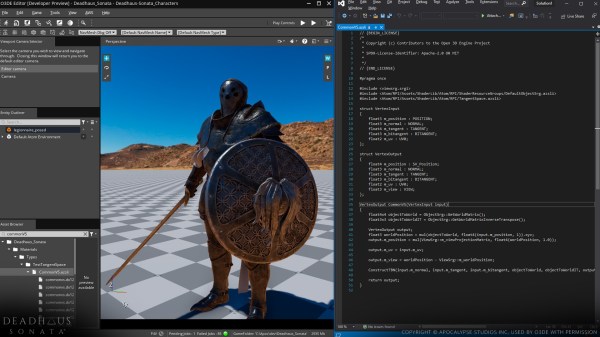
Open 3D Engine editor with Amazon Shader Language file and asset from the game Deadhaus Sonata open. (Credit: O3DE project)

Open 3D Engine: Amazon’s Old Clothes Or A Game Engine To Truly Get Excited About?

Recently Amazon announced that they would be open sourcing the 3D engine and related behind their Amazon Lumberyard game tooling effort. As Lumberyard is based on CryEngine 3.8  (~2015 vintage), this raises the question of whether this new open source engine – creatively named Open 3D Engine (O3DE) – is an open source version of a CryTek engine, and what this brings to those of us who like to tinker with 2D, 3D games and similar.

When reading through the marketing materials, one might be forgiven for thinking that O3DE is the best thing since sliced 3D bread, and is Amazon’s benevolent gift to the unwashed masses to free them from the chains imposed on them by proprietary engines like Unity and Unreal Engine. A closer look reveals however that O3DE is Lumberyard, but with many parts of Lumberyard replaced, including the renderer still in the process of being rewritten from the old CryEngine code.

What Makes a Good Game Engine?

My own game development attempts started with the Half Life engine and the Valve Hammer editor, as well as the Doom map editor. This meant that some expectations were set before encountering today’s game engines and their tools. The development experience with the Hammer editor in the late 1990s was pretty much WYSIWYG, and when I was just getting started with Unreal Engine 4 (UE4) a number of years back this was pretty much the same experience, making it relatively easy to hit the ground running. Continue reading “Open 3D Engine: Amazon’s Old Clothes Or A Game Engine To Truly Get Excited About?”

Hackaday Links Column Banner

Hackaday Links: January 9, 2022

It looks like we have a new space observatory! According to NASA, all the major deployments on the James Webb Space Telescope have been completed successfully. This includes the tricky sunshield deployment and tensioning, which went off this week without much in the way of trouble. The final major deployment, the unfolding of the starboard wing of the primary mirror of the telescope, was completed on Saturday while the spacecraft was still almost 400,000 km from its forever home orbiting Lagrange point L2. Mission controllers had allotted two weeks for the 300-odd deployments needed to turn the packaged machine into a working observatory. The remaining two weeks or so of flight include less dramatic tasks, such as trimming the shape of the primary mirror with servos that subtly alter the position and curvature of each of the 18 segments, plus a bunch of calibration tasks. But it looks like most of the really scary stuff is behind us now.

From the “Interesting Innards” department, if you’re a fan of either gaming or industrial CT scans, check out Scan of the Month’s look inside Nintendo handheld game consoles. They’ve put a bunch of games through computed tomography scans, and the results are really interesting, false-colored though they may be. Seeing the progression of technology from the original 1989 Game Boy to the Switch is fascinating. The side notes on the history and tech inside each one are pretty cool too.

A couple of weeks ago we mentioned Andrew Sink’s online low-poly generator, which takes any 3D model and allows you to control the number of polygons used to render it. He dropped us a line to let us know the tool proved popular enough that he had to move it off GitHub and onto a dedicated site. Check it out at its new home.

When something like this pops up in your feed, it seems like the best approach is to share it. It’s called DentalSlim, and claims to be the first intra-oral device designed for weight loss. It’s a hardware lock for your teeth, and it looks perfectly horrifying. The device is designed to be applied by a sadist dentist and effectively locks the lower jaw to the upper with magnets, allowing the wearer to open his or her mouth only enough to take a liquid diet. There’s also a provision for the wearer to unlock the device in an emergency, which is wise — can you imagine catching a stomach bug with your jaw locked shut? — but that seems to defeat the “hardware-enforced willpower” that the device is based on.

Have you got a bunch of filament spools lying around from all that 3D printing? Rather than put them to use rolling up strings of lights from the Christmas tree, here’s another idea: turn them into nice covered bird feeders. All you need to do is apply a rim around one side to hold the seed before hanging them out for the birds. We suppose walling off the space between the sides completely and drilling some holes could also turn them into birdhouses, too.

And finally, if your filament spool bird feeder isn’t attracting the attention of the neighborhood cats, perhaps it’s because they’ve found a nice, cozy spot to soak up some heat. At least that’s what some Starlink users are seeing as their feline friends cuddle up on Dishy McFlatface for a long winter’s nap. You see, the phased array antenna inside the enclosure gets pretty toasty, and cats are pretty much any-port-in-a-storm critters, so it’s only natural. We can’t imagine their choice of basking locale does much for data throughput, and it’s probably quite a laugh when the dish pivots to track a satellite. But it’s hard to feel sorry for something that sleeps 23-½ hours a day.


The Year Of Owning It

Talking over the year in review on the Podcast, Tom Nardi and I were brainstorming what we thought was the single overarching trend in 2021, and we came up with many different topics: victories in the right to repair, increasingly dystopian service contracts, a flourishing of cyberdecks, and even greater prevalence of reverse engineering style hacks. And then we realized: they are all different faces of the same beast — people just want to own the devices that they own.

Like Dr. Jekyll and Mr. Hyde, our modern Internet-connected-everythings have two sides. On one side, we get so much additional functionality from having everything on the net. But on the other, if your car is always connected, it gives Toyota a means to make you pay a monthly fee to use a car fob, and if you have to use Cricut’s free online service to upload designs to the cutter, they can suddenly decide to start charging you. It allows Samsung to not only spy on whatever you’re currently watching on your smart TV, but to also brick it if they want to. More and more, we don’t actually own (in the sense of control) the devices that we own (in the sense of having purchased).

We don’t have to take it lying down. On the one hand, consumer protest made Cricut walk back their plans, and may do the same with Toyota. We can achieve a lot, collectively, by just talking about our grievances, and letting the firms in question know how we feel — naturally also with our wallets. But as hackers and all-around techie types, we can do even more. When something is broken because of a bad service, we can often fix it with firmware or by standing up our own version of the service. We can pwn them.

But there’s even more to the cyberdeck and the extreme DIY movements of the last few years than just the defense against lock-in or the liberating of hardware. There’s also the pride of truly owning something because you made it. Not just owning it because you bought it, or owning it because you control it, but owning it because you understand it and because you gave birth to it.

Whichever way you’re into owning your own, I think that’s the single overarching trend of 2021 — both on the positive and proactive side and the negative and reactive. Talking about it, reverse engineering it, or building it yourself, 2021 was the year of owning it.