This Year’s Nobel Prizes Are Straight Out Of Science Fiction

In the 1966 science fiction movie Fantastic Voyage, medical personnel are shrunken to the size of microbes to enter a scientist’s body to perform brain surgery. Due to the work of this year’s winners of the Nobel Prize in Physics, laser tools now do work at this scale.

Arthur Ashkin won for his development of optical tweezers that use a laser to grip and manipulate objects as small a molecule. And Gérard Mourou and Donna Strickland won for coming up with a way to produce ultra-short laser pulses at a high-intensity, used now for performing millions of corrective laser eye surgeries every year.

Here is a look at these inventions, their inventors, and the applications which made them important enough to win a Nobel.

Continue reading “This Year’s Nobel Prizes Are Straight Out Of Science Fiction”

A Funny Thing Happened On Ada Lovelace Day…

Today is Ada Lovelace Day, a day to celebrate and encourage women in the fields of science and technology. The day is named after “Augusta Ada King-Noel, Countess of Lovelace, born Byron”, or Lady Ada Lovelace for short. You can read up more on her life and contribution to computer science at Wikipedia, for instance.

But it’s not really fair to half of the world’s population to dedicate just one day to observing the contributions of female scientists and then lavish all the laurels solely on Lovelace. So last year, the day after Ada Lovelace day, Brian Benchoff sent an internal e-mail at Hackaday HQ suggesting we tell the stories of other women in science. We put our heads together and came up with a couple dozen leads so quickly, it was clear that we were on to something good.

From a writer’s perspective, the stories of women in science are particularly appealing because they are undertold. Sure, everyone knows of Marie Curie’s brilliant and tragic dedication to uncovering the mysteries of radioactivity. But did you know how Rita Levi-Montalcini had to hide from the Italian Fascists and the German Nazis using fake names, doing research on scarce chicken eggs in her parent’s kitchen, before she would eventually discover nerve growth factor and win the Nobel Prize? We didn’t.

Do you know which biochemist is the American who’s logged the most time in space? Dr. Peggy Whitson, the space ninja. But the honor of being the first civilian in space goes to Soviet skydiver Valentina Tereshkova. Margaret Hamilton was lead software engineer on the code that got the first feet on the moon, but in the days before astronauts had learned to trust the silicon, John Glenn wanted Katherine Johnson to double-check the orbital calculations before he set foot in the Friendship 7.

And on it goes. Maria Goeppert-Mayer figured out the structure of nuclear shells, Kathleen Booth invented assembly language, and Françoise Barré-Sinoussi discovered HIV. Stephanie Kwolek even saved Hackaday writer Dan Maloney’s life by inventing Kevlar.

In all, we’ve written 30 profiles of women in science in the last year — far too many to list here by name. You can browse them all by using the Biography category. (We’ve thrown in biographies of a few men too, because women don’t have a monopoly on neat stories.)

We’re not done yet, either. So thank you, Ada Lovelace, for giving us the impetus to cover the fascinating stories and important contributions of so many women in science!


Google Discovers Google+ Servers Are Still Running

Google is pulling the plug on their social network, Google+. Users still have the better part of a year to say their goodbyes, but if the fledgling social network was a ghost town before, news of its imminent shutdown isn’t likely to liven the place up. A quick check of the site as of this writing reveals many users are already posting their farewell messages, and while there’s some rallying behind petitions to keep the lights on, the majority realize that once Google has fallen out of love with a project there’s little chance of a reprieve.

To say that this is a surprise would be disingenuous. We’d wager a lot of you already thought it was gone, honestly. It’s no secret that Google’s attempt at a “Facebook Killer” was anything but, and while there was a group of dedicated users to be sure, it never attained anywhere near the success of its competition.

According to a blog post from Google, the network’s anemic user base isn’t the only reason they’ve decided to wind down the service. A previously undisclosed security vulnerability also hastened its demise, a revelation which will particularly sting those who joined for the privacy-first design Google touted. While this fairly transparent postmortem allows us to answer what ended Google’s grand experiment in social networking, there’s still one questions left unanswered. Where are the soon to be orphaned Google+ users supposed to go?

Continue reading “Google Discovers Google+ Servers Are Still Running”

Hack My House: Running Raspberry Pi Without An SD Card

Many of us have experienced the pain that is a Raspberry Pi with a corrupted SD card. I suspect the erase-on-write nature of flash memory is responsible for much of the problem. Regardless of the cause, one solution is to use PXE booting with the Raspberry Pi 3. That’s a fancy way to say we’ll be booting the Raspberry Pi over the network, instead of from an SD card.

What does this have to do with Hacking My House? As I discussed last time, I’m using Raspberry Pi as Infrastructure by building them into the walls of every room in my house. You don’t want to drag out a ladder and screwdriver to swap out a misbehaving SD card, so booting over the network is a really good solution. I know I promised we’d discuss cabling and cameras. Think of this as a parenthetical article — we’ll talk about Ethernet and ZoneMinder next time.

So let’s dive in and see what the Preboot Execution Environment (PXE) is all about and how to use PXE with Raspberry Pi.

Continue reading “Hack My House: Running Raspberry Pi Without An SD Card”

Will Drones And Planes Be Treated As Equals By FAA?

Soon, perhaps even by the time you read this, the rules for flying remote-controlled aircraft in the United States will be very different. The Federal Aviation Authority (FAA) is pushing hard to repeal Section 336, which states that small remote-controlled aircraft as used for hobby and educational purposes aren’t under FAA jurisdiction. Despite assurances that the FAA will work towards implementing waivers for hobbyists, critics worry that in the worst case the repeal of Section 336 might mean that remote control pilots and their craft may be held to the same standards as their human-carrying counterparts.

Section 336 has already been used to shoot down the FAA’s ill-conceived attempt to get RC pilots to register themselves and their craft, so it’s little surprise they’re eager to get rid of it. But they aren’t alone. The Commercial Drone Alliance, a non-profit association dedicated to supporting enterprise use of Unmanned Aerial Systems (UAS), expressed their support for repealing Section 336 in a June press release:

Basic ‘rules of the road’ are needed to manage all this new air traffic. That is why the Commercial Drone Alliance is today calling on Congress to repeal Section 336 of the FAA Modernization and Reform Act of 2012, and include new language in the 2018 FAA Reauthorization Act to enable the FAA to regulate UAS and the National Airspace in a common sense way.

With both the industry and the FAA both pushing lawmakers to revamp the rules governing small remote-controlled aircraft, things aren’t looking good for the hobbyists who operate them. It seems likely those among us with a penchant for airborne hacking will be forced to fall in line. But what happens then?

Continue reading “Will Drones And Planes Be Treated As Equals By FAA?”

New Part Day: The RISC-V Chip With Built-In Neural Networks

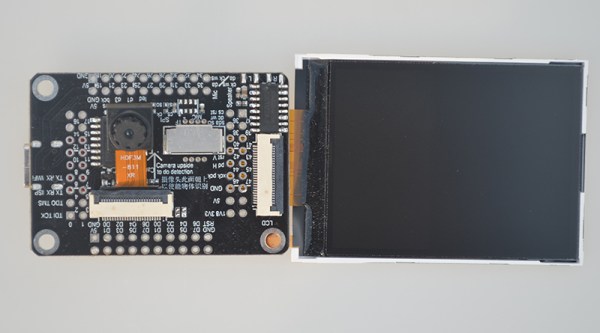
After exploring a few random online shops one day, [David] (thanks for sending this in, by the way) ran across a very interesting chip. It’s a dual-core, RISC-V chip running at 400MHz. There’s 6 MB of SRAM on the CPU, and there’s 2MB for convolutional neural network acceleration. There is, apparently, WiFi on some versions. There are already SDKs available on GitHub, and a bare chip costs a dollar or two. Interested? Log in to Taobao, realize Taobao does pre-orders, and all this can be yours.

This is a preorder — because apparently you can do that as a seller on TaoBao, but the Sipeed M1 K210 is available as a ‘core’ board with 72 pins in a one-inch square package, a version with WiFi, or as a complete development board with an OV2640 camera, 2.4 inch LCD, microphone, and onboard USB. There are videos of this chip running a face detection routine. It found Obama.

A bit of googling tells us this chip comes from a company named Kendryte, and here the specs are repeated: this is a dual-core RISC-V with an FPU, a bunch of RAM, and can run TensorFlow. Documentation is available, although the datasheet will need to be translated, and as of this writing there’s a GitHub filled with SDKs and examples, with some of the repos updated in the last hour.

Over the years we’ve seen a few RISC-V chips given development boards, and you can buy them right now. The HiFive 1 is an exceptionally powerful microcontroller with processing power that puts it right up against the Teensy (which is built around a Freescale chip), but it’s also fairly expensive. We’re not sure the Arduino Cinque (also RISC-V) ever made it to production, but again, expensive. The idea that a RISC-V microcontroller could be available for just a few dollars is very interesting, it even comes with SDKs and utilities to make the chip useful.