Jeroen Domburg Miniaturizes A Mac

His name may not ring a bell, but his handle will — Sprite_tm, a regular to these pages and to Hackaday events around the world. Hailing from The Netherlands by way of Shanghai, Jeroen Domburg dropped by the Hackaday Superconference 2017 to give a talk on a pet project of his: turning a Macintosh into, well, a pet.

You could say this is Jeroen’s second minification of vintage hardware. At last year’s Hackaday Superconference, he brought out the tiniest Game Boy ever made. This incredible hardware and software hack stuffs a complete Game Boy into something you can lose in your pocket. How do you top a miniature version of the most iconic video game system ever made? By creating a miniature version of the most iconic computer ever made, of course.

The tiny object in front of Jeroen in the title image is, in fact, a working Macintosh Plus that he built. Recreating mid-80’s technology using 2017 parts seems like it would be easy, and while it’s obviously easier than breaking the laws of physics to go the other direction, Jeroen faced some serious challenges along the way, which he goes into some detail about in his talk.

Continue reading “Jeroen Domburg Miniaturizes A Mac” →

A TEMPEST In A Dongle

If a couple of generations of spy movies have taught us anything, it’s that secret agents get the best toys. And although it may not be as cool as a radar-equipped Aston Martin or a wire-flying rig for impossible vault heists, this DIY TEMPEST system lets you snoop on computers using secondary RF emissions.

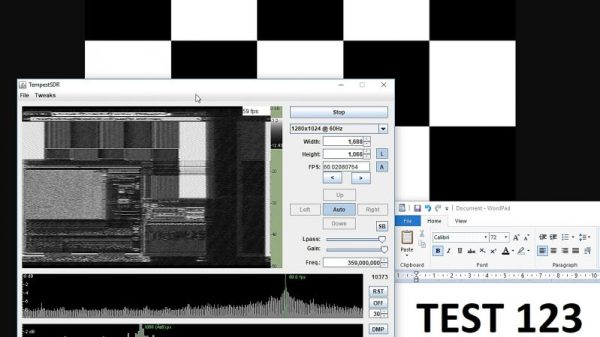
If the term TEMPEST sounds familiar, it’s because we’ve covered it before. [Elliot Williams] gave an introduction to the many modalities that fall under the TEMPEST umbrella, the US National Security Agency’s catch-all codename for bridging air gaps by monitoring the unintended RF, light, or even audio emissions of computers. And more recently, [Brian Benchoff] discussed a TEMPEST hack that avoided the need for thousands of dollars of RF gear, reducing the rig down to an SDR dongle and a simple antenna. There’s even an app for that now: TempestSDR, a multiplatform Java app that lets you screen scrape a monitor based on its RF signature. Trouble is, getting the app running on Windows machines has been a challenge, but RTL-SDR.com reader [flatfishfly] solved some of the major problems and kindly shared the magic. The video below shows TempestSDR results; it’s clear that high-contrast images at easiest to snoop on, but it shows that a $20 dongle and some open-source software can bridge an air gap. Makes you wonder what’s possible with deeper pockets.

RF sniffing is only one of many ways to exfiltrate data from an air-gapped system. From power cords to security cameras, there seems to be no end to the ways to breach systems.

Continue reading “A TEMPEST In A Dongle” →

Start Tracking Satellites With This Low-Cost Azimuth-Elevation Positioner

Tracking satellites and the ISS is pretty easy. All you really need is an SDR dongle or a handheld transceiver, a simple homebrew antenna, and a clear view of the sky. Point the antenna at the passing satellite and you’re ready to listen, or if you’re a licensed amateur, talk. But the tedious bit is the pointing. Standing in a field or on top of a tall building waving an antenna around gets tiring, and unless you’re looking for a good arm workout, limits the size of your antenna. Which is where this two-axis antenna positioner could come in handy.

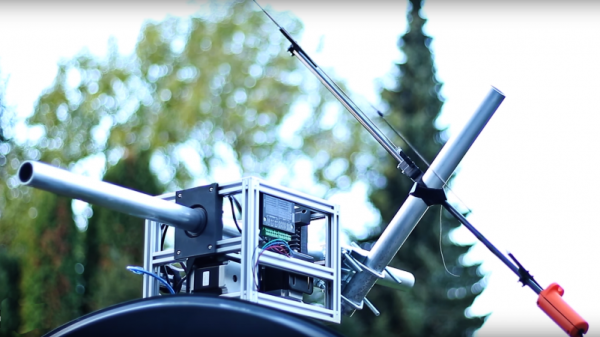
While not quite up to the job it was originally intended for — positioning a 1.2-meter dish antenna — [Manuel] did manage to create a pretty capable azimuth-elevation positioner for lightweight antennas. What’s more, he did it on the cheap — only about €150. His design seemed like it was going in the right direction, with a sturdy aluminum extrusion frame and NEMA23 steppers. But the 3D-printed parts turned out to be the Achille’s heel. At the 1:40 mark in the video below (in German with English subtitles), the hefty dish antenna is putting way too much torque on the bearings, delaminating the bearing mount. But with a slender carbon-fiber Yagi, the positioner shines. The Arduino running the motion control talks GS232, so it can get tracking data directly from the web to control the antenna in real time.

Here’s hoping [Manuel] solves some of the mechanical issues with his build. Maybe he can check out this hefty dish positioner for weather satellite tracking for inspiration.

Continue reading “Start Tracking Satellites With This Low-Cost Azimuth-Elevation Positioner” →

A Callout: Parts For An Iron Lung

Polio was a disease that devastated the United States in the 1950s, but with concerted efforts towards vaccination, is now on the verge of eradication. With the disease a distant memory for most, it’s easy to miss the fact that there are still those suffering the effects of the disease decades after its initial strike.

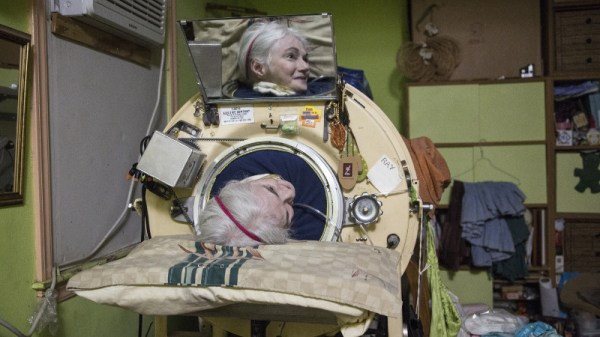
The iron lung was an invention that helped keep thousands of sufferers alive, by breathing for those who had lost the ability through the degenerative effects of the disease. A small handful of people are still relying on those machines today, and there’s a problem – who is around to keep these machines running?

The story is a powerful one, made up of interviews with those who still rely on their machines on a daily basis to stay alive. Particularly poignant is Lillard’s account of the repairman who came to fix her machine, and tried to leave before putting it back together. As someone who needs the machine operational to survive, this obviously wasn’t going to cut it.

Overall, these are people who have relied on help from friends, neighbours, and local tinkerers to help keep their machines running long after the companies responsible have long stopped supporting the hardware. This has led to an unenviable situation for Lillard herself – she’s no longer able to purchase replacement collars that seal her neck to the machine, as the subsidiary of Phillips responsible only has ten left in the country and will no longer sell to her. Naomi Wu and others are organising on Twitter to find a way to remanufacture these parts. If you’re in the know, or otherwise have the expertise, get involved or throw your ideas down in the comments.

It’s not the first time we’ve heard dark stories of medical equipment from years past – the story of the Therac-25 is particularly chilling.

[via Gizmodo]

Anouk Wipprecht: Robotic Dresses And Human Interfaces

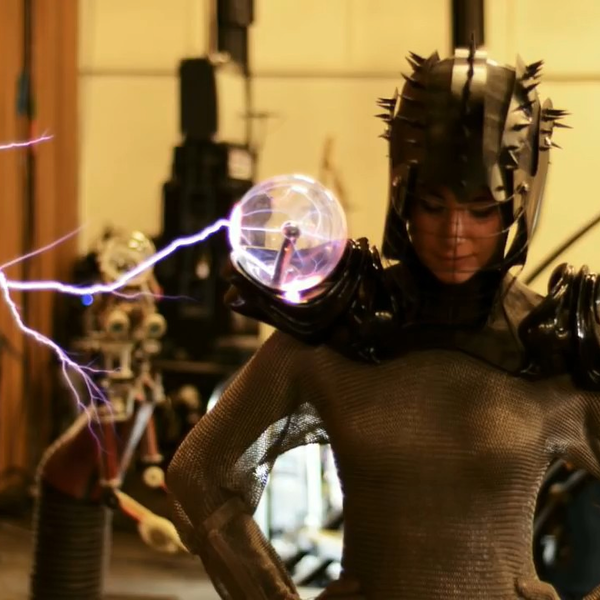
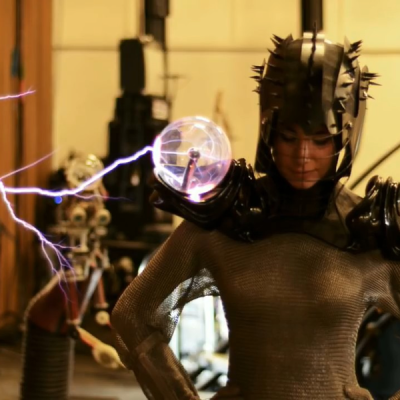
Anouk Wipprecht‘s hackerly interests are hard to summarize, so bear with us. She works primarily on technological dresses, making fashion with themes inspired by nature, but making it interactive. If that sounds a little bit vague, consider that she’s made over 40 pieces of clothing, from a spider dress that attacks when someone enters your personal space too quickly to a suit with plasma balls that lets her get hit by Arc Attack’s giant musical Tesla coils in style. She gave an inspiring talk at the 2017 Hackaday Superconference, embedded below, that you should really go watch.

Anouk has some neat insights about how the world of fashion and technology interact. Technology, and her series of spider dresses in particular, tends to evolve over related versions, while fashion tends to seek the brand-new and the now. Managing these two impulses can’t be easy.

For instance, her first spider was made with servos and laser-cut acrylic, in a construction that probably seems familiar to most Hackaday readers. But hard edges, brittle plastic, and screws that work themselves slowly loose are no match for human-borne designs. Her most recent version is stunningly beautiful, made of 3D printed nylon for flexibility, and really nails the “bones of a human-spider hybrid” aesthetic that she’s going for.

The multiple iterations of her drink-dispensing “cocktail dress” (get it?!) show the same progression. We appreciate the simple, press-button-get-drink version that she designed for a fancy restaurant in Ibiza, but we really love the idea of being a human ice-breaker at parties that another version brings to the mix: to get a drink, you have to play “truth or dare” with questions randomly chosen and displayed on a screen on the wearer’s arm.

Playfulness runs through nearly everything that Anouk creates. She starts out with a “what if?” and runs with it. But she’s not just playing around. She’s also a very dedicated documenter of her projects, because she believes in paying the inspiration forward to the next generation. And her latest project does something really brilliant: merging fashion, technology, and medical diagnostics.

It’s a stripped-down EEG that kids with ADHD can wear around in their daily lives that triggers a camera when their brains get stimulated in particular ways. Instead of a full EEG that requires a child to have 30 gel electrodes installed, and which can only be run in a medical lab, stripping down the system allows the child to go about their normal life. This approach may collect limited data in comparison to the full setup, but since it’s collected under less intimidating circumstances, the little data that it does collect may be more “real”. This project is currently in progress, so we’ll just have to wait and see what comes out. We’re excited.

There’s so much more going on in Anouk’s presentation, but don’t take our word for it. Go watch Anouk’s talk right now and you’ll find she inspires you to adds a little bit more of the human element into your projects. Be playful, awkward, or experimental. But above all, be awesome!

Continue reading “Anouk Wipprecht: Robotic Dresses And Human Interfaces” →

Joan Feynman Found Her Place In The Sun

Google ‘Joan Feynman’ and you can feel the search behemoth consider asking for clarification. Did you mean: Richard Feynman? Image search is even more biased toward Richard. After maybe seven pictures of Joan, there’s an endless scroll of Richard alone, Richard playing the bongos, Richard with Arline, the love of his life.

Yes, Joan was overshadowed by her older brother, but what physicist of the era wasn’t? Richard didn’t do it on purpose. In fact, no one supported Joan’s scientific dreams more than he did, not even their mother. Before Richard ever illuminated the world with his brilliance, he shined a light on his little sister, Joan.

Continue reading “Joan Feynman Found Her Place In The Sun” →

The Database Of The Time Lords

Time zones have been a necessity since humans could travel faster than a horse, but with computers, interconnected over a vast hive of information, a larger problem has emerged. How do you keep track of time zones? Moreover, how do you keep track of time zones throughout history?

Quick question. If it’s noon in Boston, what time is it in Phoenix? Well, Boston is in the Eastern time zone, there’s the Central time zone, and Phoenix is in the Mountain time zone; noon, eleven, ten. If it’s noon in Boston, it’s ten o’clock AM in Phoenix. Here’s a slightly harder question: if it’s noon in Boston, what time is it in Phoenix during Daylight Savings Time? Most of Arizona doesn’t observe Daylight Savings Time, so if it’s noon in Boston, it’s 9 AM in Phoenix. What about the Navajo Nation in the northwestern part of Arizona? Here, Daylight Savings Time is observed. You can’t even make a rule that all of Arizona is always on Mountain Standard Time.

Indiana is another example of bizarre time zones. For most of the 20th century, Indiana was firmly in the Central time zone. Starting in the 1960s, the line between Eastern and Central time slowly moved west from the Ohio border. Some countries opted not to observe Daylight Savings Time. In 2006, the entire state started to observe DST, but the northwest and southwest corners of the state remained firmly in the Central time zone. The odd geographic boundaries of time zones aren’t limited to the United States, either; Broken Hill, New South Wales, Australia is thirty minutes behind the rest of New South Wales.

Working out reliable answers to all of these questions is the domain of the Time Zone Database, a catalog of every time zone, time zone change, and every strange time-related political argument. It records Alaska’s transition from the Julian to the Gregorian calendar. It describes an argument in a small Michigan town in 1900. It’s used in Java, nearly every kind of Linux, hundreds of software packages, and at least a dozen of the servers and routers you’re using to read this right now.

Continue reading “The Database Of The Time Lords” →