Fix-a-Brick: Fighting The Nexus 5X Bootloop

Oh Nexus 5X, how could you? I found my beloved device was holding my files hostage having succumbed to the dreaded bootloop. But hey, we’re hackers, right? I’ve got this.

It was a long, quiet Friday afternoon when I noticed my Nexus 5X was asking to install yet another update. Usually I leave these things for a few days before eventually giving in, but at some point I must have accidentally clicked to accept the update. Later that day I found my phone mid-way through the update and figured I’d just wait it out. No dice — an hour later, my phone was off. Powering up led to it repeatedly falling back to the “Google” screen; the dreaded bootloop.

Stages of Grief

I kept my phone on me for the rest of the night’s jubilant activities, playing with it from time to time, but alas, nothing would make it budge. The problem was, my Nexus still had a full day’s video shoot locked away on its internal flash that I needed rather badly. I had to fix the phone, at least long enough to recover my files. This is the story of my attempt to debrick my Nexus 5X.

Continue reading “Fix-a-Brick: Fighting The Nexus 5X Bootloop”

Light-Painting Robot Turns Any Floor Into Art

Is [SpongeBob SquarePants] art? Opinions will differ, but there’s little doubt about how cool it is to render a pixel-mapped time-lapse portrait of Bikini Bottom’s most famous native son with a roving light painting robot.

Inspired by the recent trend of long exposure pictures of light-adorned Roombas in darkened rooms, [Hacker House] decided to go one step beyond and make a lighted robot with less random navigational tendencies. A 3D-printed frame and wheels carries a pair of steppers and a Raspberry Pi. An 8×8 Neopixel matrix on top provides the light. The software is capable of rendering both simple vector images and rastering across a large surface to produce full-color images. You’ll notice the careful coordination between movement and light in the video below, as well as the impressive turn-on-a-dime performance of the rover, both of which make the images produced so precise.

We’ve covered a lot of light-painting videos before, including jiggering a 3D-printer and using a hanging plotter to paint. But we haven’t seen a light-painter with an essentially unlimited canvas before. We’d also love to see what two or more of these little fellows could accomplish working together.

Continue reading “Light-Painting Robot Turns Any Floor Into Art”

Zelda And The Ocarina Of Things

Voice recognition is this year’s model for home automation, but aside from feeling like you’re onboard the Aries 1b arguing with HAL 9000, it just doesn’t do it for our geeky selves. So what’s even geekier? How about carrying around an ocarina in your pocket so that you can get a Raspberry Pi to unlock the door for you? (YouTube video, embedded below.) Yeah, that’ll do.

[Sufficiently Advanced]’s video gets us 90% of the way toward replicating this build. There’s a tube with a microphone and a Raspberry Pi inside. There are a bunch of ESP8266-powered gadgets scattered around the house that take care of such things as turning on and off the heater, watering plants, and even pressing a (spare) car remote with a servo.

We’d love to know what pitch- or song-recognition software the Raspberry Pi is running. We’ve wanted to implement a whistling-based home automation interface since seeing the whistled. We can hold a tune just fine, but we don’t always start out on the same exact pitch, which is a degree of freedom that [Sufficiently Advanced]’s system doesn’t have to worry about, assuming it only responds to one ocarina.

If you’re questioning the security of locking and unlocking your actual apartment by playing “Zelda’s Lullaby” from outside your window, you either overestimate the common thief or you just don’t get the joke. The use case of calling (and hopefully finding) a cell phone is reason enough for us to carry a bulky ocarina around everywhere we go!

Continue reading “Zelda And The Ocarina Of Things”

Hanging 3D Printer Uses Entire Room As Print Bed

There are many things people do with spare rooms. Some make guest rooms, others make baby rooms, while a few even make craft rooms. What do hackers do with spare rooms? Turn them into giant 3D printers of course. [Torbjørn Ludvigsen] is a physics major out of Umea University in Sweden, and built the Hangprinter for only $250 in parts. It follows the RepRap tradition of being completely open source and made mostly from parts that it can print.

The printer is fully functional, proven by printing a five-foot tall model of the Tower of Babel. [Torbjorn] hopes to improve the printer to allow it to print pieces of furniture and other larger household items.

[Torbjorn] hopes that 3D printing will not go down the same road that 2D printing went, where the printers are designed to break after so many prints. Open source is the key to stopping such machines from getting out there.

Thanks to [Jeremy Southard] for the tip!

Continue reading “Hanging 3D Printer Uses Entire Room As Print Bed”

2017 Hackaday Prize Begins Right Now

Today the 2017 Hackaday Prize begins!

This is Hackaday’s global engineering initiative that encourages people to direct their skill and energy to make the world a better place. We call it the Hackaday Prize, but it’s far more than that. Join a community of talented people who enrich their own lives by seeking out new challenges and new technologies, then pioneers a way to combine them to Build Something that Matters. Show us your build by starting a Hackaday.io project page and enter today!

You Have Every Reason to Get Involved

The Hackaday Prize truly has something for everyone. Making the world a better place doesn’t end with a grand prize for a single build. Just by talking about your ideas and sharing your excitement you become the inspiration for this and every successive generation of problem solvers. But yes, there are prizes — a lot of prizes — and they’re spectacular.

We have over $250,000 in cash going out to hundreds of entries this year. The Grand Prize of $50,000 is joined once again this year by the Best Product Prize of $30,000. Four other entries will place second through fifth and receive $20k, $15k, $10k, and $5k respectively.

But the breadth of entries is too great to stop at that. We’ll select 120 projects as finalists and award each $1000. You can even get in on Seed Funding starting right away. We’re saving those details for the end of this announcement.

How Do I Build Something that Matters?

Whoa, all this talk of prizes, but you want to know what kind of hardware will be a hit for the Hackaday Prize? Here’s what you need to know: you can enter your project at any time from now until October 16th. But the exact time that you enter matters.

Your best bet is to get started right away. The first challenge of the Hackaday Prize is: Design Your Concept. Every great build starts with a plan and this is the time to show us what you got. The key is to consider if the project benefits society in some way. Show us how, document your build plan, and you can be one of the first twenty finalists to receive $1k cash and move on to compete for the big prizes.

We’ll have four more challenges that focus on different types of entries. You only need to enter one challenge, but you may choose to enter (and win) as many of the five challenges as you wish. We’ll be looking for connected devices that don’t suck Internet of Useful Things during the IuT ! IoT challenge. After that, it’s on to all things mobile with the Wheels, Wings, and Walkers challenge. Assistive Technology challenges you to make the world a better place for the physically or mentally challenged and aging or sick people of the world. And finally, a Hackaday favorite closes the challenge rounds with Anything Goes — as long as it clearly benefits society. Each of these five challenges will yield twenty finalists who receive $1000. That’s $100k!

The Return of Best Product

Two years ago we tried something new by adding the Best Product Prize to the mix and it was an enormous hit. We’re happy to be able to bring it back again this year.

There is a difficult path from a working prototype to a product ready for its audience. As hardware development is unlocked for an ever wider engineering community, we want to see the path made wider so that the journey becomes easier. Best Product is designed to do just that.

Any Hackaday Prize entry may also choose to compete and be named the Best Product (receiving much deserved recognition as well as the addition $30k prize). You need to submit your entry no later than July 24th, which includes full documentation of the project as well as a bill of materials used in the build. We’ll select twenty finalists (sending $1k to each) who will then need to deliver three working beta test units for the final judging round of the Best Product.

How Can We Pick the Top Entries?

One amazing part of the Hackaday Prize family are the world-renowned experts who donate their time and talent as Judges. They are just as eager as everyone else to see all of this creative energy focused on solving the problems facing our civilization.

Learn more about all of these amazing people on the Hackaday Prize page.

One Last Thing: Seed Funding

When realized to their full potential, design concepts should knock the socks off of anyone who reads through them. Because of this we have one more thing in store for you during the first challenge which starts right now.

Entries with the most likes at the end of the first round will split $4,000. Each time someone on Hackaday.io “likes” your project it will move a bit higher on the leaderboard found on the Hackaday Prize page. The top projects will receive $1 for each like, with a max of $200 per entry so that at least twenty will win (but likely many more).

This seed funding is a little push to help offset the cost of building prototypes. But it really comes down to your decision to make the time and to make a difference. Enter your project in the Hackaday Prize now.

Animated Picture Frame Needs Charging Once Per Month

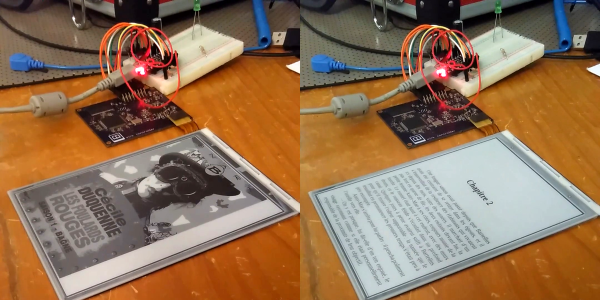
[Kyle Stewart-Frantz] took one look at a black and white photo of a mountain stream, and decided it was way too boring. How much cooler would it be if the water was moving! Like any good hacker worth his weight in 2N2222s, [Kyle] set out to make his idea a reality. After discovering some pricey options, he found a Kindle Paperwhite with a display that had decent resolution and 16 levels of grey. But would 16 levels be sufficient to produce an animation that’s pleasing to the eye?

After stumbling upon a community dedicated to hacking Kindles, [Kyle] got to work. Using a custom Amazon command called eips, he was able to access the display’s memory location and paint images to it. The next trick was to write a script that called the command multiple times to produce a GIF-like animation effect.  This… didn’t work so well. He then found some code from [GeekMaster] (thanks for the tip!) that ran a specialized video player on the Kindle that used something called ordered dithering. After a few more tweaks, he got everything working and the end result looks like something straight out of the world of Harry Potter.

The animated picture frame can run for three to four weeks between charges. This is a hack that would make a great gift and look nice in your office. If you make one, be sure to put the skull and wrenches on it first and let us know!

Continue reading “Animated Picture Frame Needs Charging Once Per Month”

Modern Wooden Houses With No Glue Or Nails

Depending where you are in the world, the techniques used to build houses can sometimes seem to be stuck in another century. Bricks and mortar, for instance, we build with them because we are used to them and have a large workforce of people trained to work with them and not much else. But in the 21st century with more advanced building technologies sitting relatively unused and looming housing crises at every turn, does it make sense to still build houses the slow and expensive way our great-grandparents did? Probably not.

Wooden houses are a promising solution to some of the problems outlined in the previous paragraph, and indeed in large parts of the world wood is the housing material of choice. It’s eco-friendly, not too expensive, and can be applied easily to multiple different types of structure. If you think of a wooden house, does the image of a log cabin come to mind, or perhaps a weatherboard house? Both construction methods that would be familiar again to your great-grandparents, so perhaps you might not call it an advanced building technology.

It’s interesting then to see an innovation from France, a system of interlocking wood sections that can be built into walls that look very similar to brick (Here’s the French language original). These are short sections of board cleverly designed with dovetailing to engage with vertical sections that interlock between different courses and leave a gap between wooden inner and outer faces of the wall that can be filled with insulation material. The effect is to create a wooden building system that can produce a vast range of structures that can be assembled in a very short time indeed. This isn’t prefabricated housing, but it delivers the speed you’d expect from it.

They have a video shoving construction of a typical house in rather idyllic French countryside, which we’ve put below the break. It has French language annotations, however for non Français speakers the context is pretty obvious.

Continue reading “Modern Wooden Houses With No Glue Or Nails”