Raspberry Pi Laptop Uses The Official Touchscreen

We’ve seen a variety of home-made laptops using the Raspberry Pi and other single board computers over the years. Usually, they combine off-the-shelf USB keyboards and trackpads with HDMI monitor panels, and cases made from layered laser cut sheet, or 3D printed plastic.

[Surferboy]’s Raspberry Pi laptop is the latest effort to come before us, and its claim to fame is the use of the official Raspberry Pi 7″ touchscreen as a display. Full instructions and 3D printer files are available on Thingiverse so you can have a go at replicating it if a portable Pi is your thing.

He’s taken the bold step of not attempting to place all the Pi’s interfaces next to the outside of the case. Instead, he’s desoldered the Ethernet and USB ports. The USB connections were wired directly to the keyboard, display, and a couple of external ports on the right-hand side of his case. This leaves the finished laptop with no Ethernet. However, losing ethernet is a worthy tradeoff for the thinner package.

[Surferboy] also brought the GPIO header to a female socket on the rear of the unit. It’s unclear exactly what battery he uses except for a reference to the battery from his keyboard. Since a keyboard battery will be too small for Pi and display we are guessing a larger pack will be necessary.

Though the Ethernet port and battery issue would probably be a dealbreaker here this has the makings of a useful and compact laptop, it will be interesting to see if it is picked up and refined by the community.

Quite a few early Pi laptops used the Motorola Lapdock, a mobile-phone-into-netbook peripheral. Some others we’ve featured have been a bit chunky, but sometimes they can be objects of beauty.

Via Recantha.co.uk.
Nexus 5X Phone Resurrected By The Oven

Warranty shmarranty — toss the phone in the oven! There’s apparently a problem with the assembly of the Nexus 5X smartphones, and it looks like it is due to faulty BGA chip soldering. LG USA has had enough problems with the phone that they may not even have enough parts or new units to fix it, so they’re offering a refund. But we all know how it is to get attached to a device, right?

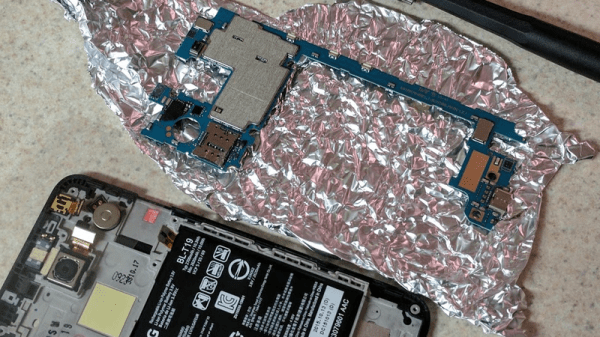
So [Alex] disassembled his beloved phone, pulled out the board in question, and gave it the XBox Red Ring Of Death treatment. He placed the board on some insulating aluminum foil, and baked it for six and a half minutes. Season with lemon and pepper, and serve! We’re honestly surprised that sticking the affected board into the oven at 195° C / 390° F for a few minutes would work at all. Isn’t that a low temperature for soldering, especially with a lead-free mix? Could it have been a problem with humidity after all? Continue reading “Nexus 5X Phone Resurrected By The Oven”

Ping Pong Ball Improves The Google Daydream Controller

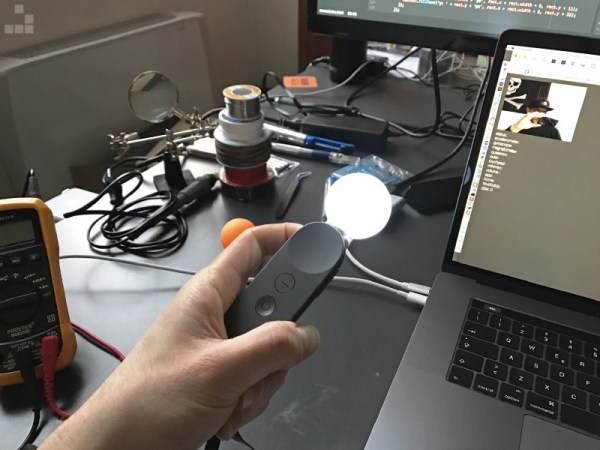
[Matteo] has just released a new installment of his Google Daydream VR controller hack, which we first covered last year (when he got it working with iOS). This time around he’s managed to forge a half Daydream, half PlayStation Move controller hybrid.

The original controller only managed a mere 3 DOF (Degrees of Freedom) using the internal accelerometer; although this conveyed rotational motion around the 3 axis, transitional information was completely lacking. [Matteo] resolves this by forming a simple positional marker out of a white LED enclosed in a standard ping pong ball; He tracks this setup using an iSight camera.

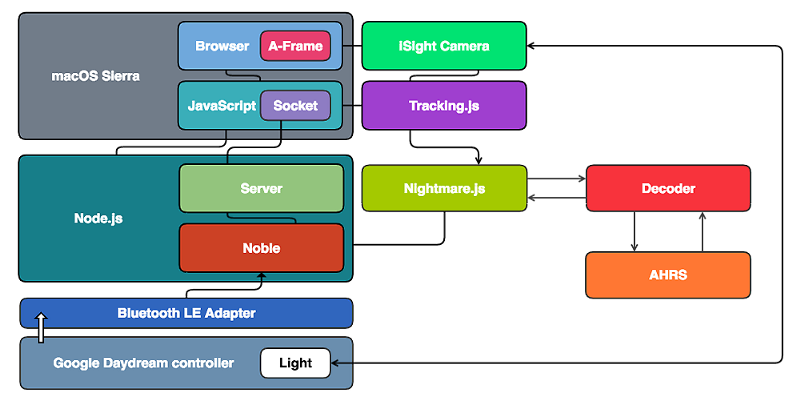
To gel everything together, he adds motion tracking to his already extensively developed software stack, which enables him to unshackle the Daydream controller from Android. He deciphers the Bluetooth packets and streams the sensory information straight to a web browser over a webSocket connection.

sf-stack

The results are quite impressive and the tracking is smooth. Not only does this add to the final goal of hacking his way towards a platform independent VR motion controller, he aptly gets some inspiration from Sony, extends Google’s hardware and even manages to use Apple’s webcam along the way. How’s that for carving passages between the walled gardens of consumer electronics?

Continue reading “Ping Pong Ball Improves The Google Daydream Controller”

Good In A Pinch: The Physics Of Crimped Connections

I had a friend who was an electronics assembly tech for a big defense contractor. He was a production floor guy who had a chip on his shoulder for the engineers with their fancy book-learnin’ who couldn’t figure out the simplest problems. He claimed that one assembly wasn’t passing QC and a bunch of the guys in ties couldn’t figure it out. He sidled up to assess the situation and delivered his two-word diagnosis: “Bad crimp.” The dodgy connector was re-worked and the assembly passed, much to the chagrin of the guys in the short-sleeved shirts.

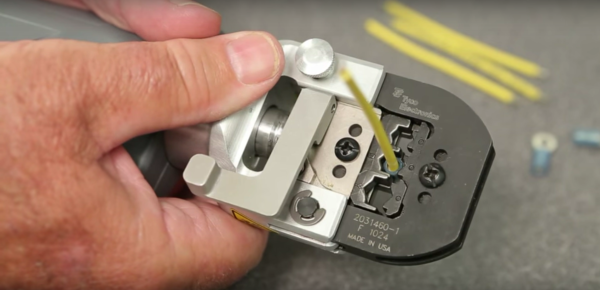
Aside from the object lesson in experience sometimes trumping education, I always wondered about that “bad crimp” proclamation. What could go wrong with a crimp to so subtly futz with a circuit that engineers were baffled? How is it that we can rely on such a simple technology to wire up so much of the modern world? What exactly is going on inside a crimped connection anyway?

Continue reading “Good In A Pinch: The Physics Of Crimped Connections”

The SmallSat Launcher War

Over the last decade or so the definition of what a ‘small satellite’ is has ballooned beyond the original cubesat design specification to satellites of 50 or 100 kg. Today a ‘smallsat’ is defined far more around the cost, and sometimes the technologies used, than the size and shape of the box that goes into orbit.

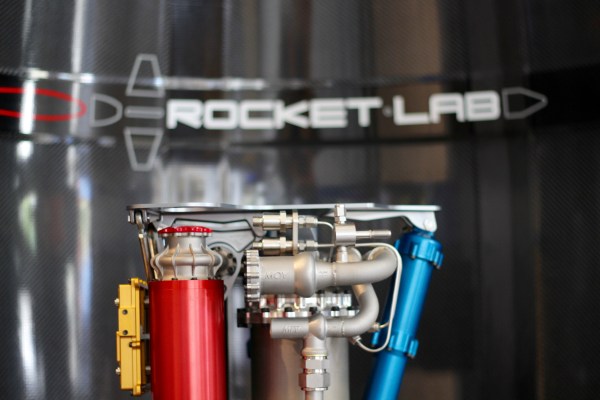
There are now more than fifty companies working on launch vehicles dedicated to lifting these small satellites into orbit, and while nobody really expects all of those to survive the next few years, it’s going to be an interesting time in the launcher market. Because I have a sneaking suspicion that Jeff Bezos’ statement that “there’s not that much interesting about cubesats” may well turn out to be the twenty first century’s “nobody needs more than 640kb,” and it’s possible that everybody is wrong about how many of the launcher companies will survive in the long term.

Continue reading “The SmallSat Launcher War”

Santos Dumont And The Origins Of Aviation

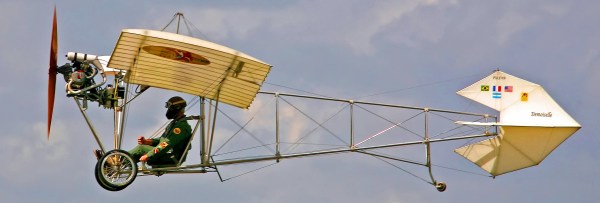
The history of aviation is a fascinating one, spanning more than two thousand years starting from kites and tower jumping. Many hackers are also aviation fans, and the name of Alberto Santos Dumont may be familiar, but if not, here we talk about his role and accomplishments in the field. Santos Dumont is one of the few aviation pioneers that made contributions in both balloons, airships and heavier-than-air aircraft.

Continue reading “Santos Dumont And The Origins Of Aviation”

AI Beats Poker Pros: Skynet Looms

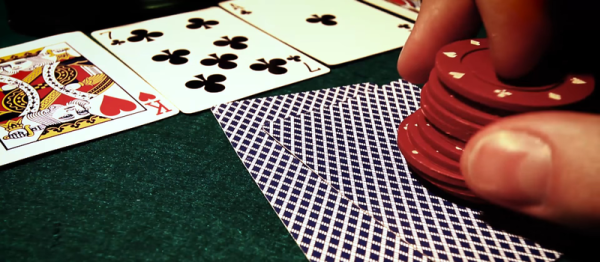
There have been a few “firsts” in AI-versus-human gaming lately, and the computers are now beating us at trivia, chess and Go. But in some sense, none of these are really interesting; they’re all games of fact. Poker is different. Aside from computing the odds of holding the winning hand, where a computer would obviously have an advantage, the key to winning in poker is bluffing, and figuring out when your opponent is bluffing. Until recently, this has helped man beat the machine. Those days are over.

Chess and Go are what a game theorist would call games of perfect information: everyone knows everything about the state of the game just from looking at the board, and this means that there is, in principle, a best strategy (series of moves) for every possible position. Granted, it’s hard to figure these out because it’s a big brute-force problem, but it’s still a brute-force problem where computers have an innate advantage. Chess and Go are games where the machines should be winning.  Continue reading “AI Beats Poker Pros: Skynet Looms”