LED Matrix Shades You Can Actually See Though

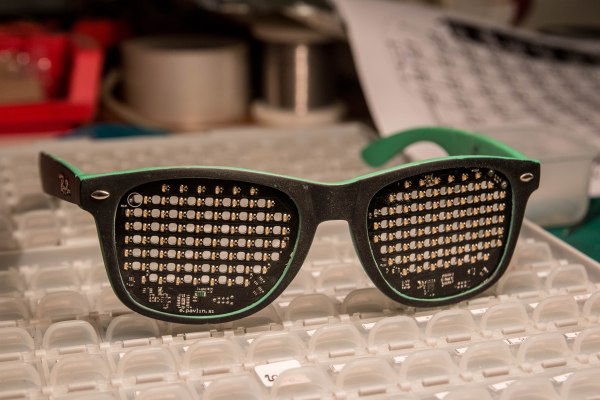
[Gal Pavlin] admits to enjoying the occasional dance music show. For those who have never been to one, LED one-upmanship at these shows is a real and terrible thing, so much so that an entire market exists around it. To that end, [Gal] built a pretty spiffy set of LED glasses.

It took quite a bit of work to arrive at the final design. All the circuitry and LEDs fit entirely within the envelope of the lenses on a pair of sunglass frames of dubious parentage. The batteries squeeze in between the user’s head and temples.

On top of the clever packaging is an equally impressive set of features. Each lens is a matrix of 69 LEDs. They have an accelerometer, a microphone, and a light sensor. There’s even a vibrating alert motor, which we feel is just showing off.  Best of all, you can actually see through the glasses, thanks to clever layout and very tiny LEDs.

The device requires a tag connect or soldering on a pigtail to program. If you’d like to build one yourself all the files are available on [Gavin]’s site. There’s a video of it in operation after the break.

Continue reading “LED Matrix Shades You Can Actually See Though”

SSH Enters The Mosh Pit

With so many systems depending on Linux, the secure shell SSH has become a staple for many developers. If you are connected to your Raspberry Pi via a cable or a wireless router a few feet away, SSH can provide you with an encrypted connection straight to the box. However, if you have a system out in a swamp somewhere with intermittent slow network access, SSH can be a real pain. When your IP address can change (for example, roaming on a cellular network), SSH has problems, too.

To combat these and other problems, you might consider an open source program called Mosh (mobile shell). There’s two parts to Mosh. One part works as a server while the other is the client application. Neither of these require root access. You can see a video about Mosh below.

Continue reading “SSH Enters The Mosh Pit”

Hams In Space Part 2: The Manned Spaceflights

Whether it’s trying to make contacts across the planet with a transmitter that would have a hard time lighting an LED, or blasting signals into space and bouncing them off the moon, amateur radio operators have always been on the forefront of communications technology. As mankind took to space in the 1950s and 1960s, hams went along for the ride with the first private satellites. But as successful as the OSCAR satellites were, they were still at best only beacons or repeaters in space. What was needed was the human touch – a real live operator making contacts with people on the ground, showing the capabilities of amateur radio while generating public interest in the space program. What was needed was a ham in space. Continue reading “Hams In Space Part 2: The Manned Spaceflights”

SpeedyCopter driving on the road

Vietnam War Helicopter Turned Amphibious Racecar

Our hats off to [SpeedyCop] and his [Gang of Outlaws] for turning a junked former Vietnam War helicopter into both an amphibious vehicle and a road race car. Yes, that’s right. It’s both driven on water and raced in the 24 Hours of LeMons at New Jersey Motorsports Park.

It started life as a 1969 Bell OH-58 Kiowa (US Army Vietnam Assault helo) and had not only served in Vietnam but also for a federal drug task force. It was chopped up for parts and the body found its way to [SpeedyCop] and friends. The body now sits on an 80s Toyota van chassis, has a Mazda Miata rear suspension, and Audi 3.0 V6 engine.

The pontoons were originally added to hide the seam between the helicopter body and the van but they then inspired the idea of making it amphibious. And with the addition of a four-blade, 7000 RPM propeller from a parasail boat, the idea became reality, as you can see in the video after the break (we suspect the trailing line is a rope to pull it back to shore in case of engine failure).

Continue reading “Vietnam War Helicopter Turned Amphibious Racecar”

Put That Amateur Radio License To Use On 915 MHz

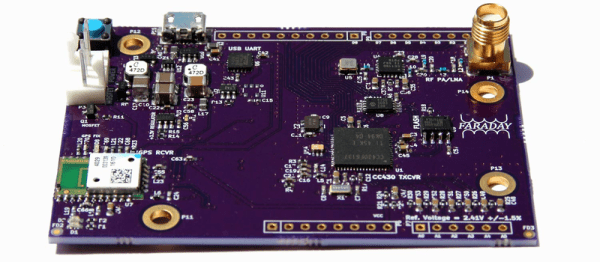
Amateur radio enthusiasts in the US will be interested in Faraday, an open-source digital radio that runs on 915 MHz, which amateur radio enthusiasts may know better as the 33 cm band.

You can transmit on 915 MHz without a license (in the US), taking advantage of the Industrial, Scientific, and Medical (ISM) exemption. This means that there’s commodity hardware available for sending and receiving, which is a plus. But you can’t do so with any real power unless you have an amateur radio license. And that’s what makes Faraday interesting — it makes it very easy to transmit and receive digital data, with decent power and range, if you’re licensed. The band is currently under-utilized, so go nuts!

The hardware design and documentation is online, and so is the firmware. The founders of the project would like you to build out a big network of these devices, possibly meshing them together. Our only regret is that the 33 cm band is only really open for use in the US, both with a license and without. Of course, there’s very little the Faraday team can do about that.

We’re no strangers to digital-mode amateur radio around here. But if you’re an amateur who hasn’t played around with digital modes yet, this might be a good way to get your feet wet.

Thanks to [Daniel] for the tip!

The Lotus Sevens: The Real Most-Hackable Cars

In the late 1940s and early 1950s, Europe was still struggling to recover from the crippling after-effects of war. In Britain it is referred to as the “austerity period”, with food still rationed and in which “make do and mend” was very much the order of the day. The consumer boom of the late 1950s and 1960s was very far in the future, and if you were a hardware hacker your source materials were limited to whatever you could find from war surplus or whatever prewar junk might come your way. This was a time in which the majority of adults had recently returned from war service, during which they had acquired practical skills through the necessities of battle that they sought an outlet for in peacetime.

One field that benefited from this unexpected flowering of creativity was that of motor racing. Before the war it had been an exclusive pursuit, with bespoke cars at famous circuits like the banked track at Brooklands, in Surrey. In a reflection of the wider social changes that followed the war the motor racers of the post-war years came from humbler backgrounds, they raced homemade specials made from tired-out prewar motors on wartime airfield perimeter tracks like the one at Silverstone which still hosts Formula One racing today.

Continue reading “The Lotus Sevens: The Real Most-Hackable Cars”

Apple Sucks Now, Here’s A ThinkPad Buyer’s Guide

For the last decade, Macs have been running a UNIX-ish operating system on x86 processors. They’ve been fantastic developer’s machines, and the MacBook Pro is the de facto standard laptop issued to all developers, all hackathon attendees, and arguably, anyone who does real work with a computer.

This week, Apple unveiled the latest MacBook Pro and provided more evidence Steve Jobs actually knew what he was doing. Fifteen hundred bones will get you a MacBook Pro with a last-gen processor, an Escape key, a headphone jack, and two Thunderbolt 3 ports (with one port required for charging). The next model up costs $1800, ditches the Escape key for a dedicated emoji bar, and includes four Thunderbolt 3 ports.

In the past, I have defended people who choose MacBooks as their laptop of choice. A MacBook is a business-class laptop, and of course carries a higher price tag. However, Apple’s latest hardware release was underwhelming and overpriced. If you’re looking for a new laptop, you would do well to consider other brands. To that end, here’s a buyer’s guide to ThinkPads, currently the second most popular laptop I’ve seen with the dev/hacker/code cracker crowd.

Continue reading “Apple Sucks Now, Here’s A ThinkPad Buyer’s Guide”