From Project To Kit: Instructions Are Everything

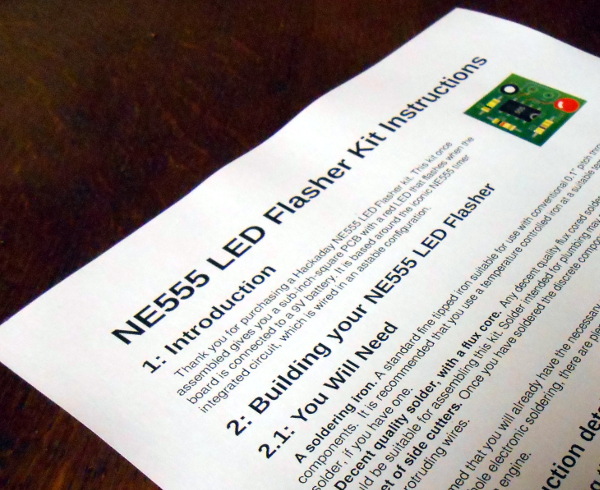
A printed copy of the instructions for our example kit

We’ve had two previous articles in this series on turning a personal electronic project into a saleable kit, in which we’ve examined the kit market in a broader context for a new entrant, and gone on to take a look at the process of assembling the hardware required to create a product. We’ve used an NE555 LED flasher as a simple example , from which we’ve gone through the exercise of setting a cost of production and therefore a retail price.

The remaining task required to complete our kit production is to write the documentation that will accompany it. These will be the instructions from which your customers will build the kit, and their success and any other customers they may send your way will hang on their quality. So many otherwise flawless kits get this part of the offering so wrong, so for a kit manufacturer it represents an easy win into which to put some effort.
Continue reading “From Project To Kit: Instructions Are Everything”

Tattoos By Robotic Arm With Pinpoint Accuracy

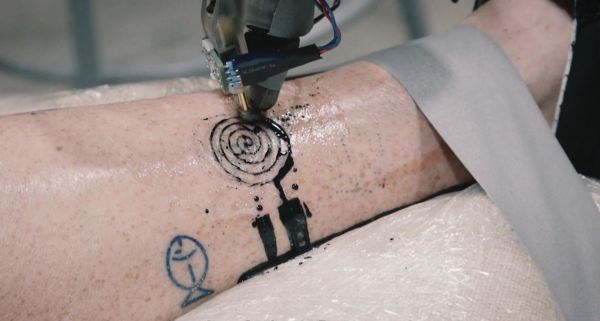
Tattoos are an ancient art, and as with most art, is usually the domain of human expertise. The delicate touch required takes years to master, but with the capacity for perfect accuracy and precision movements, enlisting a robotic arm and some clever software to tattoo a willing canvas is one step closer thanks to the efforts of [Pierre Emm] and [Johan da Silveira].

They began by using a 3D printer modified to ‘print’ with a tattoo needle. Catching the interest of the Applied Research Lab at Autodesk, the next logical step was to use an industrial robot arm get a human under the tattooing machine — dubbed Tatoué — after scanning the limb in question and loading it into Dynamo, their parametric design environment to map the design onto the virtual limb.

Continue reading “Tattoos By Robotic Arm With Pinpoint Accuracy”

Pimoroni Wash Their Hands Of Arduino

One of the big stories of last year was the fracture of the official Arduino supply into two competing organisations at daggers drawn, each headed by a different faction with its origins in the team that gave us the popular single board computers. Since then we’ve had Arduinos from Arduino LLC (the [Massimo] Arduino.cc, arguably the ‘original’, and Arduino trademark holder in the United States) and Arduino SRL (the [Musto] Arduino.org, and owner of the Arduino trademark everywhere except the US) , two websites, two forks of the IDE, and “real” Arduino boards available under a couple of names depending on where in the world you live due to a flurry of legal manoeuvres. Yes. it’s confusing.

Today came news of a supplier throwing its hands up in despair  at the demands imposed on them as part of this debacle. Pimoroni, famous as supplier of Raspberry Pi goodies, has put up a blog post explaining why they will henceforth no longer be selling Arduinos. They took the side of Arduino LLC, and the blog post details their extensive trials and delays in making contact with the company before eventually being told they would have to agree to purchase substantial stocks both Arduino and Genuino branded versions of identical products and agree to sell them through separate supply channels for both Europe and the rest of the world before they could proceed. This is not a practical proposition for a small company, and the Pimoroni people deliver a very pithy explanation of exactly why towards the bottom of their post.

We’ve covered the Arduino versus Arduino debacle extensively in the past, this is simply the latest in a long line of stories. Pimoroni have hit the nail on the head when they make the point that the customers and suppliers really don’t care about spats between the various inheritors of the Arduino legacy, they just want an Arduino. And with so many other Arduino-compatible boards available they don’t have to look very hard to find one if the right shade of blue solder-resist or the shape of the map of Italy on the back isn’t a special concern. Can we be the only ones wishing something like this might knock a bit of sense into the various parties?


Tearing Into Delta Sigma ADCs Part 2

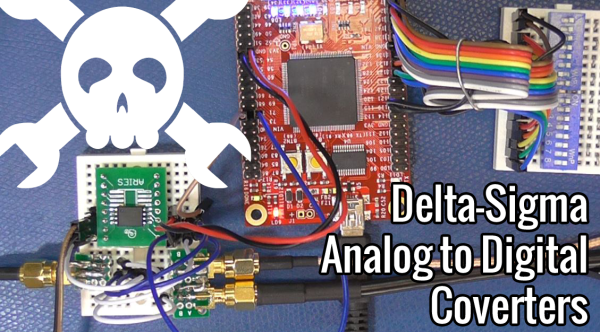
In part one, I compared the different Analog to Digital Converters (ADC) and the roles and properties of Delta Sigma ADC’s. I covered a lot of the theory behind these devices, so in this installment, I set out to find a design or two that would help me demonstrate the important points like oversampling, noise shaping and the relationship between the signal-to-noise ratio and resolution.

Modulator Implementation

modulatorCheck out part one to see the block diagrams of what what got us to here. The schematics shown below are of a couple of implementations that I played with depicting a single-order and a dual-order Delta Sigma modulators.

schematicBasically I used a clock enabled, high speed comparator, with two polarities in case I got it the logic backwards in my current state of burn out to grey matter ratio. The video includes the actual schematic used.

Since I wasn’t designing for production I accepted the need for three voltages since my bench supply was capable of providing them and this widget is destined for the drawer with the other widgets made for just a few minutes of video time anyway. Continue reading “Tearing Into Delta Sigma ADCs Part 2”

The First Evil Maid-Proof Computer

It doesn’t matter how many bits your password has, how proven your encryption is, or how many TrueCrypt volumes are on your computer. If someone wants data off your device, they can get it if they have physical access to your device. This is the ‘evil maid’ security scenario, named after hotel maids on the payroll of a three-letter agency. If someone has physical access to a laptop – even for an hour or two – the data on that laptop can be considered compromised. Until now, there has been no counter to this Evil Maid scenario, and for good reason. Preventing access to data even when it is in the possession of an Evil Maid is a very, very hard problem.

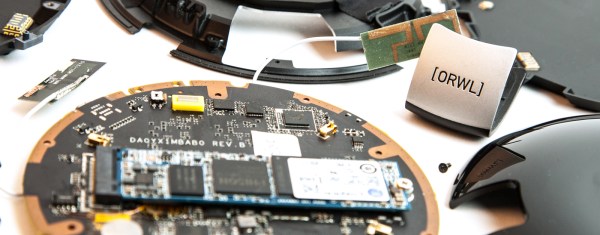
Today, Design Shift has released ORWL (as in George Orwell), the first computer designed with physical security in mind. This tiny disc of a computer is designed to defeat an Evil Maid through some very clever engineering on top of encryption tools we already use.
Continue reading “The First Evil Maid-Proof Computer”

Yak Shaving: Hacker Mode Vs Maker Mode

When I start up a new project, one that’s going to be worth writing up later on, I find it’s useful to get myself into the right mindset. I’m not a big planner like some people are — sometimes I like to let the project find its own way. But there’s also the real risk of getting lost in the details unless I rein myself in a little bit. I’m not alone in this tendency, of course. In the geek world, this is known as “yak shaving“.

The phrase comes obliquely from a Ren and Stimpy episode, and refers to common phenomenon where to get one thing done you have to first solve another problem. The second problem, of course, involves solving a third, and so on. So through this (potentially long) chain of dependencies, what looks like shaving a yak is obliquely working on cracking some actually relevant problem.
Continue reading “Yak Shaving: Hacker Mode Vs Maker Mode”

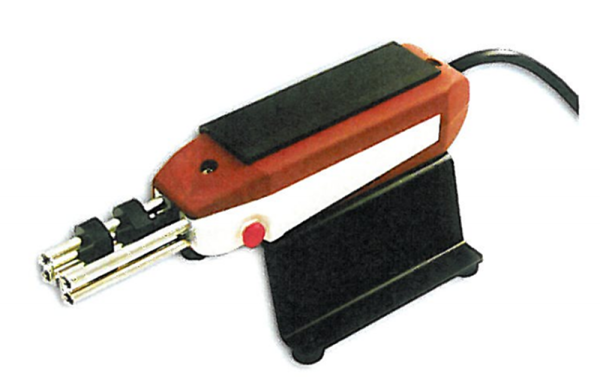
Hot Wire Strippers Are Probably The Best Tool You Aren’t Using

I wanted to point out a tool that I often use, but rarely see on other people’s workbenches: thermal strippers. They aren’t cheap, but once you’ve used them, it is hard to go back to stripping wires with an ordinary tool.

I know, I know. When I first heard of such a thing, I thought what you are probably thinking now: maybe for some exotic coated wire, but for regular wire, I just use a pair of diagonal cutters or a mechanical stripper or a razor blade. You can do that, of course, and for large solid wires, you can even get good results. But for handling any kind of wire, regardless of size, you just can’t beat a thermal stripper.

Continue reading “Hot Wire Strippers Are Probably The Best Tool You Aren’t Using”