A wild Python appeared, and it wants to play Pokemon Go. Python bots are taking over the game when you can’t, and they are good. Since you’re likely to bump into one sooner or later, here’s an overview:
One of the first workable bots and the origin of a lot of (dirty) code, as well as the (not dirty at all) Pokemon Trainer Club client secret, is [Mila432’s] Pokemon Go Bot. One of his initial goals was to make better sense of the API, which worked out better than he hoped.
Not wanting to impetuously destroy the numerous helpful applications that had been built upon the already partially known API, he decided to keep the project off Niantic’s radar. The most recent (and most powerful) version of his bot has not been released. The current version works fine within its limited functionality: Wandering around and looting Pokestops.
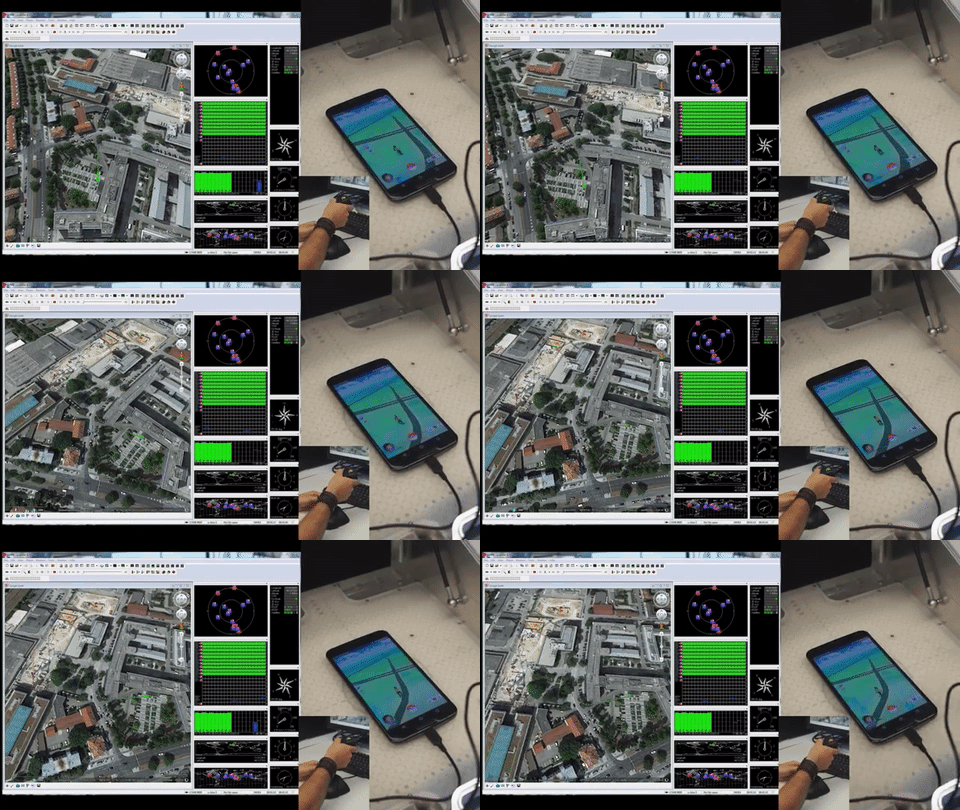
Since Pokemon Go blew up the world a couple of weeks ago we’ve been trying to catch ’em all. Not the Pokemon; we’ve been trying to collect all the hardware hacks, and in particular the most complete GPS spoofing hack. We are now ready to declare the first Grandmaster GPS spoofing hack for Pokemon Go. It broadcasts fake GPS signals to your phone allowing the player to “walk around” the real world using a gaming joystick.
Just about everything about this looks right to us. They’re transmitting radio signals and are doing the responsible thing by using an RF shield box that includes a GPS antenna. Hardware setup means popping the phone inside and hooking up the signal generator and GPS evaluation hardware. Google Earth then becomes the navigation interface — a joystick allows for live player movements, coordinates are converted to GPS signals which are transmitted inside of the box.
Now, we did say “just about right”. First off, that RF shielding box isn’t going to stop your fake GPS signals when you leave the lid open (done so they can get at the phone’s touchscreen). That can probably be forgiven for the prototype version, but it’s that accelerometer data that is a bigger question mark.
When we looked at the previous SDR-based RF spoofing and the Xcode GPS cheats for Pokemon Go there were a number of people leaving comments that Niantic, the devs responsible for Pokemon Go, will eventually realize you’re cheating because accelerometer data doesn’t match up to the amount of GPS movement going on. What do you think? Is this app sophisticated enough to pick up on this type of RF hacking?
The pioneering years in the history of capacitors was a time when capacitors were used primarily for gaining an early understanding of electricity, predating the discovery even of the electron. It was also a time for doing parlor demonstrations, such as having a line of people holding hands and discharging a capacitor through them. The modern era of capacitors begins in the late 1800s with the dawning of the age of the practical application of electricity, requiring reliable capacitors with specific properties.
Leyden Jars
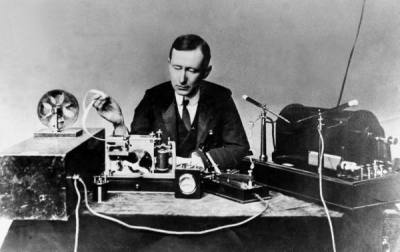
Marconi with transmitting apparatus, Published on LIFE [Public domain], via Wikimedia CommonsOne such practical use was in Marconi’s wireless spark-gap transmitters starting just before 1900 and into the first and second decade. The transmitters built up a high voltage for discharging across a spark gap and so used porcelain capacitors to withstand that voltage. High frequency was also required. These were basically Leyden jars and to get the required capacitances took a lot of space.
Mica
In 1909, William Dubilier invented smaller mica capacitors which were then used on the receiving side for the resonant circuits in wireless hardware.
Early mica capacitors were basically layers of mica and copper foils clamped together as what were called “clamped mica capacitors”. These capacitors weren’t very reliable though. Being just mica sheets pressed against metal foils, there were air gaps between the mica and foils. Those gap allowed for oxidation and corrosion, and meant that the distance between plates was subject to change, altering the capacitance.
In the 1920s silver mica capacitors were developed, ones where the mica is coated on both sides with the metal, eliminating the air gaps. With a thin metal coating instead of thicker foils, the capacitors could also be made smaller. These were very reliable. Of course we didn’t stop there. The modern era of capacitors has been marked by one breakthrough after another for a fascinating story. Let’s take a look.
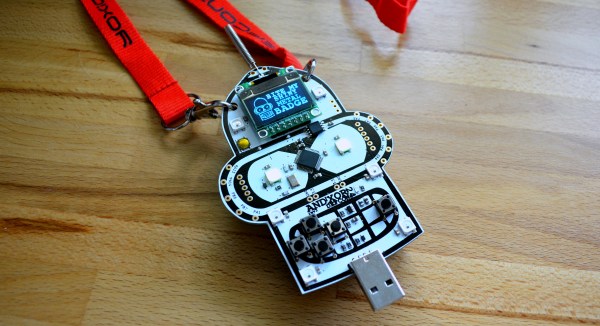
DEF CON 24 is still about two weeks away but we managed to get our hands on a hardware badge early. This is not the official hardware — there’s no way they’d let us leak that early. Although it may be unofficial in the sense that it won’t get you into the con, I’m declaring the AND!XOR badge to be officially awesome. I’ll walk you through it. There’s also a video below.
Over the past several years, building your own electronic badge has become an impromptu event. People who met at DEF CON and have been returning year after year spend the time in between coming up with great ideas and building as many badges as they can leading up to the event. This is how I met the trio who built this badge — AND!XOR, Andrew Riley, and Jorge Lacoste — last year they invited me up to their room where they were assembling the last of the Crypto Badges. Go check out my guide to 2015 Unofficial DEF CON badges for more on that story (and a video of the AM transmissions that badge was capable of).
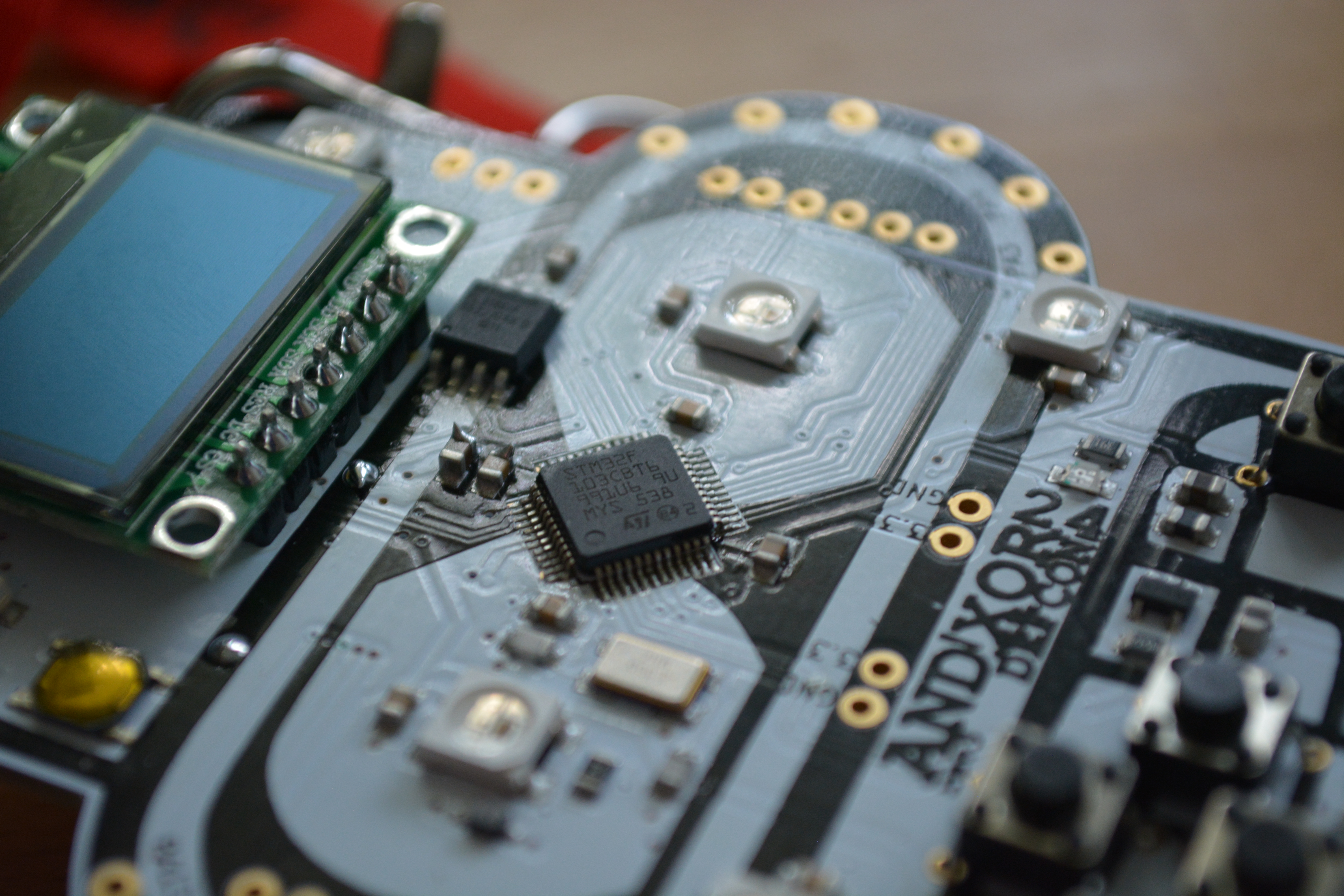
The outline is this year’s badge is of course Bender from Futurama. Both eyes are RGB LEDs, with another half dozen located at different points around his head. The microcontroller, an STM32F103 ARM Cortex-M0 Cortex-M3, sits in a diamond pattern between his eyes. Above the eyes you’ll find 16 Mbit of flash, a 128×64 OLED screen, and a reset button. The user inputs are five switches and the badge is powered by three AA batteries found on the flip side.
That alone makes an interesting piece of hardware, but the RFM69W module makes all of the badges interactive. The spring coming off the top of Bender’s dome is a coil antenna for the 433 MHz communications. I only have the one badge on hand so I couldn’t delve too deeply what interactive tricks a large pool of badges will perform, but the menu hints at a structure in place for some very fun and interesting applications.
Some of our more dedicated readers may remember me as that promising and talented new writer who disappeared after only a couple of months last fall. Or, alternatively, that moronic new writer who had no idea what he was talking about. But, I’m just going to go ahead and assume it was the former in order to protect my ego. In either case, if you remember me at all, you may have wondered why I left. Was it cholera? Was I drafted into a top-secret CIA program? Did I join a circus as a fledgling trapeze artist?
No, it was none of that. That would be absurd. What would make you think I had any trapeze skills at all, much less circus-worthy ones? The truth is a lot more straightforward, but was also a lot scarier (and more exciting) for me — I started a business. The astute readers among you have probably already put the dots together and figured out that I failed. The title was a pretty strong hint, right? This isn’t a story of bootstraps-pulling success, or a heartwarming underdog tale. This is an opportunity for me to talk about the lessons I learned as I failed, and to give the entrepreneurs out there something to consider when they start their businesses. We’ll laugh together, we’ll cry together, and maybe we’ll even learn something together. Ready? Alright, let’s dive right into the heart of it, starting when I was seven years old…
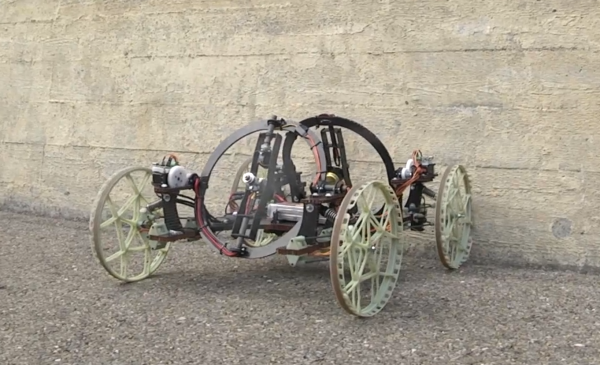
This collaboration between ETH and the Disney empire’s research arm is a ultra-light robot that can roll across horizontal surfaces and also transition and climb walls.
The robot has four wheels with one steerable set, but its secret sauce is the two propellers gimbaled on its back. Using these propellers it can move itself across the ground, but also, when approaching a wall, provide enough thrust to overcome the gravity vector.
Naturally, the lighter the robot, the less force will be needed to keep it on the wall. That’s why the frame is made from carbon fiber corrugated sandwich panels. The motors, batteries, and controllers are all also light and small.
We liked how the robot was, apparently, using its propellers to provide additional stability even while on the ground. There is a video after the break, and more information can also be found on the Disney Research webpage.
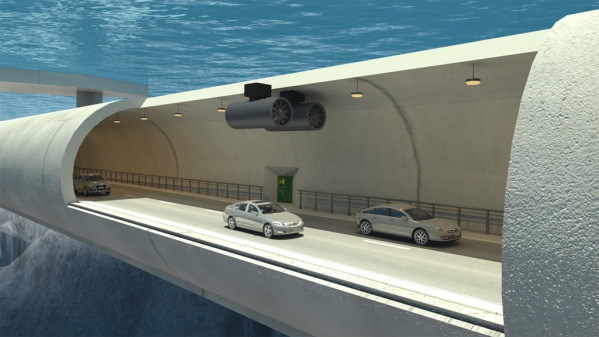
The gist of the idea is to suspend an underwater tunnel from floating pontoons. By the time you finished reading that sentence, you probably already had a list of things in your head that seem to make this a terrible idea. After all, it does seem to combine the worst aspects of both underwater tunnels and bridges. But, the idea may actually be a good one, and it’s already being seriously considered in Norway.