Bunnie And Snowden Explore IPhone’s Hackability

[Bunnie Huang] and [Edward Snowden] have teamed up to publish a paper exploring the possibility of introspection on the iPhone.
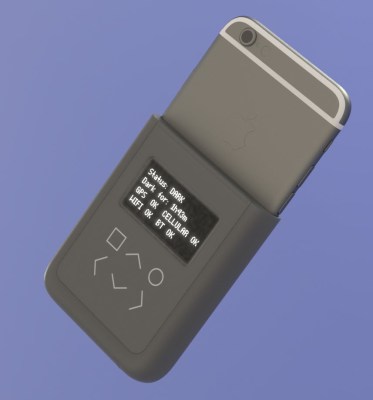
A rendering of the proposed introspection device attached to an iPhone6

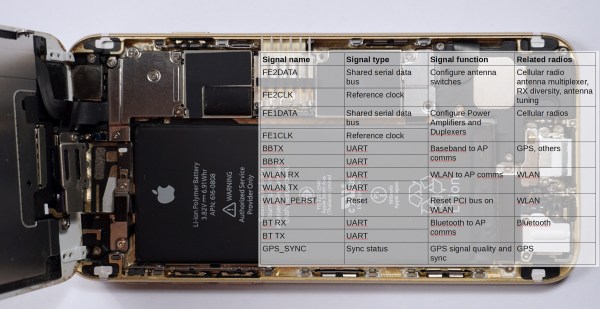
The idea is that phones are increasingly complex and potentially vulnerable to all kinds of digital surveillance. Even airplane mode is insufficient for knowing that your phone isn’t somehow transmitting information. The paper looks at the various radios on the iPhone, going so far as opening up the device and reading signals at each of the chips for cell, WiFi, Bluetooth, GPS, and NFC to determine whether the chip itself is doing anything, regardless of what the screen says. This introspection can then be used to be confident that the phone is not communicating when it shouldn’t be.

The paper goes on to propose a device that they will prototype in the coming year which uses an FPC that goes into the phone through the SIM card port. It would contain a battery, display, buttons, multiple SIM cards, and an FPGA to monitor the various buses and chips and report on activity.

Significant hacking of an iPhone will still be required, but the idea is to increase transparency and be certain that your device is only doing what you want it to.
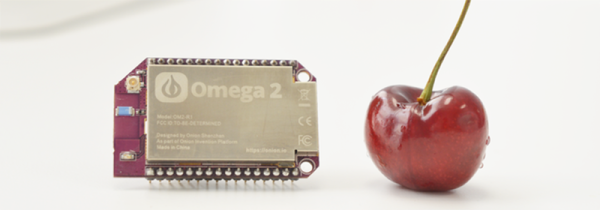
The Onion Omega2: The Latest Router Dev Board

A few years ago, the best way to put a device or project online was by hacking a router. With an inconspicuous Linksys WRT54G held onto a project with baling wire, anything can connect to the Internet. A lot has changed in a few years, and now those routers are development boards themselves. The latest of these is the Onion Omega2, a follow-up crowdfunding campaign to the very popular original Omega. Now, this tiny dev board is faster, more capable, and now it’s giving the Raspberry Pi Zero a run for its money.

The original Onion Omega was released last year with specs you would expect from an Internet of Things development board designed upon a chip for a cheap router. The original Onion used an Atheros AR9331 SOC running at 400 MHZ, had 64MB of RAM and 16MB of storage – enough to run a lightweight Linux distro – and also included USB, 802.11b/g/n, and a handful of GPIOs and a single UART. The Omega2 is a vast improvement over the original Omega, featuring a CPU that is 45% faster. The upgraded version of the Omega sports twice as much RAM, twice as much storage, and a MicroSD slot. This enables some Linux distros with a little more oomph behind them, and of course the SD card allows for local storage.

The original Onion Omega was funded through a crowdfunding campaign, with a single Onion Omega and dock available for a pledge of $19. Taking a lesson from the C.H.I.P. and the Pi Zero, the team at Onion have slashed the price. The Omega2 is only five dollars. If you want more RAM, storage, and an SD card socket, that price goes up to $9 USD. That’s amazing, and just goes to show how far hardware designed to service the Internet of Things has come in just a few short years.

MicroPython On The ESP8266: Kicking The Tires

Scripting languages are for large computers, right? “Real” embedded device work is a hellish, never-ending cycle of code, compile, and re-flash. Well, I used to think so too, but with the proliferation of scripting and other interactive languages to microcontrollers over the last few years, the hurdle to interactive development on the small chips has gotten a lot lower.

On the ESP8266 platform, I’ve tried out NodeMCU’s Lua and ESP8266 BASIC. (For the last half-year, I’ve been using the awesome Mecrisp-Stellaris almost exclusively on the STM32F1xx and F4xx chips, but haven’t dipped into ESP8266 Forth yet.)

NodeMCU is great because it’s got everything you could want built in, and through cloud services it’s easy to get a tailored build made that maximizes free flash memory for your projects. I just don’t dig the asynchronous Lua thing (you might, try it!). ESP BASIC has a different set of libraries, and is missing MQTT for my purposes. Still it’s pretty slick, and worth a look.

So when the MicroPython folks announced that they were releasing the binary builds for the ESP, I thought it was time to give it a spin. I’ve used Python for nearly twelve years now, so it’s like a comfortable shoe for me. Would MicroPython be the same on the ESP8266? The short answer is yes and no.

Continue reading “MicroPython On The ESP8266: Kicking The Tires”

Red Carpet BB-8 internals

How BB-8 Works Revealed At Star Wars Celebration Europe

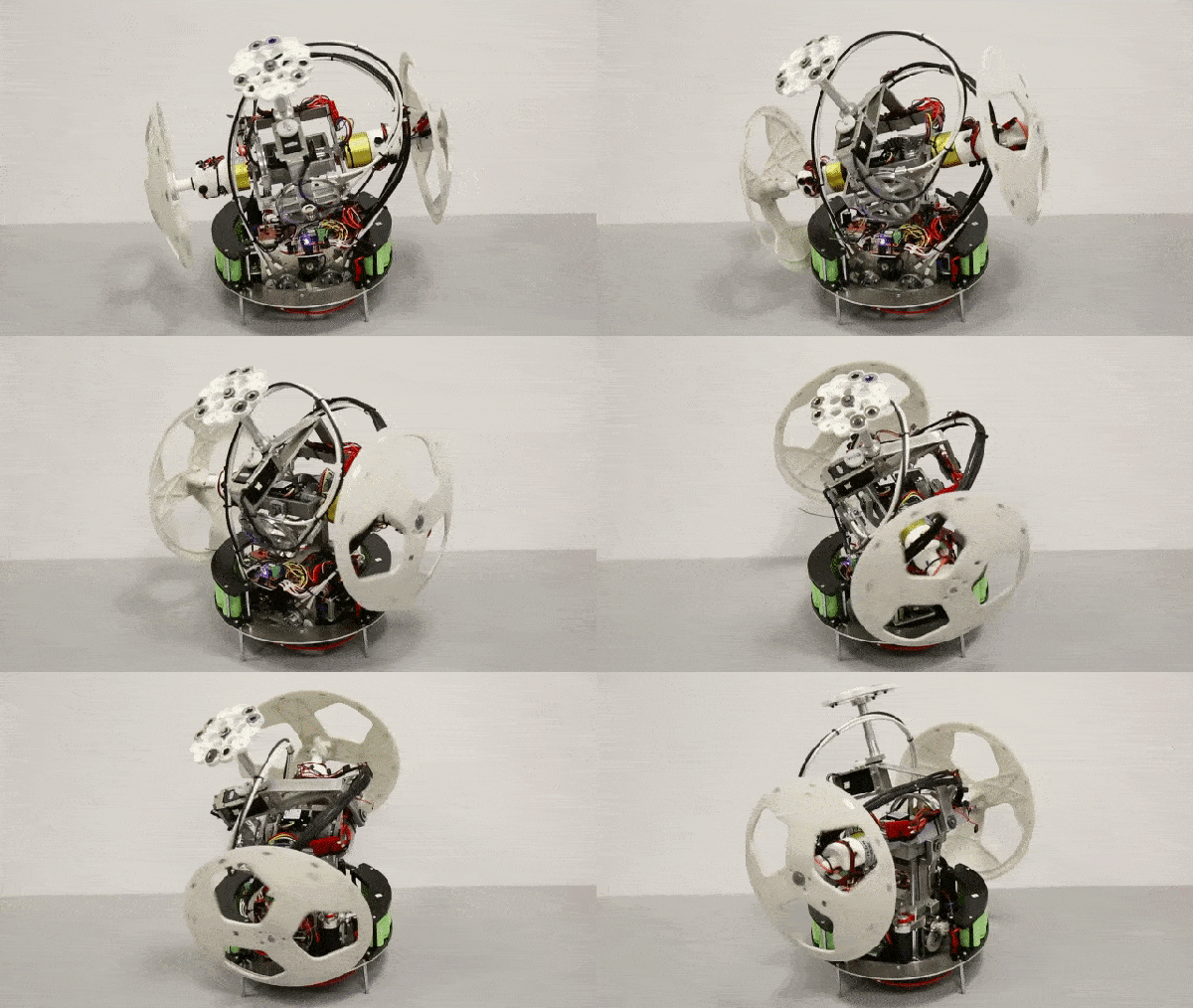
Finally the workings of the official BB-8 that you’ve seen rolling around at various events have been revealed. Its makers [Matt Denton] and [Josh Lee] participated in an hour-long presentation at Star Wars Celebration Europe 2016 just this past week where the various views of its internals were shown in action. It’s since had BB-8 builders (yours truly included) analyzing the workings for new ideas. We also now have the official name for it, red carpet BB-8.

For the first half of their talk they went over how BB-8 was implemented for Star Wars: The Force Awakens. As we’ve long known this was done using 7 puppeted BB-8’s, though it was revealed that only 4 were actually used, including a stationary one called the wiggler whose purpose you can guess. Another thing we didn’t know is that they did consider building a working BB-8 for filming but decided they needed something bullet proof, that would work right every time without making a film crew wait for repairs, and so went with the puppets instead.

The second half of their talk contained the big reveal, the mechanism inside red carpet BB-8’s ball. It turns out to be pretty close to what many builders have been doing. If you’ve seen the DIYer’s guide to the different BB-8 drive systems then you’ll understand when we say it’s a pendulum drive (aka axle drive). That is, there’s a motorized axle that crosses the middle of the ball and the ball rotates on that axle. Meanwhile a large mass suspended below the axle acts as the pendulum mass.

BB-8 builders have known the importance of keeping as much mass as possible as low down as possible for stability, but it was revealed the great extent to which that has been done in the red carpet version. Motors for the head’s pitch and yaw are located at the bottom and their motion is transferred up to the center using what are maybe best known as bicycle brake cables. Another big reveal was a linear actuator for the body roll, tilting the center stuff with respect to the mass lower down. The actuator itself is located in the lower section. Also, BB-8 builders have been mounting the drive motors for rotating the ball with respect to the axle, in line with the axle. However, in red carpet BB-8 the motor is also at the bottom and its motion appears to be transferred up to the axle via belt and worm gears. You may mistake the gold cylinders on either side of the central gimbal system to be motors but they’re actually Moflon slip rings.

Those are just a few of the insights gained so far from analyzing the video below. Doubtless people will be noticing a lot more in the weeks to come.

Continue reading “How BB-8 Works Revealed At Star Wars Celebration Europe”

Motorcycling Like It’s 1905 With A Home Made Engine

The modern motorcycle represents the pinnacle of over a century of refinement in design and manufacture of its every component. A modest outlay will secure you a machine capable of three figure speeds with impeccable handling, breathtaking acceleration and stopping power, that somehow seems also to possess bulletproof reliability that will take it to a hundred thousand miles of faithful transport.

At the dawn of the internal combustion engine age it was a different matter. Machines were little more than bicycles with rudimentary engines attached, brakes and tyres were barely capable of doing the job demanded of them, and the early motorcyclists were a hardy and daring breed.

You might think that this article would now head into retrotechtacular territory with a nostalgic look at an early motorcycle, but instead its subject has a much more recent origin. We happened upon [Buddfab]’s contemporary build of a 1905-era motorcycle, and we think it’s a bike you’d all like to see.

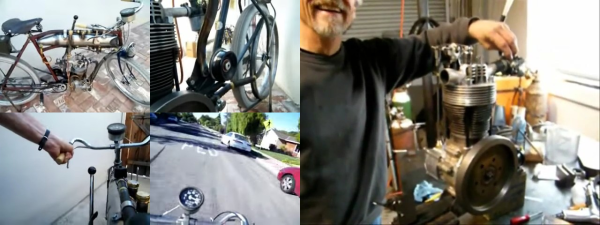
The bike itself is a faithful reproduction of a typical Edwardian machine. It has a modified bicycle frame with a belt drive and springer front forks. That’s all very impressive, but the engine is a masterpiece, crafting a more modern parts bin into something resembling a 1905 original. He’s taken the cylinder, piston, and half a cylinder head from an aircooled VW flat four and mated it with the crankshaft of a 125cc Honda, welding the two connecting rods together to join German and Japanese parts. With a custom-made crankcase, Lucas points, and the carburetor from a British Seagull outboard motor it both looks and sounds like an original, though we’d expect it to be significantly more reliable.

You can see videos of both bike and engine below the break, as he takes it for a spin through American suburbia. Sadly we’ll never see it passed to the definitive writer on early motorcycles for an expert view, but it would fool us completely.

Continue reading “Motorcycling Like It’s 1905 With A Home Made Engine”

Pokemon Go Cheat Fools GPS With Software Defined Radio

Using Xcode to spoof GPS locations in Pokemon Go (like we saw this morning) isn’t that much of a hack, and frankly, it’s not even a legit GPS spoof. After all, it’s not like we’re using an SDR to spoof the physical GPS signal to cheat Pokemon Go.

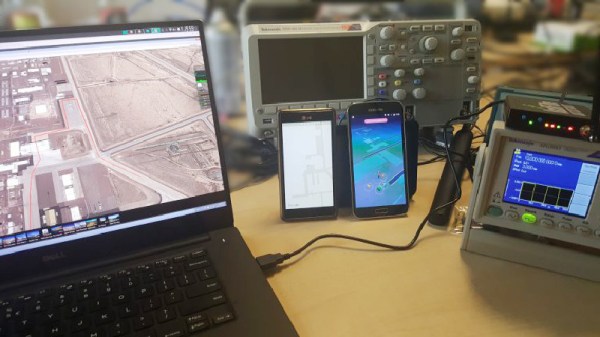
To [Stefan Kiese], this isn’t much more than an exercise. He’s not even playing Pokemon Go. To squeeze a usable GPS signal out of his HackRF One, a $300 Software Defined Radio, [Stefan] uses an external precision clock. This makes up for the insufficient calibration of the HackRF’s internal clock, although he points out that this might also be fixed entirely in software.

Continue reading “Pokemon Go Cheat Fools GPS With Software Defined Radio”

New Part Day: ST’s 32-Bit 3D Printer Controller

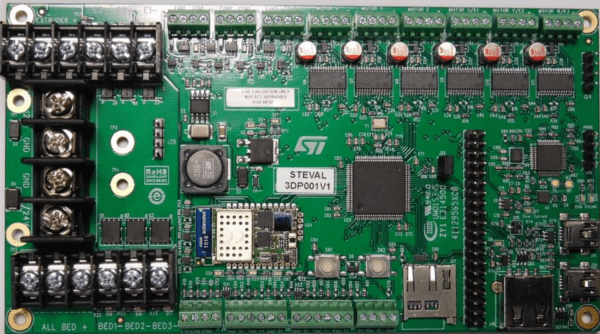
There are a few 32-bit ARM-based 3D printer controller boards out there such as the Smoothieboard, the Azteeg X5 mini, [Traumflug]’s Gen5 electronics, whatever board is in the Monoprice MP Mini Select, and several others I will be criticized for not mentioning. All of these ARM boards provide smoother acceleration, better control, and ultimately better prints from whatever 3D printer they’re controlling. Now, out of the blue, there’s a new board. It’s an evaluation board from ST — much like those famous Discovery boards — that sells itself as a plug and play solution for 3D printers.

The heart of this board is an STM32F401 — not the king of the STM32 line or the fastest ARM microcontroller, but anything faster or more capable will add considerably more to the BOM for this board. This controller board features six of ST’s L6474 motor drivers with enough current for some beefy NEMA 23 stepper motors , a multi-zone heated bed, and connections for a WiFi module and external LCD and keypad. You can buy this board right now for $118. This board isn’t a game changer, but it is evidence the game has been changed.

As with all 3D printer controller boards, there are a few aspects that will leave users wanting more. This is a board meant for 12V heaters (except for the bed, which has a 24V, 20A output), and the stepper drivers can only go up to 16 microsteps. That said, there’s not much else to complain about. This offering comes with a 32-bit firmware called Marlin4ST. From a quick perusal, it looks like the familiar configuration.h is still there, and still does what it’s supposed to do.

This ST Discovery board is extremely capable, available now, and relatively cheap, but that’s not really the big story here. What this board represents is a reference design and working firmware for a 32-bit ARM-based printer controller. That’s the future, and with this board the future might come a little sooner.

Thanks [jagerboots] for sending this one in.