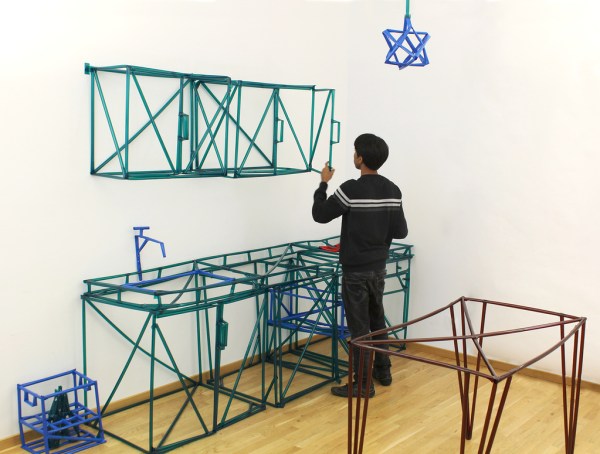
Sometimes you just need a life-sized model. When you do, reach for your (highly modified) tape gun and get drawing.
As the Protopiper team describes it, the “gun” is a computer-aided hand held fabrication device for imagining layouts of large objects — the main example they give is furniture. Want to make sure that couch will fit? Why not spend 10 minutes building a tape model of it?
Sound crazy? Kind of, but the device itself is rather ingenious. It takes normal tape, measures it, and rolls it into tube form, which results in a surprisingly strong structure allowing you to build 3D shapes quite easily. From a design point of view it’s quite brilliant.
From the mechanism that rolls the tape into a structural tube to the winged end-connectors that allow you to easily attach to another tube or structure, the whole thing must have gone through many design iterations to get right. We’re impressed.
One thing has stayed with the James Bond movie franchise through the decades: Mr. Bond always has the most wonderful of gadgets. Be it handheld, car-based, or otherwise, there’s always something to thrill that is mostly believable.
The biggest problem with all of those gadgets is that they mark Commander Bond as an obvious spy. “So Mr. Bond, I see you have a book with many random five character groups. Nothing suspicious about that at all!” And we all know that import/export specialists often carry exploding cufflinks or briefcases full of unknown electronics in hidden compartments.
Just as steganography hides data in plain sight, the best spy gadgets are the ones that don’t seem to be a spy gadget. It is no wonder some old weapons are little more than sticks or farm implements. You can tell a peasant he can’t have a sword, but it is hard to ban sticks.
Imagine you were a cold war era spy living in a hostile country with a cover job with Universal Exports. Would you rather get caught with a sophisticated encryption machine or an ordinary consumer radio? I’m guessing you went with the radio. You aren’t the only one. That was one of the presumed purposes to the mysterious shortwave broadcasts known as number stations. These were very common during the cold war, but there are still a few of them operating. Continue reading “Secret Radio Stations By The Numbers”→
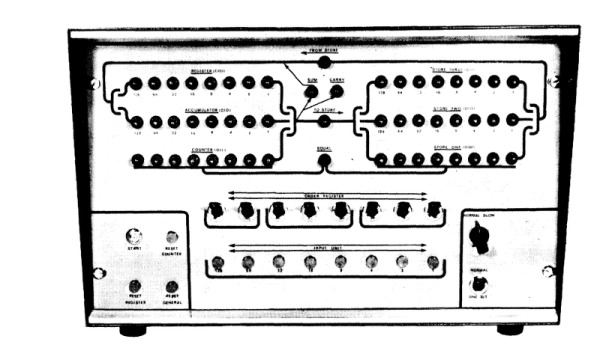
What kind of computer could you build in 1967? Well, if you were reading Wireless World (a UK magazine) and had a good bit of spare cash, you could build [Brian Crank’s] Wireless World Computer. You only needed 400 germanium transistors, 1800 resistors, and an odd number of capacitors, switches, diodes, and neon bulbs. You also needed a good bit of patience, we suspect.
In 1967, the computer cost about 50 pounds to build (perhaps $125 at 1967 exchange rates which would now be about $900 in today’s money). To save parts (and thus money and build complexity), the computer used a trick: it processed data one bit at a time. Many older computers did this, including another UK computer named EDSAC.
The name of the game in rocketry or ballooning is weight. The amount of mass that can be removed from one of these high-altitude devices directly impacts how high and how far it can go. Even NASA, which estimates about $10,000 per pound for low-earth orbit, has huge incentives to make lightweight components. And, while the Santa Barbara Hackerspace won’t be getting quite that much altitude, their APRS-enabled balloon/rocket tracker certainly helps cut down on weight.
Tracksoar is a 2″ x .75″ x .5″ board which weighs in at 45 grams with a pair of AA batteries and boasts an ATmega 328P microcontroller with plenty of processing power for its array of on-board sensors. Not to mention everything else you would need like digital I/O, a GPS module, and, of course, the APRS radio which allows it to send data over amateur radio frequencies. The key to all of this is that the APRS module is integrated with the board itself, which saves weight over the conventional method of having a separate APRS module in addition to the microcontroller and sensors.
As far as we can see, this is one of the smallest APRS modules we’ve ever seen. It could certainly be useful for anyone trying to save weight in any high-altitude project. There are a few other APRS projects out there as well but remember: an amateur radio license will almost certainly be required to use any of these.
A Complex Programmable Logic Device (CPLD) is a great piece of hardware to have in your repertoire. As its name implies, you can program these chips to serve the logic functions you need. This might be replacing an obsolete chip, or maybe just a way to learn and try different techniques. What better way to learn than to get your hands on a CPLD and give it a try?
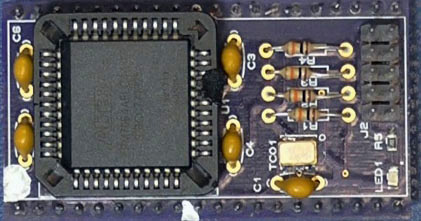
I created a CPLD module with the intent of being able to plug it into lots of things including solderless breadboards, but I screwed up. It seems that the plugin space available on a solderless breadboard is 1.1”, I had made the footprint 1” wide leaving no room for a row of wires on both sides. Duh.
But let me back up and show more about what I’m doing , I wanted to make a programmable piece of logic that could be built as a kit one could easily solder at home, could be programmed in-circuit, and could work at 3.3 or 5 volts.
To implement an easily solderable kit I went with an older CPLD part that also has 3.3v and 5v versions that will maintain its programming regardless of power. The logic itself is a CPLD IC from the Altera Max family with two versions that fit the board with either 32 or 64 macrocells. A macrocell is the basic logic building block and it is programmed with logic “terms” and then interconnected to other macrocells through a programmable interconnect.
In the early days of World War II, the Japanese army invaded Burma (now Myanmar) and forced an end to British colonial rule there. Occupying Burma required troops and massive amounts of materiel, though, and the Japanese navy was taking a beating on the 2,000 mile sea route around the Malay Peninsula. And so it was decided that a railway connecting Thailand and Burma would be constructed through dense tropical jungle over hilly terrain with hundreds of rivers, including the Kwae Noi River, made famous by the Hollywood treatment of the story in The Bridge on the River Kwai. The real story of what came to be known as the Burma Death Railway is far grislier than any movie could make it, and the ways that the prisoners who built it managed to stay alive is a fascinating case study in making do with what you’ve got and finding solutions that save lives.
Nutrition from Next-to Nothing
POWs in camp. [Source: The Thai-Burma Railway and Hellfire Pass]Labor for the massive project was to come from the ultimate spoil of war – slaves. About 250,000 to 300,000 slaves were used to build the Burma-Siam Railway. Among them were about 60,000 Allied prisoners of war, primarily Australian, Dutch, British and American. POWs were singled out for especially brutal treatment by the Japanese and Korean guards, with punishment meted out with rifle butt and bamboo pole.
With the POWs was Doctor Henri Hekking, who had been born and raised in the former Dutch East Indies colony of Java (now Indonesia). He had spent his early years with his grandmother, a master herbalist who served as “doctor” for the native villagers. Inspired by his oma’s skill and convinced that the cure for any endemic disease can be found in the plants in the area, Dr. Hekking returned to Java as an officer in the Dutch army after completing medical school in the Netherlands.
After his capture by the Japanese, Dr. Hekking did everything he could to help his fellow POWs despite the complete lack of medical supplies, all the while suffering from the same miserable treatment. Hekking realized early on that the starvation rations the POWs endured were the main cause of disease in the camps; a cup of boiled white rice doesn’t provide much energy for men building a railway by hand in jungle heat, and provides none of the B vitamins needed by the body.
You don’t get much more old school than a sundial, and more new school than 3D printing. So, it is nice to see these two combined in this impressive project: the 3D printed digital sundial. We have seen a few sundial projects before, ranging from LED variants to 3D printed ones, but this one from [Julldozer] takes it to a new level.
In the video, he carefully explains how he designed the sundial. Rather than simply create it as a static 3D model, he used OpenSCAD to build it algorithmically, using the program to create the matrix for each of the numbers he wanted the sundial to show, then to combine these at the appropriate angle into a single, 3D printable model. He has open-sourced the project, releasing the OpenSCAD script for anyone who wants to tinker or build their own. It is an extremely impressive project, and there is more to come: this is the first in a new podcast series called Mojoptix from [Julldozer] that will cover similar projects. We will definitely be keeping an eye on this series.