For humans and satellites alike, making a living in space is hard. First, there’s the problem of surviving the brief but energetic and failure-prone ride there, after which you get to alternately roast and freeze as you zip around the planet at 20 times the speed of sound. The latter fact is made all the more dangerous by the swarm of space debris, both natural and man-made, that whizzes away up there along with you, waiting to cause an accident.
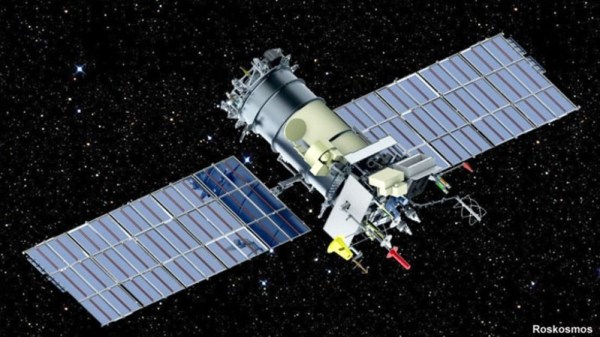
One such accident has apparently led to the early demise of a Russian weather satellite. Just a few months after launch, Meteor-M 2-2 suffered a sudden orbital anomaly (link to Russian story; English translation). Analysis of the data makes it pretty clear what happened: the satellite was struck by something, and despite some ground-controller heroics which appear to have stabilized the spacecraft, the odds are that Meteor-M 2-2 will eventually succumb to its wounds.
For nearly as long as there has been radio, there have been antennas trained on the sky, looking at the universe in a different light than traditional astronomy. Radio astronomers have used their sensitive equipment to study the Sun, the planets, distant galaxies, and strange objects from the very edge of the universe, like pulsars and quasars. Even the earliest moments of the universe have been explored, a portrait in microwave radiation of the remnants of the Big Bang.
And yet with all these observations, there’s a substantial slice of the radio spectrum that remains largely a mystery to radio astronomers. Thanks to our planet’s ionosphere, most of the signals below 30 MHz aren’t observable by ground-based radio telescopes. But now, thanks to an opportunity afforded by China’s ambitious lunar exploration program, humanity is now listening to more of what the universe is saying, and it’s doing so from a new vantage point: the far side of the moon.
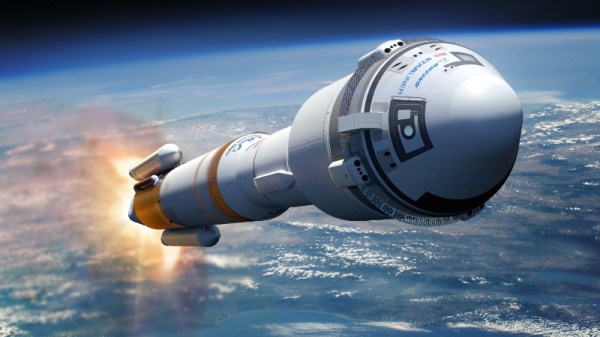
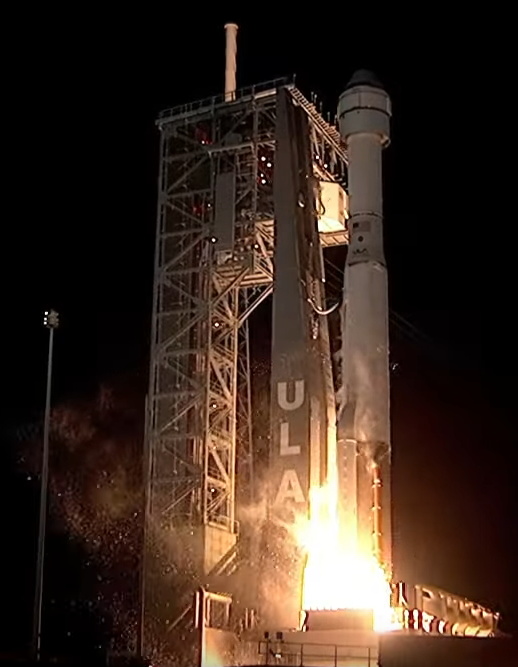
After a decade in development, the Boeing CST-100 “Starliner” lifted off from pad SLC-41 at the Cape Canaveral Air Force Station a little before dawn this morning on its first ever flight. Officially referred to as the Boeing Orbital Flight Test (Boe-OFT), this uncrewed mission was intended to verify the spacecraft’s ability to navigate in orbit and safely return to Earth. It was also planned to be a rehearsal of the autonomous rendezvous and docking procedures that will ultimately be used to deliver astronauts to the International Space Station; a capability NASA has lacked since the 2011 retirement of the Space Shuttle.
Liftoff at 6:36 AM Eastern
Unfortunately, some of those goals are now unobtainable. Due to a failure that occurred just 30 minutes into the flight, the CST-100 is now unable to reach the ISS. While the craft remains fully functional and in a stable orbit, Boeing and NASA have agreed that under the circumstances the planned eight day mission should be cut short. While there’s still some hope that the CST-100 will have the opportunity to demonstrate its orbital maneuverability during the now truncated flight, the primary focus has switched to the deorbit and landing procedures which have tentatively been moved up to the morning of December 22nd.
While official statements from all involved parties have remained predictably positive, the situation is a crushing blow to both Boeing and NASA. Just days after announcing that production of their troubled 737 MAX airliner would be suspended, the last thing that Boeing needed right now was another high-profile failure. For NASA, it’s yet another in a long line of setbacks that have made some question if private industry is really up to the task of ferrying humans to space. This isn’t the first time a CST-100 has faltered during a test, and back in August, a SpaceX Crew Dragon was obliterated while its advanced launch escape system was being evaluated.
We likely won’t have all the answers until the Starliner touches down at the White Sands Missile Range and Boeing engineers can get aboard, but ground controllers have already started piecing together an idea of what happened during those first critical moments of the flight. The big question now is, will NASA require Boeing to perform a second Orbital Flight Test before certifying the CST-100 to carry a human crew?
Let’s take a look at what happened during this morning’s launch.
Assuming you don’t work at a major space agency, you probably don’t really need to know the exact location of the International Space Station at all times. If you’d like to know just because it’s cool, this lamp is for you.
The lamp is driven by a Wemos D1, which pulls in data on the space station’s current location from Open Notify. A stepper motor and servo motor serve to control a pan-tilt assembly, aiming a 405nm laser at the inside of a 3D printed globe to indicate the station’s position above Earth. As a nice touch, there’s also a ring of NeoPixel LEDs that are controlled to glow on the sunny side of the planet, too.
This is a fun project that makes it easy to know when to bust out your ham gear to chat to the team overhead, and would also make a great conversation starter. It’s not the first hardware ISS monitor we’ve seen, either! Video after the break.
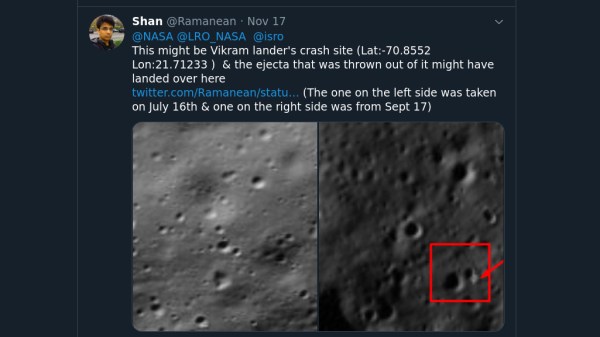
What does Pluto — not the dog, but the non-Planet — have in common with the Vikram lunar lander launched by India? Both were found by making very tiny comparisons to photographs. You’d think landing something on the moon would be old hat by now, but it turns out only three countries have managed to do it. The Chandrayaan-2 mission would have made India the fourth country. But two miles above the surface, the craft left its planned trajectory and went radio silent.
India claimed it knew where the lander crashed but never revealed any pictures or actual coordinates. NASA’s Lunar Reconnaissance Orbiter took pictures several times of the landing area but didn’t see the expected scar like the one left by the doomed Israeli lander when it crashed in April. A lot of people started looking at the NASA pictures and one Indian computer programmer and mechanical engineer, Shanmuga Subramanian, seems to have been successful.
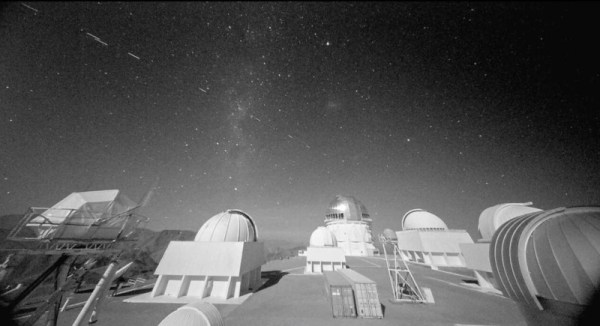
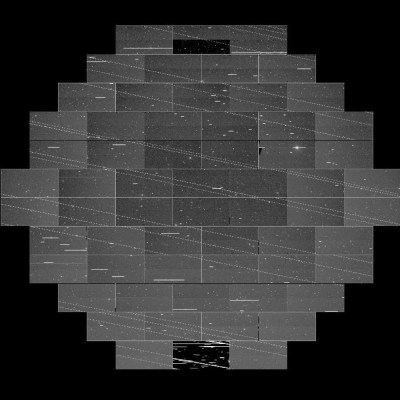
A capture from the Cerro Telolo observatory, showing the many Starlink satellite tracks spoiling the exposure.
Starlink is a project run by SpaceX to provide internet via satellite, using a variety of techniques to keep latency down and bandwidth high. There’s talk of inter-satellite laser communications, autonomous obstacle avoidance, and special designs to limit the amount of space junk created. We’ve covered the technology in a comprehensive post earlier this year.
The Starlink craft have long worried astronomers, who rely on a dark and unobstructed view of the sky to carry out their work. There are now large numbers of the satellites in relatively low orbits, and the craft have a high albedo, meaning they reflect a significant amount of the sunlight that hits them. With the craft also launching in a closely-packed train formation, there have already been impacts on research operations.
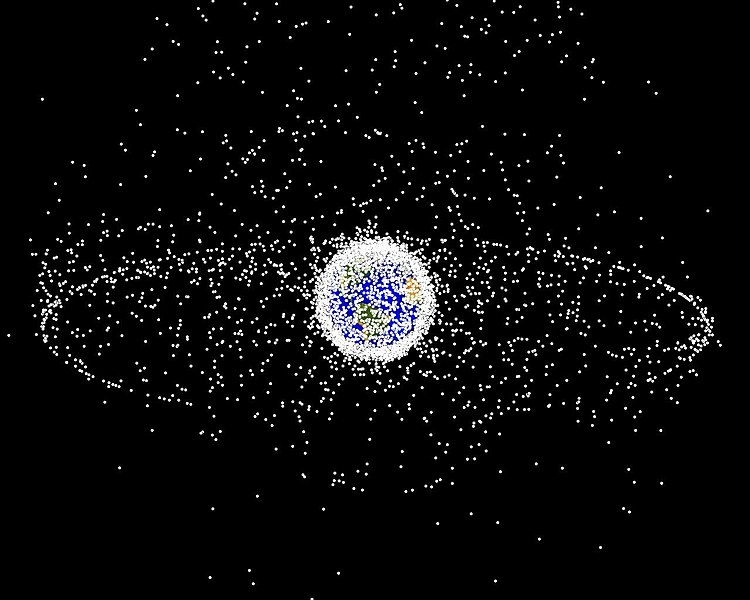
In the early days of spaceflight, when only the governments of the United States and the Soviet Union had the ability to put an object into orbit, even the most fanciful of futurists would have had a hard time believing that commercial entities would one day be launching sixty satellites at a time. What once seemed like an infinite expanse above our heads is now starting to look quite a bit smaller, and it’s only going to get more crowded as time goes on. SpaceX is gearing up to launch nearly 12,000 individual satellites for their Starlink network by the mid-2020s, and that’s just one of the “mega constellations” currently in the works.
Just some of the objects in orbit around the Earth
It might seem like overcrowding of Earth orbit is a concern for the distant future, but one needs only look at recent events to see the first hints of trouble. On September 2nd, the European Space Agency announced that one of its research spacecraft had to perform an evasive maneuver due to a higher than acceptable risk of colliding with one of the first-generation Starlink satellites. Just two weeks later, Bigelow Aerospace were informed by the United States Air Force that there was a 1 in 20 chance that a defunct Russian Cosmos 1300 satellite would strike their Genesis II space station prototype.
A collision between two satellites in orbit is almost certain to be catastrophic, ending with both spacecraft either completely destroyed or severely damaged. But in the worst case, the relative velocity between the vehicles can be so great that the impact generates thousands of individual fragments. The resulting cloud of shrapnel can circle the Earth for years or even decades, threatening to tear apart any spacecraft unlucky enough to pass by.
Fortunately avoiding these collisions shouldn’t be difficult, assuming everyone can get on the same page before it’s too late. The recently formed Space Safety Coalition (SSC) is made up of more than twenty aerospace companies that realize the importance of taking proactive steps to ensure humanity retains the unfettered access to outer space by establishing some common “Rules of the Road” for future spacecraft.