NASA Is Building A Space Station In A Weird Orbit. Here’s Why

Representatives from SpaceX, Blue Origin, and United Launch Alliance participated in a forum last week held by NASA to determine the future of humans on the moon. This isn’t just how they will live, how long they will stay, or what they will do; no, this is far more interesting: this was how humans will travel from lunar orbit from the surface of the moon. The future of the next generation of lunar lander is being determined right now.

The plan right now is entirely unlike Apollo, which sent a pair of spaceships in orbit around the moon, sent one to the surface, then returned to the mother ship for the trip back to Earth. Instead of something somewhat simple, the next era of lunar exploration will happen from a gateway orbiting in cis-lunar space. What makes this so amazing is how weird the orbit is, and the reasons behind it.

Continue reading “NASA Is Building A Space Station In A Weird Orbit. Here’s Why”

Don’t Need A Weatherman To Know Which Way The Wind Blows On Mars

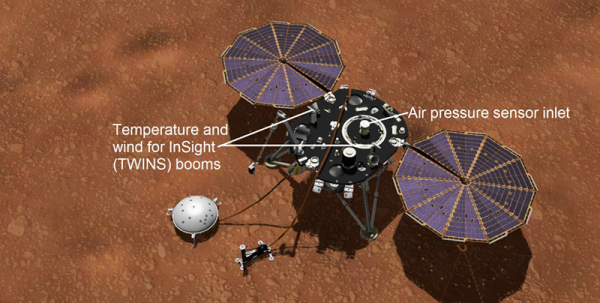
NASA’s latest Mars lander has a very precise weather package, and you can check the daily conditions on Elysium Planitia online. The data however has apparently led to a bit of a mystery. According to Ars Technica, every day at 7AM and 7PM local time, there’s an unexplained atmospheric pressure spike.

The TWINS (Temperature and Wind for InSight) package provided by Spain’s Centro de Astrobiología shows the little spikes regularly since the lander hit the ground in November. They seem to correspond to local sunrise and sunset. Keep in mind, the pressure on Mars is very low — about 1% of Earth’s atmosphere — and scientists have already ruled out instrument problems.

Continue reading “Don’t Need A Weatherman To Know Which Way The Wind Blows On Mars”

CNC Tellurion Lets You See The Earth And Moon Dance

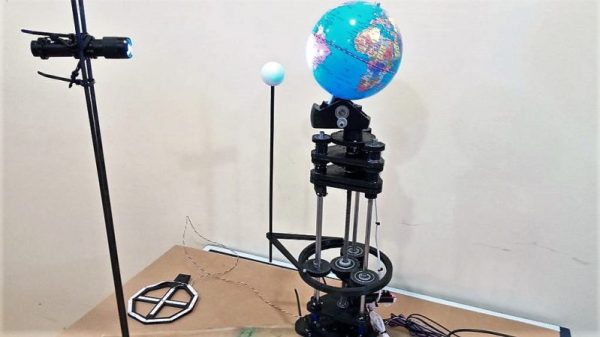
Kids – they’re such a treasure. One minute you’re having a nice chat, the next minutes they’re testing your knowledge of the natural world with a question like, “Why can we see the Moon during the day?” And before you know it, you’re building a CNC Earth-Moon orbital model.

We’ve got to applaud [sniderj]’s commitment to answering his grandson’s innocent question. What could perhaps have been demonstrated adequately with a couple of balls and a flashlight instead became an intricate tellurion that can be easily driven to show the relative position of the Earth and Moon at any date; kudos for anticipating the inevitable, “Where was the moon when I was born, Grampa?” question. The mechanism is based on the guts of a defunct 3D-printer, with the X-, Y-, and Z-axis steppers now controlling the Earth’s rotation and tilt and the Moon’s orbit respectively, with the former extruder drive controlling the tilt of the Moon’s orbital plane. A complex planetary gear train with herringbone gears, as well as a crossed-shaft helical gear set, were 3D-printed from PLA. The Earth model is a simple globe and the Moon is a ping-pong ball; [sniderj] is thinking about replacing the Moon with a 3D-printed bump-map model, a move which we strongly endorse. The video below shows the tellurion going through a couple of hundred years of the saros at warp speed.

There’s just something about machines that show the music of the spheres, whether they be ancient or more modern. And this one would be a great entry into our 3D-Printed Gears, Pulleys, and Cams contest too.

Continue reading “CNC Tellurion Lets You See The Earth And Moon Dance”

The “Impossible” Tech Behind SpaceX’s New Engine

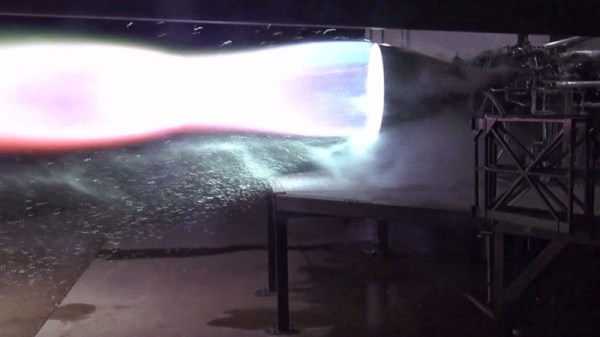
Followers of the Church of Elon will no doubt already be aware of SpaceX’s latest technical triumph: the test firing of the first full-scale Raptor engine. Of course, it was hardly a secret. As he often does, Elon has been “leaking” behind the scenes information, pictures, and even video of the event on his Twitter account. Combined with the relative transparency of SpaceX to begin with, this gives us an exceptionally clear look at how literal rocket science is performed at the Hawthorne, California based company.
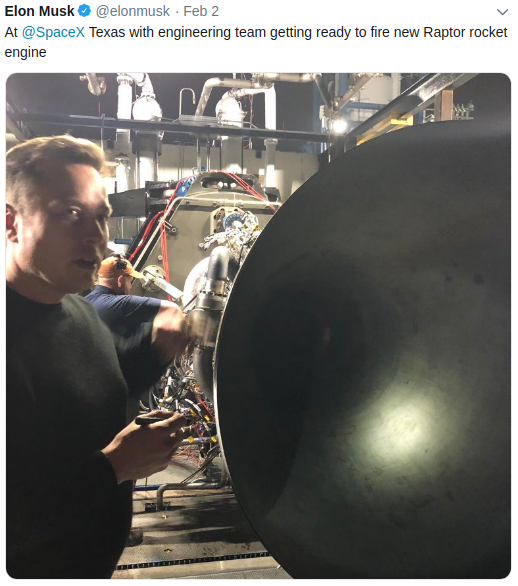
This openness has been a key part of SpaceX’s popularity on the Internet (that, and the big rockets), but its been especially illuminating in regards to the Raptor. The technology behind this next generation engine, known as “full-flow staged combustion” has for decades been considered all but impossible by the traditional aerospace players. Despite extensive research into the technology by the Soviet Union and the United States, no engine utilizing this complex combustion system has even been flown. Yet, just six years after Elon announced SpaceX was designing the Raptor, they’ve completed their first flight-ready engine.

The full-flow staged combustion engine is often considered the “Holy Grail” of rocketry, as it promises to extract the most possible energy from its liquid propellants. In a field where every ounce is important, being able to squeeze even a few percent more thrust out of the vehicle is worth fighting for. Especially if, like SpaceX, you’re planning on putting these new full-flow engines into the world’s largest operational booster rocket and spacecraft.

But what makes full-flow staged combustion more efficient, and why has it been so difficult to build an engine that utilizes it? To understand that, we’ll need to first take a closer look at more traditional rocket engines, and the design paradigms which have defined them since the very beginning.

Continue reading “The “Impossible” Tech Behind SpaceX’s New Engine”

Make Your Lego Fly

We probably all used to make our Lego fly by throwing it across the room, but Flite Test have come up with a slightly more elegant solution: they converted a Lego quadcopter to fly. They did it by adding a  miniature flight controller, battery and motors/rotors to replace the Lego ones in the Lego City Arctic Air Transport kit. This combination flies surprisingly well, thanks to a thoughtful design that balances the heavier components inside the case.

Continue reading “Make Your Lego Fly”

The Deep Space Energy Crisis Could Soon Be Over

On the face of it, powering most spacecraft would appear to be a straightforward engineering problem. After all, with no clouds to obscure the sun, adorning a satellite with enough solar panels to supply its electrical needs seems like a no-brainer. Finding a way to support photovoltaic (PV) arrays of the proper size and making sure they’re properly oriented to maximize the amount of power harvested can be tricky, but having essentially unlimited energy streaming out from the sun greatly simplifies the overall problem.

Unfortunately, this really only holds for spacecraft operating relatively close to the sun. The tyranny of the inverse square law can’t be escaped, and out much beyond the orbit of Mars, the size that a PV array needs to be to capture useful amounts of the sun’s energy starts to make them prohibitive. That’s where radioisotope thermoelectric generators (RTGs) begin to make sense.

RTGs use the heat of decaying radioisotopes to generate electricity with thermocouples, and have powered spacecraft on missions to deep space for decades. Plutonium-238 has long been the fuel of choice for RTGs, but in the early 1990s, the Cold War-era stockpile of fuel was being depleted faster than it could be replenished. The lack of Pu-238 severely limited the number of deep space and planetary missions that NASA was able to support. Thankfully, recent developments at the Oak Ridge National Laboratory (ORNL) appear to have broken the bottleneck that had limited Pu-238 production. If it pays off, the deep space energy crisis may finally be over, and science far in the dark recesses of the solar system and beyond may be back on the table.

Continue reading “The Deep Space Energy Crisis Could Soon Be Over”

Oops… Britain Launched A Satellite, But Who Remembers It?

Did you know Britain launched its first satellite after the program had already been given the axe? Me neither, until some stories of my dad’s involvement in aerospace efforts came out and I dug a little deeper into the story.

I grew up on a small farm with a workshop next to the house, that housed my dad’s blacksmith business. In front of the workshop was a yard with a greenhouse beyond it, along one edge of which there lay a long gas cylinder about a foot (300mm) in diameter. To us kids it looked like a torpedo, and I remember my dad describing the scene when a similar cylinder fell off the side of a truck and fractured its valve, setting off at speed under the force of ejected liquid across a former WW2 airfield as its pressurised contents escaped.

Everybody’s parents have a past from before their children arrived, and after leaving the RAF my dad had spent a considerable part of the 1950s as a technician, a very small cog in the huge state-financed machine working on the UK’s rocket programme for nuclear and space launches. There were other tales, of long overnight drives to the test range in the north of England, and of narrowly averted industrial accidents that seem horrific from our health-and-safety obsessed viewpoint. Sometimes they came out of the blue, such as the one about a lake of  highly dangerous liquid oxidiser-fuel mix ejected from an engine that failed to ignite and which was quietly left to evaporate, which he told me about after dealing with a cylinder spewing liquid propane when somebody reversed a tractor into a grain dryer.

Bringing Home A Piece Of History

The remains of the Black Arrow first and second stages, taken from the Skyrora promotional video.

My dad’s tales from his youth came to mind recently with the news that a privately-owned Scottish space launch company is bringing back to the UK the remains of the rocket that made the first British satellite launch from where they had lain in Australia since crashing to earth in 1971. What makes this news special is that not only was it the first successful such launch, it was also the only one. Because here in good old Blighty we hold the dubious honour of being the only country in the world to have developed a space launch capability of our own before promptly abandoning it. Behind that launch lies a fascinating succession of forgotten projects that deserve a run-through of their own, they provide a window into both the technological and geopolitical history of that period of the Cold War.

Continue reading “Oops… Britain Launched A Satellite, But Who Remembers It?”