The Future Of Space Is Tiny

While recent commercial competition has dropped the cost of reaching orbit to a point that many would have deemed impossible just a decade ago, it’s still incredibly expensive. We’ve moved on from the days where space was solely the domain of world superpowers into an era where multi-billion dollar companies can join on on the fun, but the technological leaps required to reduce it much further are still largely relegated to the drawing board. For the time being, thing’s are as good as they’re going to get.

Starlink satellites ready for launch

If we can’t count on the per pound cost of an orbital launch to keep dropping over the next few years, the next best option would logically be to design spacecraft that are smaller and lighter. Thankfully, that part is fairly easy. The smartphone revolution means we can already pack an incredible amount sensors and processing power into something that can fit in the palm of your hand. But there’s a catch: the Tsiolkovsky rocket equation.

Often referred to as simply the “rocket equation”, it allows you to calculate (among other things) the ratio of a vehicle’s useful cargo to its total mass. For an orbital rocket, this figure is very small. Even with a modern launcher like the Falcon 9, the payload makes up less than 5% of the liftoff weight. In other words, the laws of physics demand that orbital rockets are huge.

Unfortunately, the cost of operating such a rocket doesn’t scale with how much mass it’s carrying. No matter how light the payload is, SpaceX is going to want around $60,000,000 USD to launch the Falcon 9. But what if you packed it full of dozens, or even hundreds, of smaller satellites? If they all belong to the same operator, then it’s an extremely cost-effective way to fly. On the other hand, if all those “passengers” belong to different groups that split the cost of the launch, each individual operator could be looking at a hundredfold price reduction.

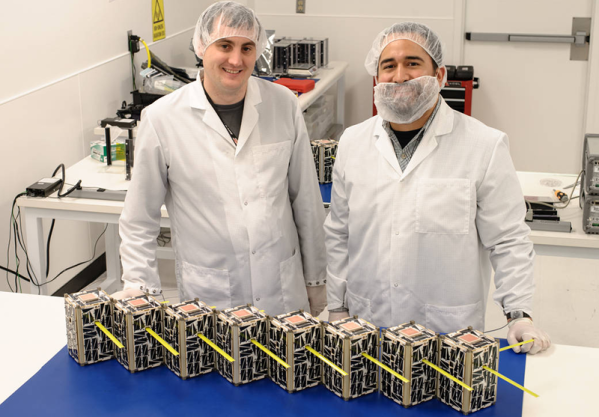
SpaceX has already packed 60 of their small and light Starlink satellites into a single launch, but even those craft are massive compared to what other groups are working on. We’re seeing the dawn of a new era of spacecraft that are even smaller than CubeSats. These tiny spacecraft offer exciting new possibilities, but also introduce unique engineering challenges.

Continue reading “The Future Of Space Is Tiny”

Small Lightsail Will Propel Cubesat

If you read science fiction, you are probably familiar with the idea of a light or solar sail. A very large and lightweight sail catches solar “wind” that accelerates a payload connected to the sail. Some schemes replace the sun with a laser. Like most things, sails have pros and cons. They don’t require you to carry fuel, but they are also maddeningly slow to accelerate and require huge sails since there isn’t much pressure produced by a star at a distance. So far not many real spacecraft have used the technique, IKAROS was the first back in 2010. However, this month should see the launch of a crowdfunded cubesat that will use a solar sail to move to a higher orbit.

The 5 kg satellite built by Georgia Tech students is about the size of a loaf of bread. Once in orbit, it will deploy solar panels and a square solar sail nearly 20 feet long on each side. Despite the nearly 350 square feet of area, the sail is less than 5 microns thick. You can see more details about the mission in the video below.

Continue reading “Small Lightsail Will Propel Cubesat”

Snoopy Come Home: The Search For Apollo 10

When it comes to the quest for artifacts from the Space Race of the 1960s, few items are more sought after than flown hardware. Oh sure, there have been stories of small samples of the 382 kg of moon rocks and dust that were returned at the cost of something like $25 billion making it into the hands of private collectors, and chunks of the moon may be the ultimate collector’s item, but really, at the end of the day it’s just rock and dust. The serious space junkie wants hardware – the actual pieces of human engineering that helped bring an epic adventure to fruition, and the closer to the moon the artifact got, the more desirable it is.

Sadly, of the 3,000,000 kg launch weight of a Saturn V rocket, only the 5,600 kg command module ever returned to Earth intact. The rest was left along the way, mostly either burned up in the atmosphere or left on the surface of the Moon. While some of these artifacts are recoverable – Jeff Bezos himself devoted a portion of his sizable fortune to salvage one of the 65 F1 engines that were deposited into the Atlantic ocean – those left on the Moon are, for now, unrecoverable, and in most cases they are twisted heaps of wreckage that was intentionally crashed into the lunar surface.

But at least one artifact escaped this ignominious fate, silently orbiting the sun for the last 50 years. This lonely outpost of the space program, the ascent stage from the Apollo 10 Lunar Module, appears to have been located by a team of amateur astronomers, and if indeed the spacecraft, dubbed “Snoopy” by its crew, is still out there, it raises the intriguing possibility of scoring the ultimate Apollo artifact by recovering it and bringing it back home.

Continue reading “Snoopy Come Home: The Search For Apollo 10”

An Evening With Space Shuttle Atlantis

When I got the call asking if I’d be willing to fly down to Kennedy Space Center and cover an event, I agreed immediately. Then about a week later, I remembered to call back and ask what I was supposed to be doing. Not that it mattered, I’d gladly write a few thousand words about the National Crocheting Championships if they started holding them at KSC. I hadn’t been there in years, since before the Space Shuttle program had ended, and I was eager to see the exhibit created for the fourth member of the Shuttle fleet, Atlantis.

So you can imagine my reaction when I learned that the event Hackaday wanted me to cover, the Cornell Cup Finals, would culminate in a private viewing of the Atlantis exhibit after normal park hours. After which, the winners of the competition would be announced during a dinner held under the orbiter itself. It promised to be a memorable evening for the students, a well deserved reward for the incredible work they put in during the competition.

Thinking back on it now, the organizers of the Cornell Cup and the staff at Kennedy Space Center should truly be commended. It was an incredible night, and everyone I spoke to felt humbled by the unique experience. There was a real, palpable, energy about it that you simply can’t manufacture. Of course, nobody sitting under Atlantis that night was more excited than the students. Though I may have come in as a close second.

I’ll admit it was somewhat bittersweet to see such an incredible piece of engineering turned into a museum piece; it looked as if Atlantis could blast off for another mission at any moment. But there’s no denying that the exhibit does a fantastic job of celebrating the history and accomplishments of the Space Shuttle program. NASA officially considers the surviving Shuttle orbiters to be on a “Mission of Inspiration”, so rather than being mothballed in a hangar somewhere in the desert, they are out on display where the public can get up close and personal with one of humanities greatest achievements. Judging by the response I saw, the mission is going quite well indeed.

If you have the means to do so, you should absolutely make the trip to Cape Canaveral to see Atlantis and all the other fascinating pieces of space history housed at KSC. There’s absolutely no substitute for seeing the real thing, but if you can’t quite make the trip to Florida, hopefully this account courtesy of your humble scribe will serve to give you a taste of what the exhibit has to offer.

Continue reading “An Evening With Space Shuttle Atlantis”

BioSentinel Mission Aims To Put Yeast Into Deep Space

It’s a truly exciting time for space enthusiasts. Humanity is finally shaking itself out of the half-century-long doldrums of deep space exploration and planning a return to the Moon and a push to Mars. Yes, exciting things have happened since the glory days of Apollo. We’ve reached out into the outer planets, drilled holes in asteroids, and made tracks across the face of Mars in an improbably durable rover. We’ve built magnificent space telescopes, created a permanent space station to replace a couple of temporary ones, and put an intricate constellation of satellites into service.

Those are all laudable achievements, but not a single living creature has intentionally achieved approached Earth escape velocity since three astronauts and five mice did it aboard Apollo 17 at 3:46 AM on December 7, 1972. Since then, we’ve all been stuck down here at the bottom of Earth’s gravity well, with only a lucky few of us getting a tease of what space travel is really like with low Earth orbit (LEO) missions.

But if NASA has its way, and certain difficulties with launch vehicles can be ironed out, in 2020 Earthlings will once again slip the surly bonds and make a trip to deep space. Of course those Earthlings will just be cultures of yeast carried into orbit around the Sun on a cubesat, but it’s a start, and it’s a good bet that more complex organisms won’t be far behind.

Continue reading “BioSentinel Mission Aims To Put Yeast Into Deep Space”

See Starlink’s “Space Train” Before It Leaves The Station

Have you looked up into the night sky recently and seen a bizarre line of luminous dots? Have you noticed an uptick in the number of UFO reports mentioned in the news and social media? If so, you may have already been touched by what many have come to affectionately call Elon Musk’s “Space Train”: a line of tightly grouped Starlink satellites that are making their way around the globe.

Some have wondered what’s so unique about the Starlink satellites that allows them to be visible from the ground by the naked eye, but that’s actually nothing new. It’s all about being in the right place at the right time, for both the observer and the spacecraft in question. The trick is having the object in space catch the light from the Sun when it has, from the observer’s point of view, already set. It’s essentially the same reason the Moon shines at night, but on a far smaller scale.

The ISS as it travels through Earth’s night and day

The phenomena is known as “satellite flare”, and chasing them is a favorite pastime of avid sky watchers. If you know when and where to look on a clear night, you can easily spot the International Space Station as it zips across the sky thanks to this principle. NASA even offers a service which uses email or SMS to tell you when the ISS should be visible from your location.

What makes the Starlink satellites unique isn’t that we can see them from the ground, but that there’s so many of them flying in a straight line. The initial launch released 60 satellites in a far tighter formation than we’ve ever seen before; Elon even warned that collisions between the individual Starlink satellites wasn’t out of the realm of possibility. The cumulative effect of these close proximity satellite flares is a bit startling, and understandably has people concerned about what the night sky might look like when all 12,000 Starlink satellites are in orbit.

The good news is, the effect is only temporary. As the satellites spread out and begin individual maneuvers, that long line in the sky will fade away. But before Elon’s “Space Train” departs for good, let’s look at how it was created, and how you can still catch a glimpse of this unique phenomena.

Continue reading “See Starlink’s “Space Train” Before It Leaves The Station”

There And Back Again: A Falcon 9 Launch Story

It’s true that I’m not known for keeping particularly regular hours, but even I had my doubts about this plan. We’d go to sleep around midnight, wake up at 3 AM, drive up the coast aimlessly, then turn around and attend a full-day event where we’d have to maintain at least some semblance of professionalism. It was a bad idea, terrible even. But there I was at 11:30 PM sitting in a Waffle House with Thomas, the Supplyframe videographer, getting dangerously close to signing off on it.

Officially we were there to cover the Cornell Cup Finals being held at Kennedy Space Center, but as it so happens, our arrival in Florida perfectly coincided with the launch of CRS-17, SpaceX’s latest International Space Station resupply mission. Technically this was not part of our assignment. But really, what choice did we have?

Even if our respective bosses didn’t see it as a wasted opportunity, we had to consider the locals. In the few hours we’d been here, it seemed the launch was all anyone wanted to talk about. Everyone from the airport shuttle driver to the waitress who brought us our hash browns reminded us a rocket would be lifting off soon. If we didn’t go, then come Friday afternoon we’d be the only people in Cape Canaveral who didn’t have a personal account of the event. By all indications, an unforgivable cultural faux pas in central Florida.

Of course, the truth of the matter is that we didn’t actually need any convincing to go on this adventure. We had the supreme good fortune of finding ourselves in the vicinity of Kennedy Space Center a few hours before they were going to send a rocket thundering off into the black, and there was no way we could just sleep through it. No, there was never any choice in the matter. We were going.

Continue reading “There And Back Again: A Falcon 9 Launch Story”