Digital X-Ray Scanner Teardown Yields Bounty Of Engineering Goodies

We’ll just go ahead and say it right up front: we love teardowns. Ripping into old gear and seeing how engineers solved problems — or didn’t — is endlessly fascinating, even for everyday devices like printers and radios. But where teardowns really get interesting is when the target is something so odd and so specialized that you wouldn’t normally expect to get a peek at the outside, let alone tramp through its guts.

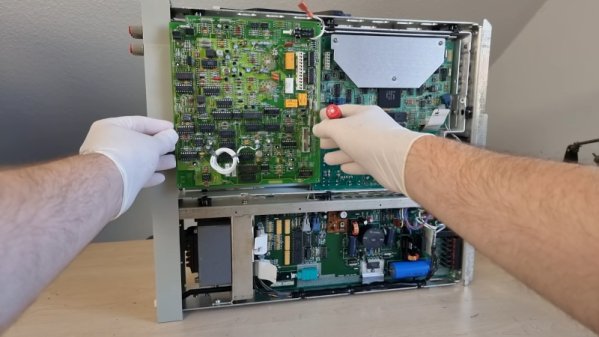
[Mads Barnkob] happened upon one such item, a Fujifilm FCR XG-1 digital radiography scanner. The once expensive and still very heavy piece of medical equipment was sort of a “digital film system” that a practitioner could use to replace the old-fashioned silver-based films used in radiography, without going all-in on a completely new digital X-ray suite. It’s a complex piece of equipment, the engineering of which yields a lot of extremely interesting details.

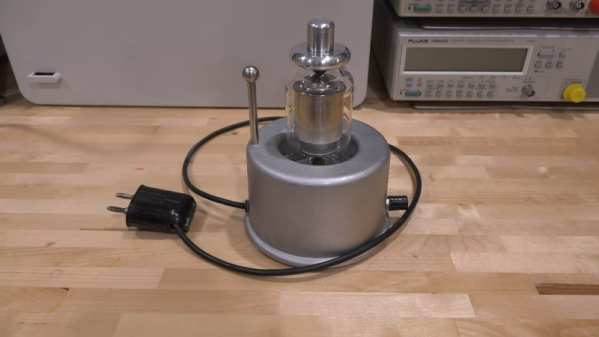
The video below is the third part of [Mads]’ series, where he zeroes in on the object of his desire: the machine’s photomultiplier tube. The stuff that surrounds the tube, though, is the real star, at least to us; that bent acrylic light pipe alone is worth the price of admission. Previous videos focused on the laser scanner unit inside the machine, as well as the mechatronics needed to transport the imaging plates and scan them. The video below also shows experiments with the PM tube, which when coupled with a block of scintillating plastic worked as a great radiation detector.

We’ve covered a bit about the making of X-rays before, and a few of the sensors used to detect them too. We’ve also featured a few interesting X-ray looks inside of tech, from a Starlink dish to knock-off adapters.

Continue reading “Digital X-Ray Scanner Teardown Yields Bounty Of Engineering Goodies”

Aircraft Compass Teardown

We didn’t know what a C-2400 LP was before we saw [David’s] video below, but it turned out to be pretty interesting. The device is an aircraft compass and after replacing it, he decided to take it apart for us. Turns out, that like a nautical compass, these devices need adjustment for all the metal around them. But while a ship’s compass has huge steel balls for that purpose, the tiny and lightweight aviation compass has to be a bit more parsimonious.

The little device that stands in for a binnacle’s compensators — often called Kelvin’s balls — is almost like a mechanical watch. Tiny gears and ratchets, all in brass. Apparently, the device is pretty reliable since the date on this one is 1966.

Continue reading “Aircraft Compass Teardown”

Teardown: RADICA I-Racer

Long before the Oculus Rift and HTC Vive came along, some of the biggest names in gaming tried to develop practical stereoscopic displays. These early attempts at virtual reality (VR) were hindered by the technical limitations of their time, and most never progressed beyond the prototype stage. Of the ones that did make it to retail shelves, none managed to stick around for very long. The best known example is Nintendo’s Virtual Boy, which ended up being a financial disaster upon its release in 1995 and some regard as the gaming giant’s greatest blunder.

Despite these public failures, Radica still felt compelled to throw their hat into the ring. Best known for their line of relatively simplistic LCD handheld games, the company produced several rudimentary stereoscopic stand-alone titles in the late 1990s to try and cash in on the VR fad. Among the later entries in this series was 1999’s NASCAR i-Racer, which at least externally, looks quite a bit like modern VR headset.

Featuring a head-mounted stereoscopic display, a handheld controller, force feedback, and integrated headphones, you’d certainly be forgiven for thinking the i-Racer was ahead of its time. But its reliance on the primitive LCD technology that put Radica on the map, combined with the need to keep the game as cheap as possible, keeps the experience planted firmly in the 1990s. But perhaps there’s something we can do about that.

Continue reading “Teardown: RADICA I-Racer”

Inside The VIC-20

Commodore machines are well-loved around here, but usually when you think Commodore, you think about the Commodore 64, or maybe the PET or Amiga. But the Commodore 64 had an older sister, the VIC 20. This was the first computer to sell a million units and has a lot in common with its better-known successor. The machine was only made for a few years, and [Dubious Engineering] has been restoring one over a few videos. In the video below, he opens it up for a look inside, among other things.

If you want to get straight to the opening, you’ll need to fast forward about 5 and a half minutes. The keyboard pulls off and a nice old-fashioned set of cables made from individual wires connect to the skinny main board with all the smarts on it. No ribbon cables or flex PCBs!

Continue reading “Inside The VIC-20”

A “Disgusting” 1980s Computer Restored

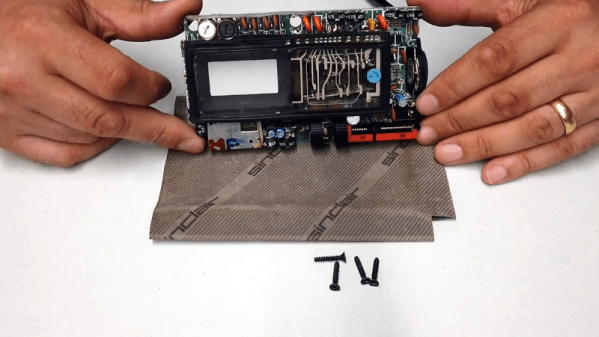
It takes a special eye to see a junkyard car and envision it as your latest hotrod. The guys at RMC found what they termed a “disgusting” Acorn Electron and decided to restore it to its former glory. The Electron was a budget version of the BBC micro with a 6502 running at 2 MHz when executing code from ROM and 1 MHz when it hit the RAM. Apparently, at least some of the bus was operating at 4 bits instead of 8. Go figure.

The 1982 machine was meant to head off the Sinclair ZX and was set to sell for about £200. However, the machine didn’t catch on like the Sinclair and undersold it by around 20 times with a paltry quarter of a million units.

Continue reading “A “Disgusting” 1980s Computer Restored”

Apple AirTag Spills Its Secrets

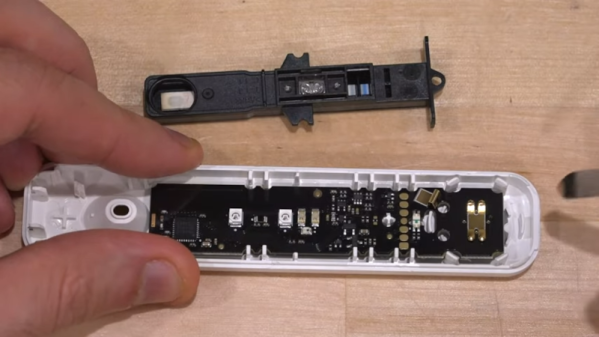
The Apple AirTag is a $29 Bluetooth beacon that sticks onto your stuff and helps you locate it when lost. It’s more than just a beeper though, the idea is that it can be silently spotted by any iDevice — almost like a crowd-sourced mesh network — and its owner alerted of its position wherever they are in the world.

There are so many questions about its privacy implications despite Apple’s reassurances, so naturally it has been of great interest to those who research such things. First among those working on it to gain control of its nRF52832 microcontroller is [Stacksmashing], who used a glitching technique whereby the chip’s internal power supply is interrupted with precise timing, to bypass the internally enabled protection of its debug port. The firmware has been dumped, and of course a tag has been repurposed for the far more worthwhile application of Rickrolling Bluetooth snoopers.

The idea of a global network of every iDevice helping reunite owners with their lost possessions is on the face of it a very interesting one, and Apple are at great pains on the AirTag product page to reassure customers about the system’s security. On one hand this work opens up the AirTag as a slightly expensive way to get an nRF microcontroller for other applications, but the real value will come as the firmware is analysed to see how at the tag itself works.

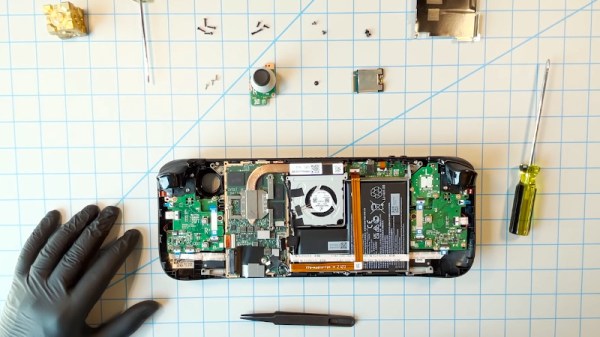
[Stacksmashing] has appeared on these pages many times before, often in the context of Nintendo hardware. Just one piece of work is the guide to opening up a Nintendo Game and Watch.

Inside A DEC Hard Drive

A lot of technology from the not-so-distant past doesn’t resemble modern versions very much. For a case in point, look at the DEC RS08 disk drive meant to pair with a circa 1970 PDP-8. Paired with an RF08 controller, this was state of the art, holding 262K 12-bit words with a blistering access speed of almost 63K/second unless you were plugged into 50Hz AC when it was closer to 50K/second. [Uniservo] had the disk unit, but not the controller. Someone else had a controller, but no disk drive. So [Uniservo] is shipping the disk to its new owner in a move worthy of a Reeses’ Peanutbutter Cup. The problem? The disk is super fragile and shipping is risky, so he decided to remove the platter for separate packing. Good thing for us, because we get a peek inside.

The nickel-cobalt platter looks like a thick LP record with heads underneath. As you might guess from the data transfer specification, the motor was just a common AC motor that rotated the platter against the head.

Continue reading “Inside A DEC Hard Drive”