Old school vernier calipers served engineers and machinists well for a long time — and did a perfectly good job. Digital models then came along and were easier to read. They now rule the roost, despite their thirst for batteries. Humans are naturally wired to make the least effort possible at all times. That’s why you always drive to the store that’s only a few blocks from your doorstep. In this vein, you may find a digital protractor preferable to the classic printed type.
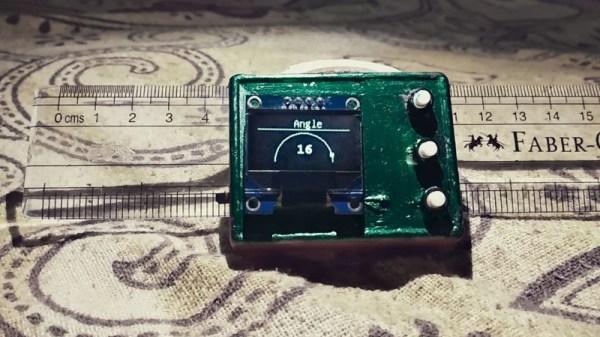
[Nirav Jadav]’s project is a simple one but serves as a good learning experience for those getting to grips with microcontrollers. An Arduino Pro Mini serves as the brains, reading signals from an MPU6050 gyroscope. Measured angles are displayed on a small OLED screen.
To use the protractor, first the reference button must be pressed, then the device may be rotated to measure the angle. Relying on a gyroscope means that it’s likely less accurate than a printed device, particularly if it isn’t recalibrated every few measurements to account for drift.
However, like many projects to grace these pages, its value lies not in its usability, but in the journey of creation. To build such a device requires programming ability, an understanding of interfacing with external peripheral devices, as well as how to drive a graphical display. These skills are highly useful in a wide variety of projects, and they’ll serve [Nirav] well in projects to come.
Once you’ve built your digital protractor, why not have a stab at building a digital measuring tape?
[Thanks to Baldpower for the tip!]