New Electric Motor Tech Spins With No Magnets

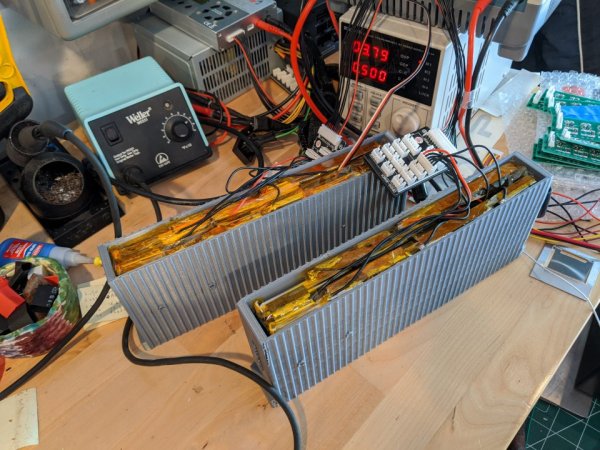
When you think of electric motors, you usually think of magnets. But magnets are heavy, and good magnets can pose problems when you need lots of them. A technology called SESM (separately excited synchronous motors) requires no magnets, but now ZF — a German company — claims to have a different scheme using inductive excitation. Motors that employ SESM tend to be larger and require a direct current to turn the rotor. This DC is often supplied by slip rings or an AC induction with a rectifier. The innovation here is that the inductive excitation is built completely into the shaft, which the company claims makes the motor both compact and powerful.

This kind of motor is usually destined for electric vehicles. The company claims the motor reduces losses by about 15% over conventional techniques. To maximize efficiency, conventional SESM uses slip rings or brushes to transmit power to the shaft. However, ZF claims their inductive improvements are even more efficient and can reduce axial size by around 90 mm.

Another advantage of the technology is that there is no need to provide a dry space for slip rings. That means fewer seals and the ability to cool the rotor with oil as you would with a motor containing permanent magnets. The company plans to offer a 400 V version of the motor and an 800 V that uses silicon carbide electronics.

If you build your own motors, have you tried anything like this? Usually, we don’t see motors this big, of course. We have, however, seen builds of reluctance motors that don’t use magnets.

Teaching A Mini-Tesla To Steer Itself

At the risk of stating the obvious, even when you’ve got unlimited resources and access to the best engineering minds, self-driving cars are hard. Building a multi-ton guided missile that can handle the chaotic environment of rush-hour traffic without killing someone is a challenge, to say the least. So if you’re looking to get into the autonomous car game, perhaps it’s best to start small.

If [Austin Blake]’s fun-sized Tesla go-kart looks familiar, it’s probably because we covered the Teskart back when he whipped up this little demon of an EV from a Radio Flyer toy. Adding self-driving to the kart is a natural next step, so [Austin] set off on a journey into machine learning to make it happen. Having settled on behavioral cloning, which trains a model to replicate a behavior by showing it examples of the behavior, he built a bolt-on frame to hold a steering servo made from an electric wheelchair motor, some drive electronics, and a webcam attached to a laptop. Ten or so human-piloted laps around a walking path at a park resulted in a 48,000-image training set, along with the steering wheel angle at each point.

The first go-around wasn’t so great, with the Teskart seemingly bent on going off the track. [Austin] retooled by adding two more webcams, to get a little parallax data and hopefully improve the training data. After a bug fix, the improved model really seemed to do the trick, with the Teskart pretty much keeping in its lane around the track, no matter how fast [Austin] pushed it. Check out the video below to see the Teskart in action.

It’s important to note that this isn’t even close to “Full Self-Driving.” The only thing being controlled is the steering angle; [Austin] is controlling the throttle himself and generally acting as the safety driver should the car veer off course, which it tends to do at one particular junction. But it’s a great first step, and we’re looking forward to further development.

Continue reading “Teaching A Mini-Tesla To Steer Itself”

An Electric Unicycle, In Minimalist Form

When self balancing scooters hit the market a few years ago they brought alongside them a range of machines, from the hoverboard kids toys which have provided so many useful parts, to the stand-astride electric unicycles. These last machines have a bulky battery and controller box atop the wheel, and [Dycus] set his sights on this by transferring it to a backpack with the vehicle’s IMU sensor relocated to one of the pedals.

Such a job is not merely a simple case of rewiring with some longer cables, as a first challenge the IMU communicates via I2C which isn’t suitable for longer distances. This is solved by a chipset which places the I2C on a differential pair, but even then it’s not quite a case of stepping on and zipping about. The PID parameters of the balancing algorithm on a stock machine are tuned for the extra weight of the battery on top, and these needed to be modified. Fortunately there have been enough people hacking the STM microcontroller and firmware involved for this task to be achievable, but we’d rate it as still something not for the faint-hearted.

The final result can be seen in the video below, and the quality of the physical work shows as very high. The former battery box is repurposed into a stylish backpack, and though the newly minimalist foot pedals and wheel are a little less easy to get going he zips around with ease.

Hungry for more? This ain’t the first we’ve shown you.

Continue reading “An Electric Unicycle, In Minimalist Form”

Hoverboard Turned Into Bonkers Omniwheeled Bike

Segways stunned the world when they first hit the market in 2001. Hoverboards then terrified the world with nasty accidents and surprise fires. [James Bruton] loves hoverboards regardless, and set out on a mighty upgrade regime turning the ride-on toy into a giant omniwheeled bicycle.

The build relies on two giant omniwheels of [James’s] own creation, using lasercut and 3D-printed parts. The wheels are mounted perpendicularly on either end of a boxy plywood “bike frame” built in two sections, with a split in the middle. The two halves can rotate relative to each other, much like the two halves of a stock hoverboard.

Amazingly, the build relies on the stock hoverboard motors and electronics. The hoverboard wheel motors are responsible for driving the omniwheels at either end via a toothed belt drive. The gear ratio of the belt reduction is set up to cancel out the greater diameter of the omniwheels, such that the hoverboard’s tuning isn’t disrupted. Wisely, [James] also fitted a safety power cutout, too.

The result is a self-balancing “bike” the likes of which you’ve never seen before. At present, it can balance upright and rotate relatively well. However, control is difficult, requiring the use of the rider’s body weight and the twisting of the bike’s sections. [James] has instead contemplated using servos to tilt the hoverboard sensors instead for an easier control method than the current setup.

It’s a truly bonkers build which is a testament to [James’s] creativity and prowess. We’ve seen some other great hoverboard hacks before, but nothing quite like this. Video after the break.

Continue reading “Hoverboard Turned Into Bonkers Omniwheeled Bike”

3D Printing RC Car Tires To Go Fast

There’s a bit of a high-speed arms race in the RC world on YouTube these days. [Michael Rectin] is in on the action, and he’s been exploring how to 3D print a decent set of tires to help his RC car reach higher speeds mph.

His first efforts involved experiments with TPU. The tires looked okay, but had very little traction. He later moved on to VarioShore TPU, a filament capable of delivering various properties depending on the printing method. Printing for the softest, and thus grippiest, possible tires, [Michael] whipped up some sporty looking boots for his wheels.

His tires improved overĀ  off-road RC tires in one major way. His design didn’t suffer significant ballooning as the rotational velocity increased. However, the VarioShore material lacked grip compared to off-the-shelf rubber RC tires designed for high-speed use. The commercially-available tires also offered a smoother ride.

[Michael] also demonstrated some neat tricks for high-speed RC driving. He used a modified flight controller to correct the car’s steering in response to perturbations, and put in a scaling method that reduces steering inputs at higher speed. That didn’t entirely stop the carnage though, with some incidents seeing wheels thrown off in big tumbling crashes.

Electric-powered RC cars can go darn quick these days, but you might want to consider jet power if you want to break records. Video after the break.

Continue reading “3D Printing RC Car Tires To Go Fast”

Next-Gen Autopilot Puts A Robot At The Controls

While the concept of automotive “autopilots” are still in their infancy, pretty much any aircraft larger than an ultralight will have some mechanism to at least hold a fixed course and altitude. Typically the autopilot system is built into the airplane’s controls, but this new system replaces the pilot themselves in a manner reminiscent of the movie Airplane.

The robot pilot, known as PIBOT, uses both AI and robotics technology to fly the airplane without altering the aircraft. Unlike a normal autopilot system, this one can be fed the aircraft’s manuals in natural language, understand them, and use that information to fly the airplane. That includes operating any of the aircraft’s cockpit controls, not just the control column and pedal assembly. Supposedly, the autopilot can handle everything from takeoff to landing, and operate capably during heavy turbulence.

The Korea Advanced Institute of Science and Technology (KAIST) research team that built the machine hopes that it will pave the way for more advanced autopilot systems, and although this one has only been tested in simulators so far it shows enormous promise, and even has certain capabilities that go far beyond human pilots’ abilities including the ability to remember a much wider variety of charts. The team also hopes to eventually migrate the technology to the land, especially military vehicles, although we’ve seen how challenging that can be already.

This Car Has Wooden Performance

If you were to take a look at the car parked closest to where you are sitting, there’s an overwhelming probability that its main structural parts are made of steel. A few might be aluminium and fewer still composite materials, but by and large that’s it for automotive structures. This hasn’t stopped the inventive Russians at [Garage 54] from experimenting though, and in their latest they’ve made a car with a chassis made of wood. Not carefully sawn and assembled wooden structural components, oh no. These are wooden tree trunks and branches.

Of course it’s an opportunity for them to run wild on their very successful schtick of the crazy Eastern European YouTuber, but behind that it’s entertaining to watch how they adapt a drive train — taken we’re guessing from the FIAT 124-derived Zhiguli, or Lada as most of us would know it — to such an unconventional chassis. A lot of wire binding is used, and even then the car has a lot of the flexible about it. We’re not so sure about the differential without oil or indeed the front suspension that appears to be developing a lean, but they do manage to take it out of the forest and onto the road.

Are unconventional and definitely-not-road-legal motors your thing? Here’s another, courtesy of some Dutch lads.

Continue reading “This Car Has Wooden Performance”