No Moving Parts: Phased Array Antennas Move While Standing Still

If you watch old science fiction or military movies — or if you were alive back in the 1960s — you probably know the cliche for a radar antenna is a spinning dish. Although the very first radar antennas were made from wire, as radar sets moved higher in frequency, antennas got smaller and rotating them meant you could “look” in different directions. When most people got their TV with an antenna, rotating those were pretty common, too. But these days you don’t see many moving antennas. Why? Because antennas these days move electrically rather than physically using multiple antennas in a phased array. These electronically scanned phased array antennas are the subject of Hunter Scott’s talk at 2018’s Supercon. Didn’t make it? No problem,  you can watch the video below.

While this seems like new technology, it actually dates back to 1905. Karl Braun fed the output of a transmitter to three monopoles set up as a triangle. One antenna had a 90 degree phase shift. The two in-phase antennas caused a stronger signal in one direction, while the out-of-phase antenna canceled most of the signal and the resulting aggregate was a unidirectional beam. By changing the antenna fed with the delay, the beam could rotate in three 120 degree steps.

Today phased arrays are in all sorts of radio equipment from broadcast radio transmitters to WiFi routers and 5G phones. The technique even has uses in optics and acoustics.

Continue reading “No Moving Parts: Phased Array Antennas Move While Standing Still”
Manhole Covers Hide Antennas

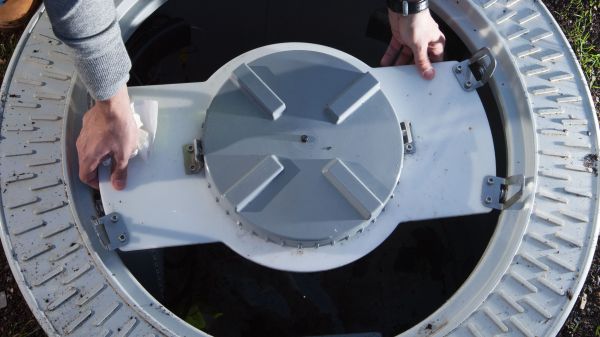
5G is gearing up to be the most extensive implementation of mesh networking ever, and that could mean antennas will not need to broadcast for miles, just far enough to reach some devices. That unsightly cell infrastructure stuck on water towers and church steeples could soon be hidden under low-profile hunks of metal we are already used to seeing; manhole covers. This makes sense because 5G’s millimeter radio waves are more or less line-of-sight, and cell users probably wouldn’t want to lose connectivity every time they walk behind a building.

At the moment, Vodafone in the UK is testing similar 4G antennas and reaching 195 megabits/sec download speeds. Each antenna covers a 200-meter radius and uses a fiber network because, courtesy of existing underground infrastructure. There is some signal loss from transmitting and receiving beneath a slab of metal, but that will be taken into account when designing the network. The inevitable shift to 5G will then be a relatively straightforward matter of lifting the old antennas out and laying the new hardware inside, requiring only a worker and a van instead of a construction crew.

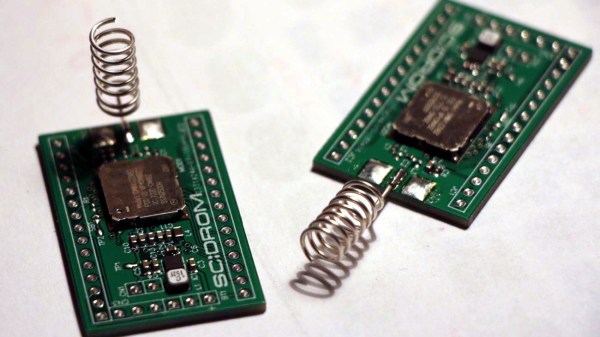
We want to help you find all the hidden cell phone antennas and pick your own cell module.

Via IEEE Spectrum.

Solar-Powered IoT Sensor Saves Wine Batch From Overheating

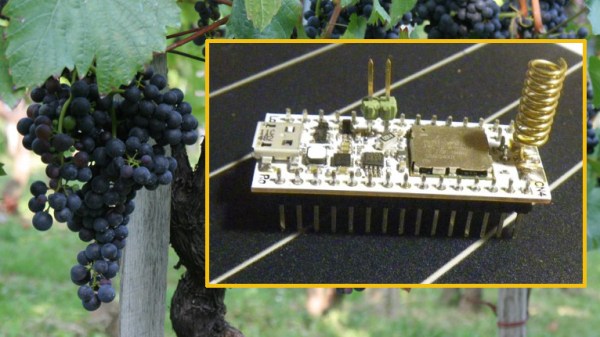
Making wine isn’t just about following a recipe, it’s a chemical process that needs to be monitored and managed for best results. The larger the batch, the more painful it is to have something go wrong. This means that the stakes are high for small vineyards such as the family one [Mare] works with, which have insufficient resources to afford high-end equipment yet have the same needs as larger winemakers. The most useful thing to monitor is the temperature profile of the fermentation process, and [Mare] created an exceptional IoT system to do that using LoRa wireless and solar power.

It’s not enough just to measure temperature of the fermenting liquid; viewing how the temperature changes over time is critical to understanding the process and spotting any trouble. [Mare] originally used a Raspberry Pi, I2C temperature sensor, and a Wi-Fi connection to a database to do the monitoring. This was a success, but it was also overkill. To improve the system, the Raspberry Pi was replaced with a LoRaDunchy board, an STM-based module of [Mare]’s own design which is pin-compatible with the Arduino Nano. It includes a battery charger, power management, and LoRa wireless communication. Adding a solar cell and lithium-polymer battery was all it took to figuratively cut the power cord.

Sensing the temperature of fermentation is done by sealing the temperature sensor into a thin aluminum tube, and lowering that into the vat. There it remains, with the LoRaDunchy board periodically waking up to read the sensor and report the tempurature over LoRa before going back to sleep, all the while sipping power from the battery which in turn gets recharged with solar power.

It’s an elegant system that has already paid off. A 500 litre vat of wine generated an alarm when the temperature rose above 24 Celsius for 10 minutes. An email alert allowed the owner to begin mixing the solution and add ice water to put the brakes on the runaway reaction. The temperature dropped and slow fermentation resumed, thanks to the twin powers of gathering the right data, then doing something meaningful with it.

Vineyards and LoRa have joined forces before, for example in the Vinduino project which aims to enable water-smart farming. If you’re unfamiliar with LoRa in general, the LoRa on the ESP32 project page contains a good primer, and if the antenna on the module shown here looks familiar to you it’s because we recently featured [Mare]’s guide on making DIY LoRa antennas from salvaged wire.

DIY Mini Helical Antennas From Salvaged Co-ax Cable

[Mare] has a visual guide and simple instructions for making DIY mini helical 868 MHz antennas for LoRa applications. 868 MHz is a license-free band in Europe, and this method yields a perfectly serviceable antenna that’s useful where space is constrained.

A metric 5 mm drill bit makes a convenient core.

The process is simple and well-documented, but as usual with antenna design it requires attention to detail. Wire for the antenna is silver-plated copper, salvaged from the core of RG214U coaxial cable. After straightening, the wire is wound tightly around a 5 mm core. 7 turns are each carefully spaced 2 mm apart. After that, it’s just a matter of measuring and bending the end for soldering to the wireless device in question. [Mare] has used this method for wireless LoRa sensors in space-constrained designs, and it also has the benefit of lowering part costs since it can be made and tested in-house.

Antennas have of course been made from far stranger things than salvaged wire; one of our favorites is this Yagi antenna made from segments of measuring tape.

Fully 3D Printed And Metalized Horn Antennas Are Shiny And Chrome

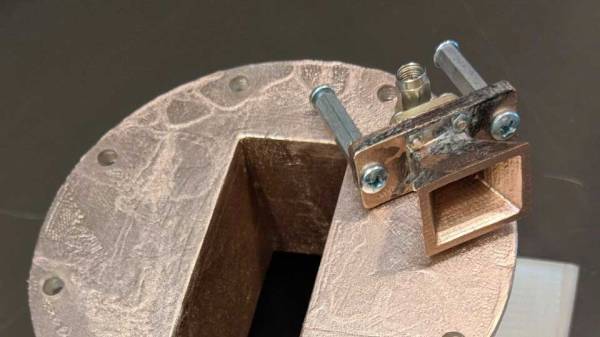
We’ve seen our share of 3D printed antennas before, but none as well documented and professionally tested as [Glenn]’s 3D printed and metalized horn antennas. It certainly helps that [Glenn] is the principal engineer at an antenna testing company, with access to an RF anechoic chamber and other test equipment.

Horn antennas are a fairly simple affair, structurally speaking, with a straight-sided horn-shaped “cone” and a receptacle for standardized waveguide or with an appropriate feed, coaxial adapters. They are moderately directional and can cover a wide range of frequencies. These horns are often used in radar guns and as feedhorns for parabolic dishes or other types of larger antenna. They are also used to discover the cosmic microwave background radiation of our universe and win Nobel Prizes.

[Glenn]’s antennas were modeled in Sketchup Make, and those files plus standard STL files are available for download. To create your own horn, print the appropriate file on a normal consumer-grade fused deposition printer. For antennas that perform well in WiFi frequency ranges you may need to use a large-format printer, as the prints can be “the size of a salad bowl”. Higher frequency horns can easily fit on most print beds.

After printing, [Glenn] settled on a process of solvent smoothing the prints, then metalizing them with commonly available conductive spray paints. The smoothing was found to be necessary to achieve the expected performance. Two different paints were tested, with a silver-based coating being the clear winner.

The full write-up has graphs of test results and more details on the process that led to these cheap, printed antenna that rival the performance of more expensive commercial products.

If you’re interested in other types of 3D printed antenna, we’ve previously covered a helical satcom feed, a large discone antenna, and an aluminum-taped smaller discone antenna.

Antennas That You Install With A Spray-Can

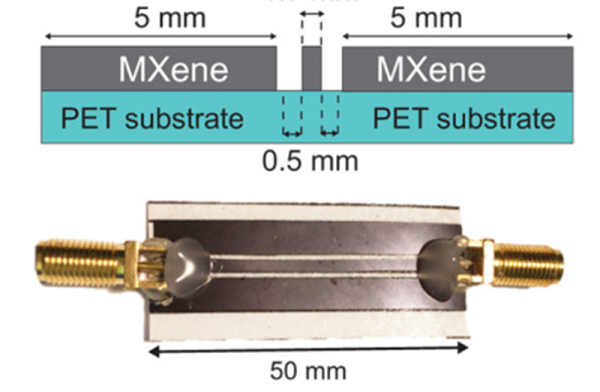
With the explosion in cell phones, WiFi, Bluetooth, and other radio technologies, the demand for antennas is increasing. Everything is getting smaller and even wearable, so traditional antennas are less practical than ever. You’ve probably seen PCB antennas on things like ESP8266s, but Drexel University researchers are now studying using titanium carbide — known as MXene — to build thin, light, and even transparent antennas that outperform copper antennas. Bucking the trend for 3D printing, these antennas are sprayed like ink or paint onto a surface.

A traditional antenna that uses metal carries most of the current at the skin (something we’ve discussed before). For example, at WiFi frequencies, a copper antenna’s skin depth is about 1.33 micrometers. That means that antennas have to be at least thick enough to carry current at that depth from all surfaces –practically 5 micrometers is about the thinnest you can reasonably go. That doesn’t sound like a lot, but when you are trying to make something thin and flexible, it is pretty thick. Using MXene, the researchers made antennas as thin as 100 nanometers thick — that’s 10% of a micrometer and only 2% of a conventional antenna.

Continue reading “Antennas That You Install With A Spray-Can”

Touch Anything And Everything

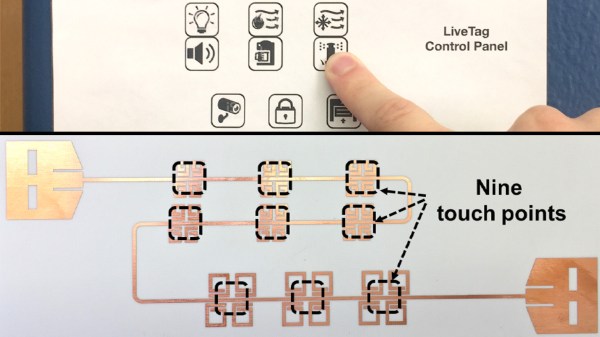
Powering IoT devices is often a question of batteries or mains power, but in rare exceptions to this rule there is no power supply (PDF Warning). At the University of Wisconsin-Madison and the University of California, San Diego, researchers have gone the extra mile to make advanced backscatter devices, and these new tags don’t need the discrete components we have seen in previous versions. They are calling it LiveTag, and it doesn’t need anything aside from a layer of foil printed or etched on a flexible ceramic-PTFE laminate. PTFE is mostly seen in the RF sector as a substrate for circuit boards.

We have seen some of the wild creations with wifi backscatter that range from dials to pushbuttons. RF backscatter works by modulating the RF signals in which we are continuously swimming. Those radio waves power the device and disrupt the ambient signals, which disruption can be detected by a receiver. With a BOM that looks like a statement more than a list, integration with many devices becomes a cost-effective reality. Do not however broadcast important data because you cannot expect great security from backscatter.

[Via IEEE Spectrum]