

Sometimes you have an idea that is so brilliant and so crazy that you just have to make it a reality. In 2011, [Look Mum No Computer] drew up plans in his notebook for a Furby organ, an organ comprised of a keyboard and a choir of Furbies. For those who don’t know what a Furby is, it’s a small, cute, furry robotic toy which speaks Furbish and a large selection of human languages. 40 million were sold during its original production run between 1998 and 2000 and many more since. Life intervened though, and, [LMNK] abandoned the Furby organ only to recently take it up again.
He couldn’t get a stable note out of the unmodified Furbies so he instead came up with what he’s calling the Furby Forman Fusion Synthesis. Each Furby is controlled by a pair of Ardunios. One Arduino sequences parts inside the Furby and the other produces a formant note, making the Furby sing vowels.
We love the label he’s given for what would otherwise be the power switch, namely the Collective Awakening switch. Flicking it causes all 44 (we count 45 but he says 44) Furbies to speak up while moving their ears, eyes, and beaks. Pressing the Loop switch makes them hold whatever sound they happen to be making. The Vowel dial changes the vowel. But you’ll just have to see and hear it for yourself in the videos below. The second video also has construction details.

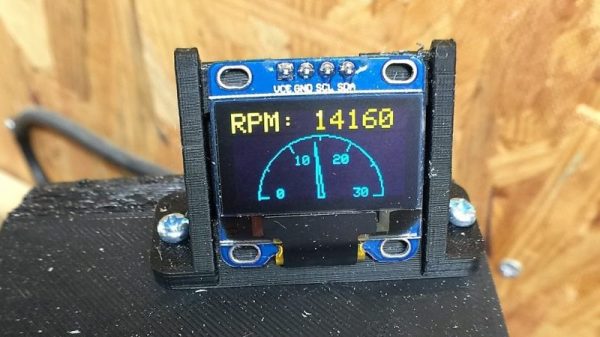
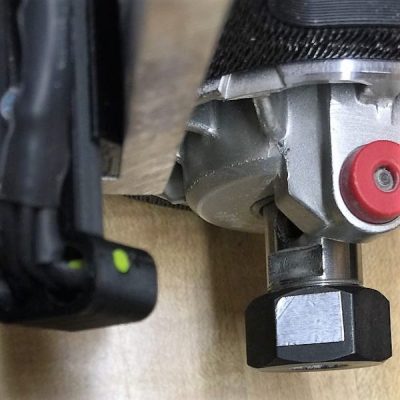 The CNC router in question is the popular Sienci, and the 3D-printed brackets for the photodiode and LED are somewhat specific for that machine. But [tmbarbour] has included STL files in his exhaustively detailed write-up, so modifying them to fit another machine should be easy. The sensor hangs down just far enough to watch a reflector on one of the flats of the collet nut; we’d worry about the reflector surviving tool changes, but it’s just a piece of shiny tape that’s easily replaced. The sensor feeds into a DIO pin on a Nano, and a small OLED display shows a digital readout along with an analog gauge. The display update speed is decent — not too laggy. Impressive build overall, and we like the idea of using a piece of PLA filament as a rivet to hold the diodes into the sensor arm.








