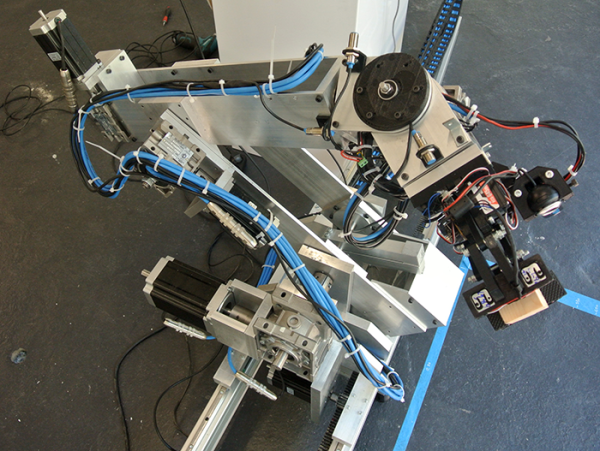
With a background in software engineering, [Kris Temmerman] decided to make a physical demonstration of his knowledge in the form of a six axis robotic arm… the final product is a delicious display of mechanical eye candy.
Built from mostly aluminum stock, [Kris] machined the bulk of his parts with a CNC mill which he picked up for cheap from China. These custom pieces coupled with some hefty stepper motors ensure the arm’s accuracy as it twists freely and slides along the gantry it’s mounted to. Though the majority of the arm is metal, the hand at the end of his robot was built with 3D printed parts and can be switched out with the future attachments [Kris] plans to design. This classic gripper piece is driven separately with its own Arduino brain controlling the individual servos in the fingers. 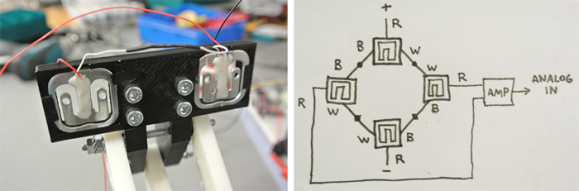
Each finger includes some load bearing sensors which [Kris] harvested from an old scale so that the gripper can tell whether or not it has a hold of an object without crushing it. To orchestrate the robot’s movement, he wrote some nice looking software in C++ which visualizes the inverse kinematics at work in each point of articulation. For the sake of demonstrating his creation in action, he whipped up a basic demo that can locate and move colored blocks laid at random on a surface. A small camera mounted on the hand determines the orientation of the blocks relative to the machine so that the wrist can rotate itself in the proper alignment in order to pick them up.
[Kris] documented the build of his robot in a fascinating speed video which includes footage of the finished arm in action at the end:
Continue reading “This Home-Made 6-Axis Robotic Arm Is Quite The Looker”