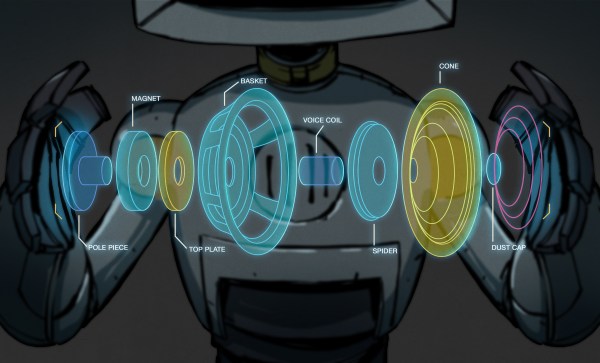
A lot of our projects make noise. It can be something as simple as a microcontroller driving a small speaker or a truly ambitious Hi-Fi project, but common to all of them is the desire to get that sound out in as audible and high-quality a manner as possible. We’ve been known to make fun of the more preposterous side of the Hi-Fi world at times, but behind it all there’s a basis of solid and provable audio engineering that can be brought to bear on almost any project involving sound and electronics. Perhaps it’s time to devote some time to a series exploring the topic, and what better place to start than the ultimate destination for all that sound. Any Hi-Fi is only as good as the ears of the person listening to it, so in out journey through the world of audio that’s where we’ll start. Continue reading “Know Audio: Start At The Very Beginning”
audio396 Articles
Neural Networks Emulate Any Guitar Pedal For $120
It’s a well-established fact that a guitarist’s acumen can be accurately gauged by the size of their pedal board- the more stompboxes, the better the player. Why have one box that can do everything when you can have many that do just a few things?
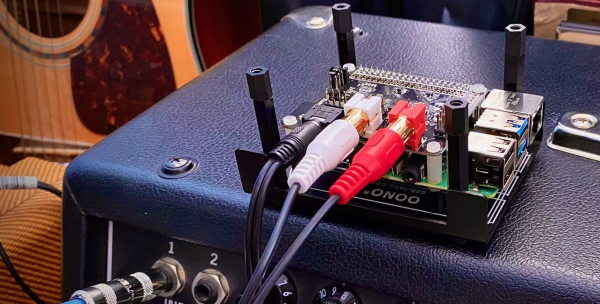
Jokes aside, the idea of replacing an entire pedal collection with a single box is nothing new. Your standard, old-school stompbox is an analog affair, using a combination of filters and amplifiers to achieve a certain sound. Some modern multi-effects processors use software models of older pedals to replicate their sound. These digital pedals have been around since the 90s, but none have been quite like the NeuralPi project. Just released by [GuitarML], the NeuralPi takes about $120 of hardware (including — you guessed it — a Raspberry Pi) and transforms it into the perfect pedal.
The key here, of course, is neural networks. The LSTM at the core of NeuralPi can be trained on any pedal you’ve got laying around to accurately reproduce its sound, and it can even do so with incredibly low latency thanks to Elk Audio OS (which even powers Matt Bellamy’s synth guitar, as used in Muse‘s Simulation Theory World Tour). The result of a trained model is a VST3 plugin, a popular format for describing audio effects.
This isn’t the first time we’ve seen some seriously cool stuff from [GuitarML], and it also hearkens back a bit to some sweet pedal simulation in LTSpice we saw last year. We can’t wait to see this project continue to develop — over time, it would be awesome to see a slick UI, or maybe somebody will design a cool enclosure with some knobs and an honest-to-god pedal for user input!
Thanks to [Mish] for the tip!
Continue reading “Neural Networks Emulate Any Guitar Pedal For $120”
Using Ikea Guts To Add Sonos Compatibility To A Vintage Speaker
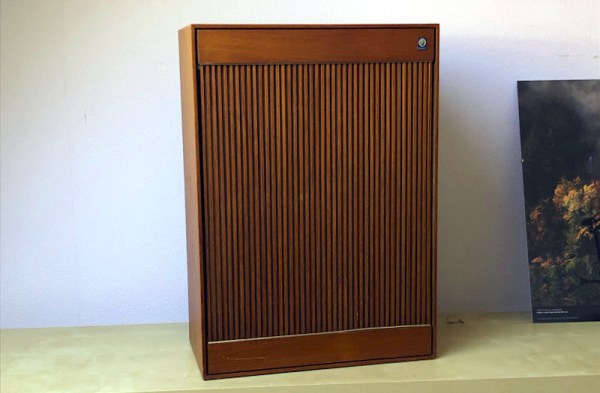
We’re in a fortunate position when it comes to audio gear, because advances in amplifier and signal processing technology have delivered us budget devices that produce a sound that’s excellent in comparison to those of a few years ago. That said, a decent quality device is good whichever decade it was manufactured in, and a speaker from the 1960s can be coaxed into life and sound excellent with a modern amplifier. It’s something [Sebastius] has explored, as he picked up an attractive-looking set of Swedish speakers from the 1960s. Wanting to bring them into the 21st century, he’s upgraded them for Sonos compatibility by hacking in the guts of an IKEA Symfonisk bookshelf speaker.
The speakers themselves looked good enough, but on closer examination they proved to bear the scars of many decades. After testing new wiring and drivers they still had a good sound to them. Their passive crossover meant that hooking them up to a single amplifier is as straightforward as it was decades ago, but a Symfonisk has an active crossover and two amplifiers. Fortunately there’s a neat hack by which those two amplifiers can be combined as one, and this is what he’s done with the resulting Symfonisk electronic package mounted on the reverse of the speaker.
The fate of the original speaker’s broken mid-range and tweeter drivers was a common enough one back in the day as speakers were ill-matched to amplifiers. Too small an amp would need turning up in volume to get a good sound resulting in distortion that would burn out the top end drivers, while too much power would result in the bass drivers being overloaded and failing. It’s unclear whether the drivers in a vintage speaker would be well-matched to an amplifier such as the Symfonisk, but we’re guessing they are safe while run at sensible volumes. Perhaps of more interest is whatever on-board DSP a Symfonisk contains, because while vintage speakers were designed for as flat a response as possible, modern compact speakers use DSP to equalise the frequency and phase responses of otherwise not-very-good-sounding enclosures. If the Symfonisk does this then those adjustments will appear as distortion in the sound of a different cabinet, but the question remains whether that distortion will be significant enough to be detectable by ear.
If the Symfonisk catches your attention, we’ve covered a teardown of it in the past.
Wood Enclosure Lends Warmth To This DIY Ribbon Microphone
We love it when someone takes an idea they’ve seen on Hackaday and runs with it, taking it in a new and different direction. That’s pretty much what we’re here for, after all, and it’s pretty gratifying to see projects like this wooden ribbon microphone come to life.
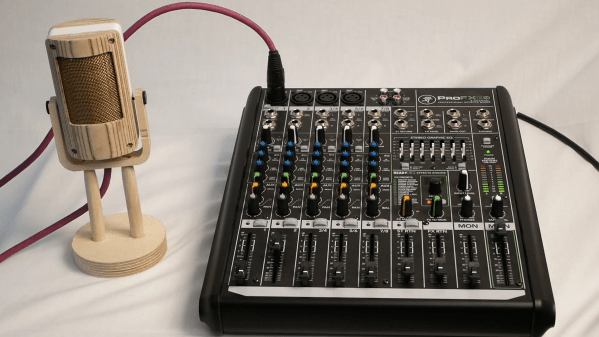
Now, we’re not completely sure that [Maya Román] was inspired by our coverage of [Frank Olson]’s homage to the RCA Model 44 studio mic rendered in walnut veneer, but we’re going to pat ourselves on the back here anyway. The interesting thing with [Maya]’s build is that she chose completely different materials and design styles for her project. Where [Frank] built as much of his mic from wood as possible, [Maya] was fine with a mixed media approach — CNC-milled plywood for the case and stand, laser-cut acrylic for the ribbon motor frame, and 3D-printed pieces here and there as needed. The woven brass cloth used as a windscreen is a nice detail; while the whole thing looks — and sounds — great, we think it would be even better with a coat of dark stain to contrast against the brass, as well as a nice glossy coat of polyurethane.
The video below shows the whole design and build process, which was a final project for [Maya]’s audio production class this semester at college. Here’s hoping that it got as good a grade as we would give it.
Continue reading “Wood Enclosure Lends Warmth To This DIY Ribbon Microphone”
Otters Deliver A High Power Stationary Audio Experience
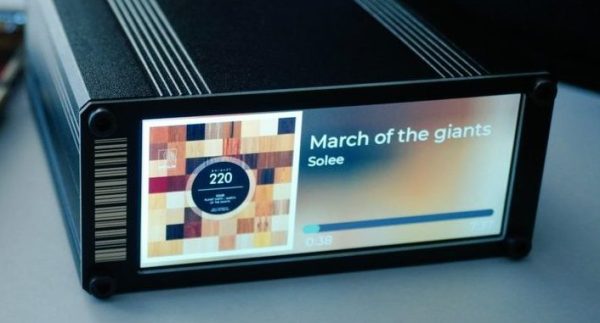
Our favorite raft of otters is back at it again with another display of open source audio prowess as they bring us the OtterCastAmp, the newest member of the OtterCast family of open source audio multitools. If you looked at the previous entry in the series – the OtterCastAudio – and thought it was nice but lacking in the pixel count or output power departments then this is the device for you.
The Amp is fundamentally a very similar device to the OtterCastAudio. It shares the same Allwinner S3 Cortex-A application processor and runs the same embedded Linux build assembled with Buildroot. In turn it offers the same substantial set of features and audio protocol support. It can be targeted by Snapcast, Spotify Connect or AirPlay if those are your tools of choice, or act as a generic PulseAudio sink for your Linux audio needs. And there’s still a separate line in so it source audio as well.
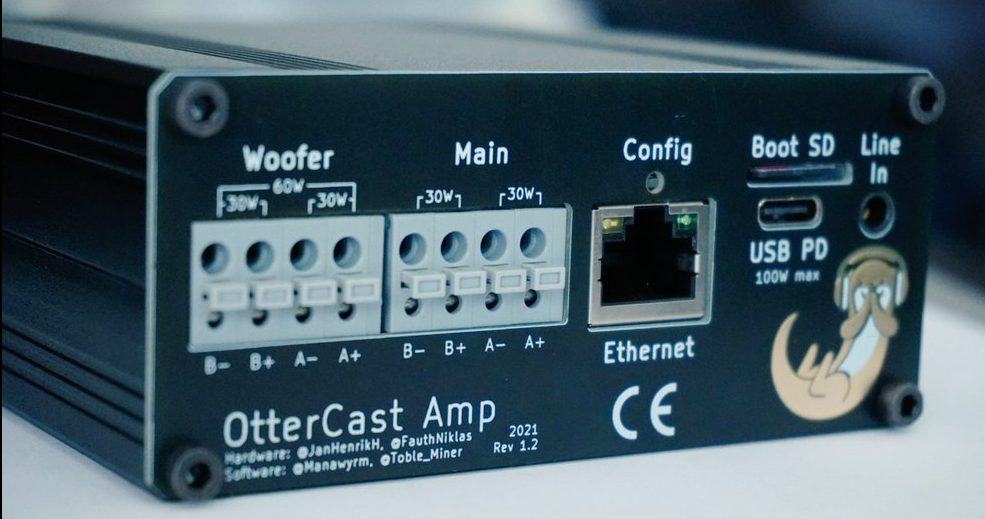
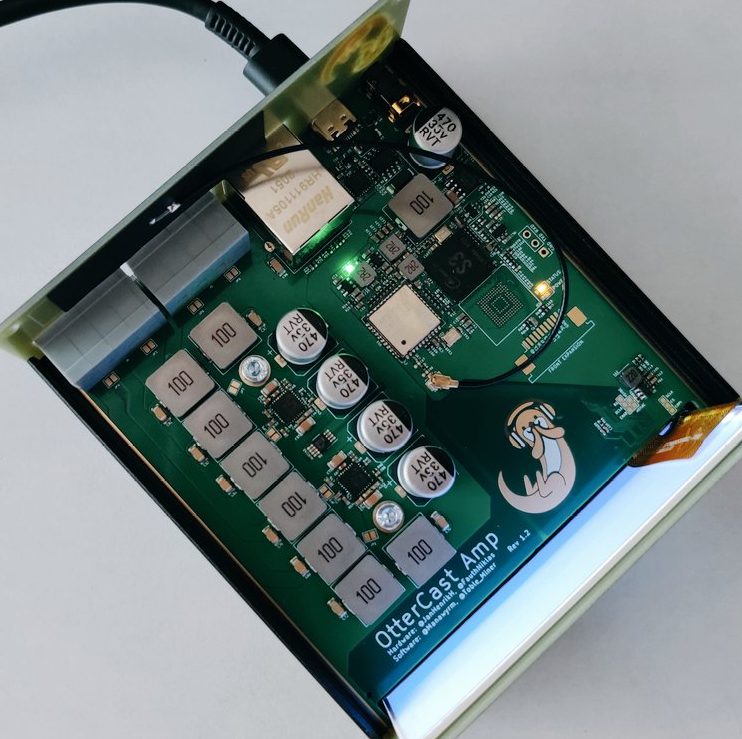
One look at the chassis and it’s clear that unlike the OtterCastAudio this is not a simple Chromecast Audio replacement. The face of the OtterCastAmp is graced by a luscious 340×800 LCD for all the cover art your listening ear can enjoy. And the raft of connectors in the back (and mountain of inductors on the PCBA) make it clear that this is a fully fledged class D amplifier, driving up to 120W of power across four channels. Though it may drive a theoretical 30W or 60W peak across its various outputs, with a maximum supply power of 100W (via USB-C power delivery, naturally) the true maximum output will be a little lower. Rounding out the feature set is an Ethernet jack and some wonderfully designed copper PCB otters to enjoy inside and out.


As before, it looks like this design is very close to ready for prime time but not quite there yet, so order at your own risk. Full fab files and some hints are linked in the repo mentioned above. If home fabrication is a little much it looks like there might be a small manufacturing run of these devices coming soon.
Mythbusting Tidal’s MQA Format – How Does It Measure Up?
MQA is an audio format that claims to use a unique “origami” algorithm, promising better quality and more musicality than other formats. At times, it’s been claimed to be a lossless format in so many words, and lauded by the streaming services that use it as the ultimate format for high-fidelity music. With the format being closed source and encoders not publicly available, these claims are hard to test. However, [GoldenSound] wasn’t born yesterday, and set out to test MQA by hook or by crook. The results were concerning. (Video, embedded below.)
To actually put the format through its paces, the only easy way available was to publish music to the Tidal streaming service, which uses the format. [GoldenSound] went this route, attempting to get some test files published. This hit a brick wall when the publishing company reported that the MQA software “would not encode the files”. The workaround? [GoldenSound] simply cut some audio test content into the middle of an acoustic track and resubmitted the files, where they were accepted without further complaint.
Testing with the content pulled from Tidal, [GoldenSound] found concerning evidence that the claims made around MQA don’t stack up. Significant amounts of added noise are often found in the MQA-processed files, and files served from Tidal are clearly not lossless. Additionally, MQA’s “blue light” authentication system, designed to guarantee to listeners that they’re listening to a identical-to-studio release, is demonstrated to be misleading at best, if not entirely fake.
Upon writing to MQA to get a response to his findings, [GoldenSound]’s test files were quickly stripped from Tidal. The company eventually disputed some of the findings, which is discussed in the video. The general upshot is that without open, transparent tools being made publicly available to analyse the format’s performance, it’s impossible to verify the company’s claims.
We’ve had fun looking at audio formats before, from the history of MP3 to musing on digital audio at truly ridiculous sample rates. Continue reading “Mythbusting Tidal’s MQA Format – How Does It Measure Up?”
You Otter Be Able To Stream That Audio: Open Hardware Eclipses Chromecast Audio
When Google halted production of the Chromecast Audio at the start of 2019, there was a (now silent) outcry. Fans of the device loved the single purpose audio streaming dongle that delivered wide compatibility and drop-dead simplicity at a rock bottom $35 price. For evidence of this, look no further than your favorite auction site where they now sell for significantly more than they did new, if you can even find an active listing. What’s a prolific hacker to do about this clear case of corporate malice? Why, reinvent it of course! And thus the Otter Cast Audio V2 was born, another high quality otter themed hack from one of our favorite teams of hardware magicians [Lucy Fauth, Jana Marie Hemsing, Toble Miner, and Manawyrm].

The Otter Cast Audio is a disc about the shape and size of standard Chromecast (about 50mm in diameter) and delivers a nearly complete superset of the original Chromecast Audio’s features plus the addition of a line in port to redirect audio from existing devices. Protocol support is more flexible than the original, with AirPlay, a web interface, Spotify Connect, Snapcast, and even a PulseAudio sink to get your Linux flavored audio bits flowing. Ironically the one thing the Otter Cast Audio doesn’t do is act as a target to Cast to. [Jan] notes that out of all the protocols supported here, actual Cast support was locked down enough that it was difficult to provide support for. We’re keeping our fingers crossed a solution can be found there to bring the Otter Cast Audio to complete feature parity with the original Chromecast Audio.
But this is Hackaday, so just as important as what the Otter Cast Audio does is how it does it. The OtterCast team have skipped right over shoehorning all this magic into a microcontroller and stepped right up to an Allwinner S3 SOC, a capable little Cortex A7 based machine with 128 MB of onboard DDR3 RAM. Pint sized by the bloated standards of a fully interactive desktop, but an absolutely perfect match to juggling WiFi, Bluetooth, Ethernet, and convenient support for all the protocols above. If you’re familiar with these hackers’ other work it won’t surprise you that what they produced here lives up to the typical extremely high quality bar set by such wonders as this USB-C adapter for JBC soldering iron handles and this TS-100 mainboard replacement.
It sounds like a small production run might be on order in the future, but until then production files optimized for a particularly popular Chinese manufacturer are provided, with complete BOM and placement files. It sounds like turnkey production costs from that manufacturer are a shockingly reasonable $10 (total) per unit with most components, and come to a still-reasonable $22 with the remaining self-sourced components manually installed.
For a demo of the finished goods, check out the tweet embedded after the break.
Continue reading “You Otter Be Able To Stream That Audio: Open Hardware Eclipses Chromecast Audio”