Award Clock Put To Good Use As A Bench Meter

award-clock-turned-voltage-meter

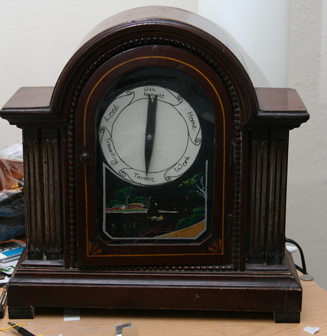
The motivation industry turns out these type of award trinkets by the millions. Here’s a way to actually put the thing to use. Instead of displaying time, the clock dial serves as the readout of a voltage meter.

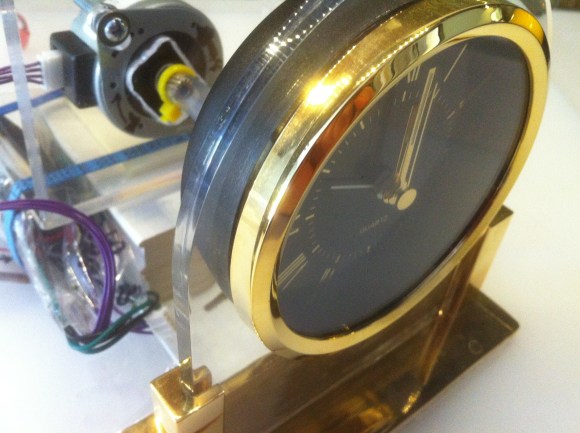
When we first saw this post we assumed that the hack used some type of coil injection to drive the hands. But it turns out that this is mechanically driven. The image above shows the stepper motor which is mounted behind the clock. Its drive shaft is coupled with the adjustment knob on the back of the clock. The precision of the motor lets the PICAXE set the clock dial based on the number of motor steps. The hour hand shows the tens value with the minutes serving as ones (base 10, not base 60). This means the top measurable voltage is 12V — when the hour hand is at 12 the measurement is 0 volts plus tenths of a volt from the minute hand. With the dial taken care of the rest of the project focuses on measuring the voltage using the ADC, which has an upper limit of just 5V. This is overcome with a simple voltage divider.

After the break you can see the accuracy of the rig as it performs measurements next to a digital voltmeter.

Continue reading “Award Clock Put To Good Use As A Bench Meter”

Accurate Timers With An AVR

timer

An awful lot of microcontroller projects use timers to repeat an action every few minutes, hours, or days. While these timers can be as accurate as a cheap digital wrist watch, there are times when you need a microcontroller’s timer to measure exactly, losing no more than a few milliseconds a day. It’s not very hard to get a timer to this level as accuracy, as [Karl] shows us in a tutorial.

The problem with keeping time with a microcontroller has to do with the crystal, clock frequency, and hardware prescalers of your chip of choice. [Karl] started his project with an ATMega168 and a 20 MHz crystal and the prescaler set at 256. This made the 78.125 interrupts per second, but the lack of floating point arithmetic means one second for the microcontroller will be 0.9984 seconds to you and me.

[Karl]’s solution to this problem was to have the ATMega count out 78 interrupts per second for seven seconds, then count out 79 interrupts for one second. It’s not terribly complicated, and now [Karl]’s timers are as accurate as the crystal used for the ‘168’s clock.

Clock Display Taller Than You Is Just What Your Living Room Has Been Missing

huge-countdown-clock

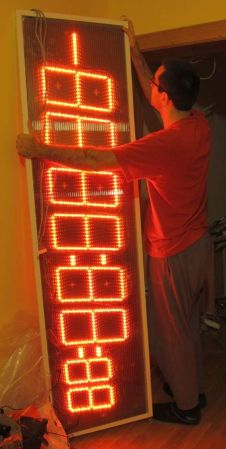
Sure, it’s time to get the countdown clocks ready to ring in the new year, but why limit it to just one night? If you end up building a six-foot digital display you can count down trivial events; like the remaining seconds of freedom before you have to pimp yourself out in that drab cubicle.

This seven-segment display is homemade and boasts six full-sized digits and two smaller digits with each pair separated by colons. You have probably already guessed that the construction was greatly simplified by using LED strips rather than individual components. This is part of the reason for the size of the display. The strips can be cut, but only down to a minimum of 3 LEDs per segment. That explains the small digits, with their larger siblings doubled in size. But there is a benefit to this constraint, it means that current limiting is already taken care of for you.

The main assembly is a wooden frame surrounding two polycarbonate sheets. The LED strips are sandwiched between those sheets, with segment and digit driver buses exiting a one point on the side. The build doesn’t detail a driver for the display but it shouldn’t be hard to find a multiplexing example that will serve the purpose.

Scrapped DVD Player Turns Into A Full Featured Clock

[Dmitry] really went the distance with this project. It started as a broken DVD player scrapped for parts, and turned into this clock with way too many features. That link is a pretty a dry technical collection of the work. You’ll definitely want to have a look at it, but we’d suggest first watching the demo video after the break which is initially much more exciting.

The donor DVD hardware included a Vacuum Fluorescent display which is the nugget which [Dmitry] was after. But that board came along with some other nice things, like an integrated IR receiver. He also chose to use the PSU from the device. An Arduino is used to drive the clock. We’re not sure where he found it, but the video shows the service manual for the DVD player which must have a been a real help in interfacing with the display. The white dome on the right is a PIR motion sensor. It brings the device out of sleep mode when someone is in the room.

The case is laser-cut and started as cardboard to ensure everything fit as designed. The enclosure makes it a showpiece, but the features of displaying day, date, time, and temperature make it functional as well. Since the VFD is alpha-numeric we think this could even see future upgrades to be used as a new-mail/tweet/IM alert as well.

QR Clock Is Unreadable By Humans And Computers Alike

The clock is a perfect technology. For just a few dollars, you can buy a digital wristwatch and chronometer able to keep extremely accurate time for years without winding a spring or replacing a battery. Anything ‘improvement’ on the design of a clock only makes it harder to read, a feature exploited by the very 1337 binary clocks we see from time to time. [Ch00f] decided it was time to give way to the march of progress and build a completely unreadable clock. He came up with a QR code clock that is unreadable by humans and cellphones alike.

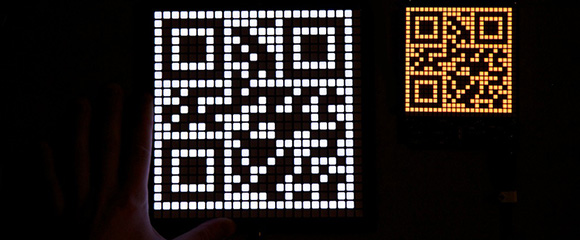
The hardware is built around nine 8×8 LED matrix panels resulting in a 24 x 24 pixel display, perfect for displaying a 21 pixel square QR code. The LED drivers are a standard multiplexed affair, but this project really shines in the firmware department.

The microcontroller [Ch00f] used – an ATMega328 – is far too small to store the 1440 QR codes for every minute of the day. No, this project would have to dynamically generate QR codes on the fly, not exactly an easy problem.

After looking over the official QR code standard, [Ch00f] wrote a rather large program that turns alphanumeric sequences into QR code. This runs on the microcontroller every minute, generating a new QR code for every minute of the day.

It’s nigh impossible for a human to read a QR code, but [Ch00f] figured he could make his project even less useful. By multiplexing the LEDs at a very low duty cycle [Ch00f] made it impossible for a camera to capture the entire QR code, even though the pattern of pixels is still visible to the human eye. A fabulously useless build that really steps up the game for unreadable clocks.

Video after the break.

Continue reading “QR Clock Is Unreadable By Humans And Computers Alike”

An Ice Tube Clock For The TI Launchpad

Because Nixies, Decatrons, and VFD tubes really are that cool, [cubeberg] over on the 43oh forums designed an IV-18 clock for the TI Launchpad.

Like adafruit’s Ice Tube clock, [cubeberg]’s project uses a surplus Russian IV-18 VFD tube conveniently sourced on eBay. On the board, there are three buttons for changing the time and setting the alarm along with a MAX6921 VFD tube driver and a small switching regulator to boost the 5 Volts on the Launchpad to the 50 V the tube requires.

There was a little bit of space left on [cubeberg]’s PCB design, and he filled that space with a header for a buzzer and a temperature sensor. Right now, the code doesn’t support an alarm function and he’s still waiting on a few components to finish off the thermometer portion of the board, but it’s still the makings of a very nice clock.

If you’d like to grab your own Launchpad ice tube clock, [bluehash] is organizing a group buy for 430h forum members. If they can get 15 pieces built, the clock will cost less than $5/unit. Very cool, and very cheap when you consider TI is practically giving Launchpads away.

Volt Meter Clock Also Displays The Temperature

[IronJungle] got around to putting together every tinkerers favorite project: a clock with a strange way of displaying the time. For his clock, [Jungle] took a trio of voltmeters and turned them into a clock that displays the current hour, minute, and second on custom paper dials.

[IronJungle] connected a PIC 14M2 microcontroller to a DS1307 real time clock to keep track of the current time. As for display, [Jungle] took a trio of volt meters and wired them in to the PWM outputs on his PIC. With this, he was able to precisely control the position of the needle in the meter, and thus display the time.

In addition to displaying the time, [IronJungle] added a small temperature sensor to his build. By pressing a button below the seconds display, the clock is able to display the current temperature in Fahrenheit, Celsius, and Kelvin.

After the break you can check out a time-lapse video of [IronJungle]’s voltmeter clock going through the hours.

Continue reading “Volt Meter Clock Also Displays The Temperature”