Clock Monitors Deep Space Network, Keeps Vigil Over Lost Mars Rover

It’s been a long, long time since we heard from Opportunity, the remarkable Mars rover that has shattered all expectations on endurance and productivity but has been silent since a planet-wide dust storm blotted out the Sun and left it starved for power. Right now, it’s perched on the edge of a crater on Mars, waiting for enough sunlight to charge its batteries so it can call home. All we can do is sit, and wait.

To pass the time until Opportunity stirs again, [G4lile0] built this Deep Space Network clock. Built around an ESP32 and a TFT display, the clock monitors the Deep Space Network (DSN) website to see if mission control is using any of the huge antennas at its disposal to listen for signals from the marooned rover. If the DSN is listening, it displays a special animation exhorting the rover to phone home; otherwise, it shows which of the many far-flung probes the network is communicating with, along with a slideshow of Mars mission photos to keep the spirits up. When the day finally comes that Opportunity checks in, an alarm will sound so [G4lile0] can pop the champagne and celebrate with the rest of us.

We realize that the odds that Opportunity will survive this ordeal are decreasing by the Sol. It’s an uphill battle; after all, the machine was 55 times its original 90-day design life when it went dark, so it’s an uphill battle. Then again, it has beaten the odds before, so there’s still hope.

Continue reading “Clock Monitors Deep Space Network, Keeps Vigil Over Lost Mars Rover”

M5Stack Device Disassembled

Putting M5Stack On LoRa And The Things Network

LoRa is the new hotness in low-power, long-range communications. Wanting to let the packets fly, [Xose] was faced with a frequecny problem and ended up developing a Europe-friendly LoRa module for the M5Stack system. The hardware is aimed at getting onto The Things Network, a LoRa based network that provides connectivity for IoT devices. While there was an existing M5Stack module for LoRa, it only supported 433 MHz. Since [Xose] is in Europe, an 868 MHz or 915 MHz radio was needed. To solve this, a custom board was built to connect the HopeRF RFM69 series of modules to the M5Stack.

If you haven’t heard of it before, the M5Stack platform is a stackable development board platform. Like Arduino, you can add functionality by stacking PCBs using a standard header. Unlike Arduino, M5Stack fits in a case nicely and is designed for building devices with user interfaces. For $35, you get an ESP32 based system with WiFi, Bluetooth, a color LCD, battery, buttons, a speaker, and IO connectors.

With the hardware in place, [Xose] 3D printed a custom case to hold the board and added it to the stack. The firmware acts as a monitor for The Things Network, showing live coverage. The final product looks very clean for a prototype, maintaining the finished look of M5Stack.

The firmware, board design, and case design files for the project are all available on Github.

DrawBot Badge Represents The CNC World In Badge Design

Badges come in all shapes and sizes, but a badge that draws on a stack of Post-It notes is definitely a new one. The design uses three of the smallest, cheapest hobby servos reasonably available and has a drawing quality that creator [Bart Dring] describes as “adorably wiggly”. It all started when he decided that the CNC and mechanical design world needed to be better represented in the grassroots demo scene that is the badge world, and a small drawing machine that could be cheaply made from readily available components seemed just the ticket.

Two arms control the position of a pen, and a third motor lifts the assembly in order to raise or lower the pen to the drawing surface. Gravity does most of the work for pen pressure, so the badge needs to be hanging on a lanyard or on a tabletop in order to work. An ESP32 using [Bart]’s own port of Grbl does the work of motion control, and a small stack of Post-It notes serves as a writing surface. Without the 3D printed parts, [Bart] says the bill of materials clocks in somewhere under $12.

We’ve seen similar designs doing things like writing out the time with a UV LED, but a compact DrawBot on a badge is definitely a new twist and the fact that it creates a physical drawing that can be peeled off the stack also sets it apart from others in the badgelife scene.

Video Review: AND!XOR DEF CON 26 Badge

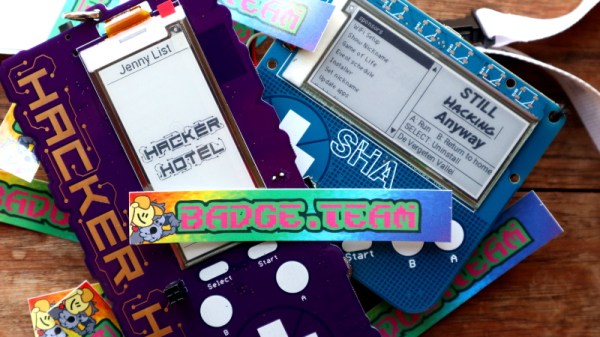
The AND!XOR team have somehow managed to outdo themselves once again this year. Their newest unofficial hardware badge for DEF CON 26 just arrived. It’s a delightful creation in hardware, software, and the interactive challenges built into both.

They call this the “Wild West of IoT”, a name that draws from the aesthetic as well as the badge-to-badge communications features. Built on the ESP32-WROVER module which brings both WiFi and Bluetooth to the party, the badges are designed to form a wireless botnet at the conference. Anyone with a badge can work to advance their level and take more and more control of the botnet as they do.

Check out the video overview and then join me below for a deeper dive into all this badge has to offer.

Continue reading “Video Review: AND!XOR DEF CON 26 Badge”

Grbl Ported To The ESP32

If you’re building a CNC or laser, there’s an excellent chance you’ll be using Grbl to get moving. It’s also a pretty safe bet you’d end up running it on some variation of the Arduino sitting in a motor controller breakout board. It’s cheap, easy to setup and use, and effectively the “industry” standard for DIY machines so there’s no shortage of information out there. What’s not to love?

Well, quite a few things in fact. As [bdring] explains, Grbl pushes the capability of the Arduino to the very limit; making it something of a dead-end for future development. Plus the Arduino needs to be plugged into the host computer via USB to function, a rather quaint idea to many in 2018. These were just some of the reasons he decided to port Grbl to the ESP32 board.

Price wise the Arduino and ESP32 are around the same, but the ESP does have the advantage of being much more powerful than the 8-bit Italian Stallion. Its got way more flash and RAM as well, and perhaps most importantly, includes Wi-Fi and Bluetooth out of the box. It still needs to be plugged into a board to hold the motor drivers like the Arduino, but beyond that [bdring] opines the ESP32 is about as close to the perfect Grbl platform as you can get.

[bdring] reports that porting the code over to the ESP32 wasn’t terrible, but it wasn’t exactly a walk in the park either. The bulk of the code went by without too much trouble, but when it came to the parts that needed precise timing things got tricky. The ESP32 makes use of a Real Time Operating System (RTOS) that’s not too happy about giving up control of the hardware. Turning off the RTOS was an option, but that would nuke Bluetooth and Wi-Fi so obviously not an ideal solution. Eventually he figured out how to get interrupts more or less playing nicely with the RTOS, but mentions there’s still some more work to be done before he’s ready to release the firmware to the public.

If you’ve been browsing Hackaday for a while you may remember [bdring]. He’s got a real knack for making things move, and has created a number of fantastic little CNC machines recently which have definitely caught our eye.

[Thanks to Jon and Craig for the tip.]

Continue reading “Grbl Ported To The ESP32”

A Sneak Preview Of The Hacker Warehouse Badge

We were lucky enough to get our hands on a hand-soldered prototype of the new Hacker Warehouse badge, and boy is this one a treat. It’s fashionable, it’s blinky, and most impressively, it’s a very useful tool. This badge can replace the Google Authenticator two factor authentication app on your phone, and it’s a USB Rubber Ducky. It’s also a badge. Is this the year badges become useful? Check out the video below to find out more.

This is the time of year when hardware hackers from all across North America are busy working on the demoscene of hardware and manufacturing. This is badgelife, the celebration of manufacturing custom wearable electronics for one special weekend in Las Vegas. In just about a month from now, there will be thousands of independent badges flooding Caesar’s Palace in Vegas, complete with blinkies, custom chips, innovative manufacturing processes, and so many memes rendered in fiberglass and soldermask.

Continue reading “A Sneak Preview Of The Hacker Warehouse Badge”

Carousel Of Cereals Mixes And Matches Custom Breakfast Blends

There are those who reckon the humble bowl of breakfast cereal to be the height of culinary achievement. Look askance if you must, but cereal junkies are a thing, and they have a point. The magic comes not from just filling a bowl and adding a splash of milk, but by knowing which cereals to mix together.

Who needs all that fussy mixing, though, when you can automate and customize your cereal dispensing chores? That’s the approach [Kevin Obermann] and [Adrian Bernhart] took with their Cereal Dispensing Machine, even if they went a little further than necessary. Laser-cut plywood forms a four-station carousel for off-the-shelf dry-good dispensers, each of which got a stepper motor to replace the wrist-twisting. The original motors were a bit too wimpy to handle the more rugged morning selections and were eventually upgraded to gear motors. The platform that supports the dispensers also holds all the electronics, including an ESP32 to run everything and host the web app needed to choose your poison. Plus RGB LEDs, because breakfast should look like a rave. Sadly, the team ran out of GPIO pins and were unable to run the peristaltic pump needed to add the milk. There will always be version 2.0, though.

If cereal isn’t your automated breakfast of choice, we understand. Perhaps a more [Wallace] and [Gromit] style breakfast machine would do, or a robotic peanut butter sandwich any time of day is a treat.

Continue reading “Carousel Of Cereals Mixes And Matches Custom Breakfast Blends”