Less Dear Heating For The Deer

Keeping animals from tropical regions of the world in a cold climate is an expensive business, they need a warm environment in their pens and sleeping areas. Marwell Zoo was spending a small fortune keeping its herd of nyalas (an antelope, not as the title suggests a deer, native to Southern Africa) warm with electric heating, so they went looking for a technology that could reduce their costs by only heating while an animal was in its pen.

One might expect that a passive IR sensor would solve the problem, but a sleeping nyala too soon becomes part of the background heat for these devices, and as a result, the heaters would not operate for long enough to keep the animals warm. The solution came from an unlikely source, a coffee queue monitoring project at the IBM Watson headquarters in Munich, that used an array of infra-red sensors to monitor the changing heat patterns and thus gauge the likelihood of a lengthy wait for a beverage.

In the zoo application, an array of thermal sensors hooked up to ESP8266 boards talk back to a Raspberry Pi that aggregates the readings and sends them to the IBM Watson cloud where they are analyzed by a neural net. The decision is then made whether or not a nyala is in the field of view, and the animal is toasted accordingly.

This project has some similarities with a Hackaday Prize entry, automated wildlife recognition, in its use of Watson.

Nyala image: Charlesjsharp [CC BY-SA 4.0 ].

3D Print A Home Automation Switch

If you are the kind of person who won’t use cheap Sonoff modules to control AC powered devices, we don’t blame you and you should probably stop reading now. However, if you don’t mind a little exposed AC wiring and you have a 3D printer, you might be interested in the second generation of [530 Project’s] in-wall light switch.

The 3D printed switch fits a standard box and uses the guts of a Sonoff controller. These work with all the popular ecosystems such as Alexa and Google Home. And they are cheap. Like, really cheap. If you already have a 3D printer, even counting the cost of the filament these are going to be a small fraction of the cost of a commercial switch. You can see a video about the device, below.

Continue reading “3D Print A Home Automation Switch”

3D Printed Wave Lamp Forecasts The Weather

While browsing Thingiverse, [Dushyant Ahuja] found a rather pleasing wave lamp, and since a mere lamp on its own would not quite be enough, he added a means by which his lamp could provide weather alerts by means of changing its color.

It’s fair to say that the wave lamp is not a print for the faint-hearted, and it took him 30 hours to complete. However, it has the interesting feature of not requiring a support or raft. There is also a base for the lamp designed to take a strip of addressable LEDs, and he modified its design to mount a small PCB containing an ESP8266 module and a level shifter chip. The code for the ESP relies on the OpenWeatherMap API, and changes the LED color based on the rainfall forecast.

Casting our minds back a decade, this lamp is reminiscent of the long-departed Nabaztag product, best described as an internet-connected plastic anthropomorphic rabbit that could keep you updated with information such as weather or stock market trends through lighting up and the movement of its ears. It was an overpriced idea tied into a proprietary online back end that was probably well before its time back in 2004. Perhaps repackaged for 2017 with a commodity microcontroller board Nabaztag has finally found its application.

There is a short video showing the color change and an LED animation, which we’ve put below the break.

Continue reading “3D Printed Wave Lamp Forecasts The Weather”

Finding Your Motorbike Using Wi-Fi

An urban planner once told me that every car requires at least four times as much space as they actually occupy. Each needs a spot on the roads, and three available parking spaces: one at home, one at work, and one to shop. Motorcycles are much smaller, but they still spend most of their time parked.

Motorcycles are the primary means of transport in Southeast Asia, and learning to safely drive one is an essential part of adapting to life here. Assuming it’s not pouring rain and you’re not flooded past your ankles, it’s actually quite a pleasant experience… until you have to park.

Unlike the parking lots you may be familiar with, there’s no expectation that your bike won’t be moved. In fact, it might very well end up on another floor, in another parking lot, or behind hundreds of impassable parked bikes on the roof. In the latter case, the attendant will shrug and suggest you come back in a few hours. Eventually, this won’t even register as a frustration – you will simply reason that there are plenty of other things that are more convenient here, like the weather (recent typhoon aside) or unlimited symmetrical fiber to the home for USD 5 a month.

That being said, with a little technology the problem could be lessened a bit while waiting for automated parking lots to become commonplace. On rare occasions I see people with little radio emitters that make their headlights flash, but they’re not terribly common here and require carrying yet another thing on my already full key chain (homes here typically use several different locks). It seemed pretty easy to pull off something similar using my smart phone with an ESP8266 running NodeMCU. I had been meaning to try out the sleep modes to save battery power anyway, so off I went.

Continue reading “Finding Your Motorbike Using Wi-Fi”

Two Factor Authentication With The ESP8266

Google Authenticator is a particularly popular smartphone application that can be used as a token for many two factor authentication (2FA) systems by generating a time-based one time password (referred to as TOTP). With Google Authenticator, the combination of your user name and password along with the single-use code generated by the application allows you to securely authenticate yourself in a way that would be difficult for an attacker to replicate.

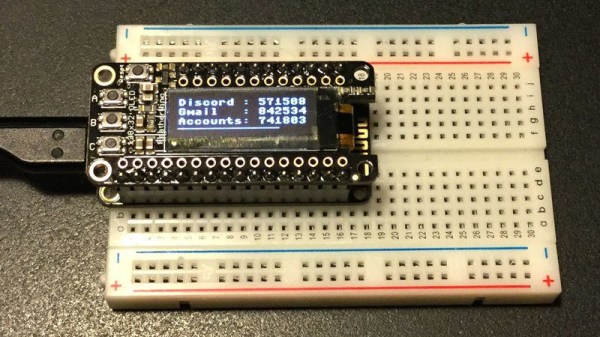
That sounds great, but what if you don’t have a smartphone? That’s the situation that [Lady Ada] recently found herself in, and rather than going the easy route and buying a hardware 2FA token that’s compatible with Google Authenticator, she decided to build one herself based on the ESP8266. With the hardware and source documented on her site, the makings of an open source Google Authenticator hardware token are available for anyone who’s interested.

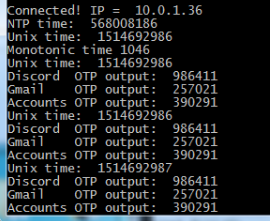
Generated codes can also be viewed via serial.

For the hardware, all you need is the ESP8266 and a display. Naturally [Lady Ada] uses her own particular spin on both devices which you can purchase if you want to create an identical device, but the concept will work the same on the generic hardware you’ve probably already got in the parts bin. Software wise, the code is written in CircuitPython, a derivative of MicroPython, which aims to make microcontroller development easier. If you haven’t tried MicroPython before, grab an ESP and give this a roll.

Conceptually, TOTP is relatively simple. You just need to know what time it is, and run an SHA1 hash. The time part is simple enough, as the ESP8266 can connect to the network and get the current time from NTP. The calculation of the TOTP is handled by the Python code once you’ve provided it with the “secret” pulled from the Google Authenticator application. It’s worth noting here that this means your 2FA secrets will be held in clear-text on the ESP8266’s flash, so try not to use this to secure any nuclear launch systems or anything, OK? Then again, if you ever lose it the beauty of 2-factor is you can invalidate the secret and generate a new one.

We’ve covered the ins and outs of 2FA applications before here at Hackaday if you’d like to know more about the concept, in addition to previous efforts to develop a hardware token for Google Authenticator.

Mine Bitcoin With An ESP8266

With all the hype surrounding cryptocurrencies and the current high not quite so high but still pretty eye-watering price of Bitcoin, there are some things which might once have been pure folly that could now be deemed worthy of pursuit. There is an excavation mission being considered to unearth a hard drive containing an early Bitcoin wallet in a Welsh landfill, for instance. But a more approachable task for you may be the possibility of mining using minimal hardware.

Take [Merlot Machina]’s project for example, implementing a Bitcoin miner on an ESP8266. Part of this is the timeless pursuit of answering the joke question: “Will it mine Bitcoin”, and the other part is looking at this like a lottery ticket. Is it a worthwhile punt at a prize for a minimal investment?

He gives us a rundown of some of the statistics involved, and comes away with the conclusion that it is something like a not-very-good lottery ticket. The ESP performs 1200 hashes per second while the entire Bitcoin community manages about 1.2 exahashes per second. This he calculates gives him a 1 in 1016 chance of mining a block every ten minutes, which for the tiny cost of an ESP and its relatively frugal power budget is a chance he sees as worth taking.

So far he has implemented the hashing algorithm and verified it against a known hash on an already-mined block. At this point though he’s hit a roadblock in the need to run Bitcoin core on a server to keep the ESP supplied with new block headers, so the ESP miner remains a proof of concept. The write-up is still an interesting read though, and given that many readers will have a few spare ESP boards it’s possible that one of you may take it to the next level and Win It Big. If that’s you, you’ll be able to sit on your private island sipping a cool drink, and laugh at the commenters who said it would never happen. Meanwhile here at Hackaday we’ll stick to tried-and-trusted revenue generation strategies, such as bringing you the latest hardware hacks.

This might seem a peculiarly slow miner, but it’s not the slowest we’ve seen by any means. The ever-prolific [Ken Shirriff] has tried it on an IBM 1401 mainframe and a Xerox Alto, and you can of course do it the old-fashioned way.

An IoT Christmas Tree For Your Hacker-Mas Celebrations

Smart Christmas trees may soon come to mean something more than a fashionably decorated tree. Forging ahead with this new definition, [Ayan Pahwa], with help from [Akshay Kumar], [Anshul Katta], and [Abhishek Maurya] turned their office’s Christmas Tree into an IoT device you can watch live!

As an IoT device, the tree relies on the ever-popular ESP8266 NodeMCU — activated and controlled by Alexa, as well as from a web page. The LEDs for the tree — and the offline-only tree-topper controlled by an Arduino Pro Mini — are the similarly popular Neopixels.

For those viewing online, a Raspberry Pi and camera have been attached to this project to check out the tree’s lighting. To make that possible, [Pahwa] had to enlist the use of ngrok to make the Pi’s –normally — LAN-only camera server accessible over the internet. The aforementioned web page was coded in Javascript/CSS and hosted on a server running an instance of Ubuntu 16.04.

Continue reading “An IoT Christmas Tree For Your Hacker-Mas Celebrations”