Papercraft Gyroscope

Although spring keeps trying to break through the winter doldrums you might be looking for just one more weekend activity before the outdoor season begins. Grab the kids and give this paper gyroscope a try.

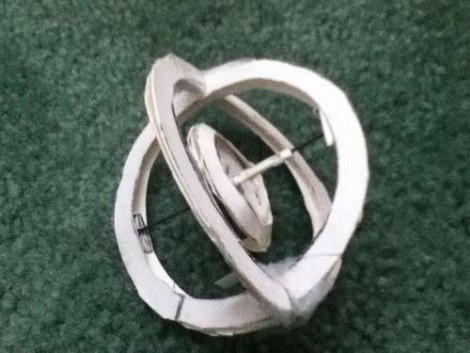
It’s not an electronic sensor made of paper, but the modern equivalent of a spinning top. The frame remains stationary while the center assembly spins at high speed, keeping the whole thing balanced on one narrow point. [Dombeef] put together a printable template which you can use to make your own parts. He got a hold of the heavy paper that’s used to hold X-ray film, but you can just trace out multiple copies of the parts and make a beefy section by laminating them together with glue. Combine the inner and outer parts using a paper clip as the axis and you’re ready to go. Pull hard on a bit of floss wound around the axis to get the center frame spinning, then sit back and see how long it will remain standing.
Measure Earth’s Rotation With PlayStation Move

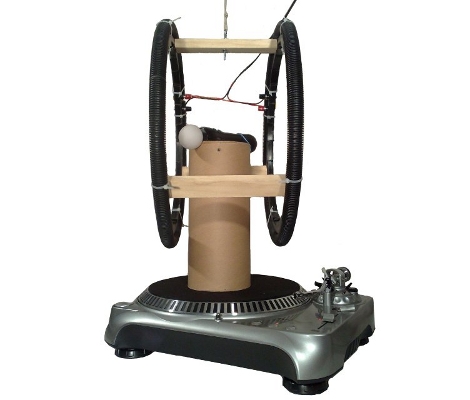
This somewhat odd-looking apparatus is being used to measure earth’s rotation. At the heart of the system is a PlayStation Move controller, used because of its dual-axis gyroscope which has the highest dynamic range compared to other available products like the Wii Motion Plus. It rests on a column perched atop a record player that was chosen because of its precision rotation rate. The two rings that flank the controller make up a Helmholtz coil which is used to cancel out the earth’s magnetic field which was found to be interfering with measurements taken by the Move controller. By recording data over time the experimenter can prove that the earth is indeed rotating, as well as ascertain longitude data and find true north. Check out the data-packed video after the break.

Continue reading “Measure Earth’s Rotation With PlayStation Move”

Data Logging Football

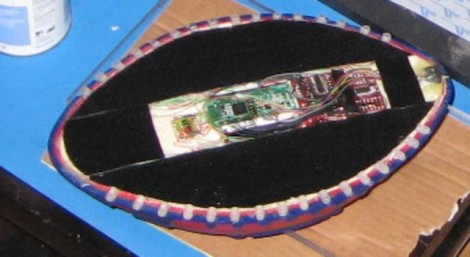
[Ben Kokes] threw together a hardware package to capture data from a football. In the center of a Nerf football he made room for an accelerometer, gyroscope, and an electronic compass.  All three can capture 3-axis data and, along with the LEDs ringing the circumference, they’ve controlled by an XMEGA192 microcontroller.

This makes us think back to a time when baseballs with a built-in speed sensor first hit the market… does this hack have mass marketing potential? Perhaps, but only if the $225 sensor price tag were greatly reduced. When we first started reading the description we hoped that [Ben] had coded an interpreter that would render 3D playback video from the data. He hasn’t done that, but from the data graphs he did assemble we don’t think that functionality is out of the question. We’ll keep our fingers crossed.

Easy Quadrotor Helicopter Instructions

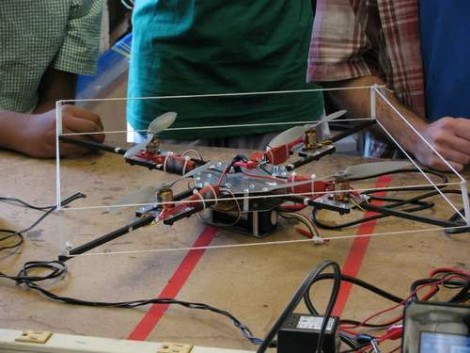
Here’s a great tutorial on building your own quadrotor helicopter. This build isn’t necessarily less expensive than others we’ve seen since quality motors, propellers, and control circuitry aren’t cheap. But the design and assembly is well documented and presents a well-planned building procedure. The carbon-fiber tubes that make up the frame have extensions to protect the motors and propellers in the event of a crash. The Arduino, IMU, and transceiver are all tucked away between two aluminum body plates as well. They only thing missing is a solid methodology for tuning the four motors, a critical procedure that is just touched up at the end of the article.

Adding Motion Control To An RC Transmitter

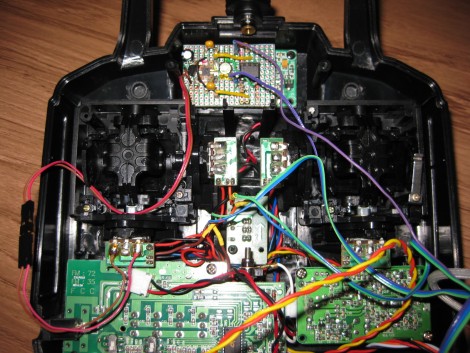
If your soldering skills are up to snuff you can add a motion control feature to your radio controlled transmitter. [Starlino] used a combination accelerometer and gyroscope module as an alternate source of analog control information. He built a filter to dial in the analog voltage range to match that of one of the sticks on the controller. A switch is used to disconnect the signal when motion input is not desired. This would be a nice addition to one of those more creative aerial hacks.

Gaming’s Newest Accessory: Headbands

These aren’t terrorists, they’re electrical engineering students. For their final project they developed a headband and rifle input system for the NES. The controllers send data to a laptop which then maps out the inputs to NES controller commands and sends them to an original NES console, no emulation here.

The controllers in the headband and rifle are Firefly sensor network nodes. Originally, [Kevin] and [Evan] tried using accelerometers for motion information but found the data do be unreliable. After an upgrade to gyroscope modules the interface is much more responsive, as seen about 3:50 into the video after the break. We like seeing motion controller hacks and we appreciate the choice of a classic system (and lesser known game title). This really makes it a whole different game.

Continue reading “Gaming’s Newest Accessory: Headbands”

AeroQuad – Build Your Own Quadcopter

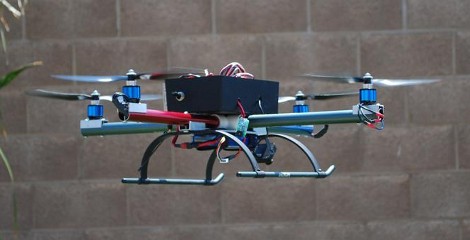
It hurts us to look at this quadcopter, agonizingly so when we watch the video after the break. That’s because we feel the unstoppable compulsion to build one. This four-rotor helicopter has a lot to be proud of; it features Gyro stabilization, Xbee remote control for very long distance operation, and computer interface for data graphing and calibration.

We like the quadcopter that we came across at CES but building one of our own is more fun than buying it ready-made. The pain we’re feeling is mostly in our pocketbook. To help ease the agony we scoured the parts list and the assembly instructions in order to get an estimate of what this might cost. We’re looking at around $415 plus shipping, not including transmitter and receiver for controlling it.  Yep, that’s a sharp stabbing pain but we’re not sure we can just let it go.

Continue reading “AeroQuad – Build Your Own Quadcopter”