Raspberry Pi And ESP32-S2 Team Up For MutantC_V4

Back in 2019 we first came across the mutantC, an open source 3D printable Raspberry Pi handheld created by [rahmanshaber] that took more than a little inspiration from Sony’s VAIO ultra-mobile PCs (UMPCs) from the early 2000s. It was an impressive first effort, but it clearly had a long way to go before it could really be a practical mobile device.

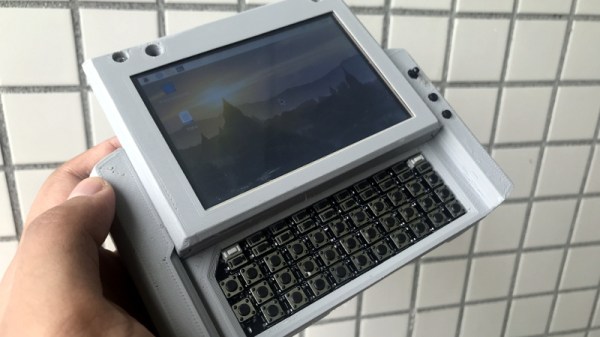
Well after two years of development and three iterative versions of this Linux powered QWERTY slider, [rahmanshaber] is ready to show off the new and improved mutantC_v4. Outwardly it looks quite similar to the original version, with the notable addition of a tiny thumbstick and a pair of programmable buttons on the right side that can be used for input in addition to the touch screen. But inside it’s a whole other story, with so many changes and improvements that we hardly even know where to start.

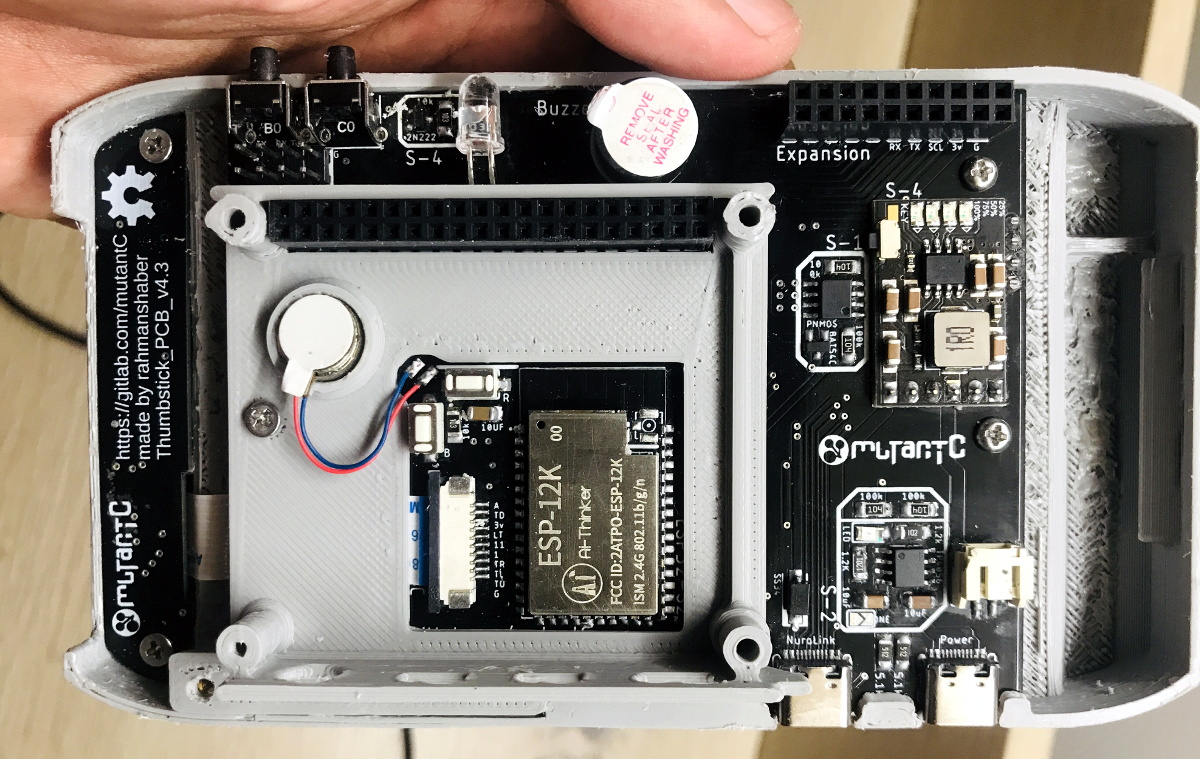
Inside the mutantC_v4, showing off the ESP32-S2

Probably the most notable improvement is the addition of an ESP32-S2, specifically a bare ESP-12K module, to the main PCB. Previous versions of the hardware used an Arduino Pro Micro to interface with all the hardware, but the added horsepower of the ESP32 should come in handy with the array of sensors, controls, and NeoPixels that [rahmanshaber] has tasked the chip with. There’s even a buzzer and a coin-style vibration motor in there to provide some feedback to the user. While the board has changed significantly, it still retains compatibility with the Pi Zero, 2, 3, and 4.

Another notable addition is the expansion connector on the bottom of the handheld that has pins for I2C, UART, and 3.3 V. In the video below, [rahmanshaber] mentions that this feature was previously implemented with a standard 2×6 female header block, but is now using a far slimmer female USB-C port. We do wonder if it’s not a bit confusing to have this faux-USB port right next to the real one that’s actually used to charge the system, but with such cramped quarters occasionally you’ve got to make some tough decisions like that.

It’s quite inspiring to see how [rahmanshaber] has honed his skills since releasing the first version of the mutantC. The 3D printed parts and PCBs have matured considerably over the last two years, showing how quickly a dedicated hobbyist can advance their abilities. The most recent version has been entered in the 2021 Hackaday Prize. But the show isn’t over yet, as we hear v5 of this impressive handheld may tackle the Raspberry Pi 4 Compute Module.

Continue reading “Raspberry Pi And ESP32-S2 Team Up For MutantC_V4”

PS2 Gets The Ginger Portable Treatment

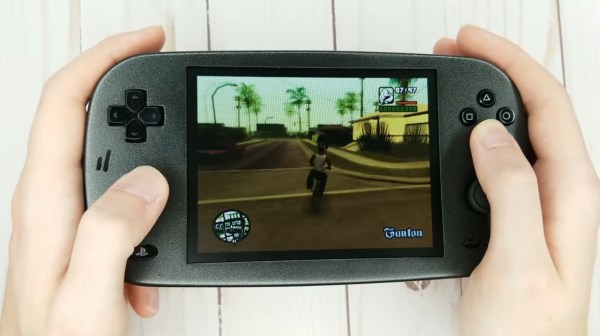
The first thing we notice about this portable PS2 is that the plastic looks like a consumer-grade shell, not a 3D printed case. It comes from [GingerOfOz], who has lots of portable conversions under his belt, so we are not surprised this looks like a genuine Sony device. When you are as experienced as he, details like plastic texture, and button selection, are solved problems, but shouldn’t be taken for granted by us mortals.

Of course, this isn’t just pretty, and if it weren’t functional, we wouldn’t be talking about it. The system plays nearly all PS2 titles from USB memory. The notable exceptions are the ones that refuse to load without a Dualshock controller. Rude. If you’re wondering if it plays games at full speed, yes. It achieves authentic speed because it uses a PS2 slim motherboard which gets cut down by a Dremel. Custom PCBs provide the rest of the hardware, like volume buttons and battery charging. There is no optical drive since they are power hogs, so your cinematic cut scenes may lag, and load times are a little longer.

Modern mobile phones are one of the most powerful gaming systems ever built, but there is something about purpose-built portable gaming hardware that just feels right. You know?

Continue reading “PS2 Gets The Ginger Portable Treatment”

Handheld Hackintosh Runs Mac OS On LattePanda

We’ve seen a huge influx of bespoke portable computers over the last couple of years thanks to availability of increasingly powerful single-board computers. The vast majority of these have been ARM powered using something like the Raspberry Pi 4, and naturally, run Linux. Only a handful have run on x86 hardware, usually because whoever built it wanted to be able to run Windows.

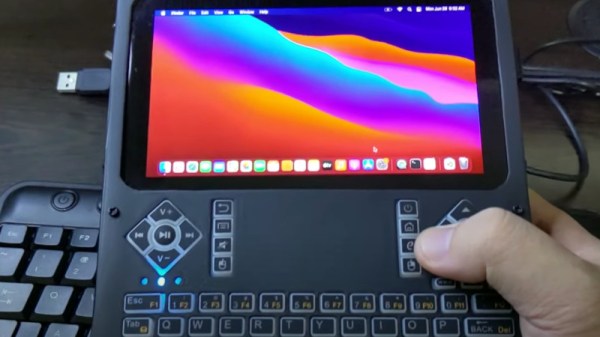
But this handheld x86 Hackintosh running the latest Mac OS on the LattePanda Alpha is truly something unique. Creator [iketsj] claims it to be a world’s first, and after a bit of searching, we’re inclined to agree. While others have installed Mac OS on the LattePanda to create Hackintosh laptops, this would indeed appear to be the first handheld computer to utilize this particular hardware and software blend.

Like other custom portables we’be seen, this one starts with a 3D printed enclosure. The overall design reminds us a bit of the YARH.IO we covered last year, and even borrows the trick of reusing the membrane and PCB of one of those miniature keyboard/pointer combos. Which in this case ends up being especially important, as in keeping with Apple’s own portable Mac OS machines, the screen on this handheld doesn’t support touch.

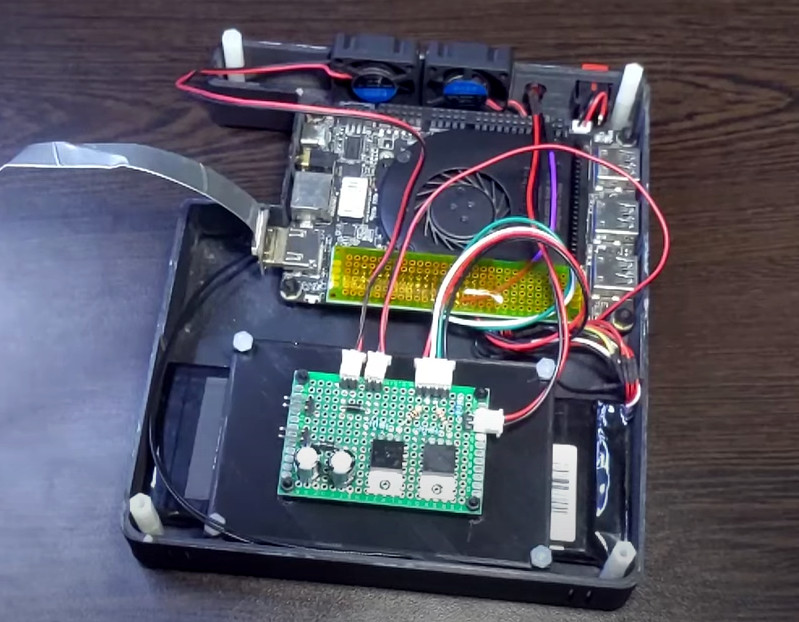
We especially like how the integrated Arduino on the LattePanda is being used in conjunction with some MOSFETs to control power to the handheld’s LCD, keyboard, and fans. While it sounds like the fans are currently running at full throttle, [iketsj] mentions he does intend on adding automatic speed control in the future. A dedicated “chassis controller” like this makes a lot of sense, and is something we imagine will only become more common as these portable builds become increasingly complex.

Now that we’ve seen a custom portable computer running Mac OS, are we due to see a whole new wave of cyberdecks sporting Cupertino’s software in the future? Maybe not. As [iketsj] points out at the end of this video, Apple’s switch from x86 to their own in-house silicon will almost certainly mean the death of the Hackintosh project within the next few years, bringing a fascinating era of computer hacking to a close.

Continue reading “Handheld Hackintosh Runs Mac OS On LattePanda”

Electric Window Motor Becomes Mini Chainsaw

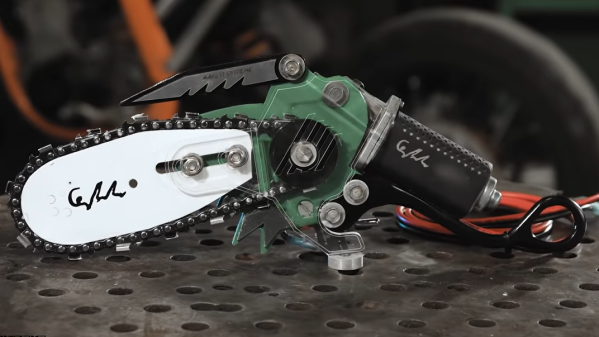
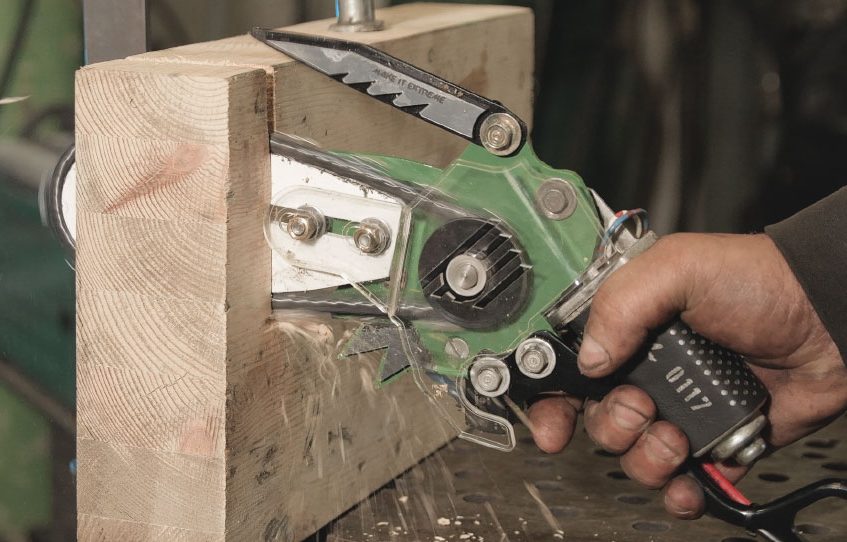
This mini handheld chainsaw by [Make it Extreme] is based around an electric motor from a car door, the same ones used to raise and lower car windows. They are common salvage parts, and with the right modifications and a few spare chainsaw bits attached, it turns out that the motor is more than capable of enough zip to cut through a variety of wood. Add a cordless tool battery pack, and the portable mini handheld chainsaw is born.

What’s really remarkable about the build video (embedded below, after the break) is not simply that it shows the build process and somehow manages to make it all look easy. No, what’s truly remarkable is that in the video it is always clear what is happening, and all without a single word being spoken. There’s no narration, no watching someone talk, just a solid build and demonstration. The principle of “show, don’t tell” is definitely taken to heart, here.

So, how well does it work as a chainsaw? It seems to work quite well! [Make it Extreme] does feel that a chain with smaller teeth and a higher motor speed would probably be an improvement, but the unit as built certainly can cut. You can judge for yourself by watching the build video, embedded below.

Continue reading “Electric Window Motor Becomes Mini Chainsaw”

Hacking A 3D Pen For Better Performance

When 3D pens first became available, many assumed them to be gimmicky or part of a general fad that would eventually die out. Like most revolutionary technologies, though, they’ve found a firm foothold, especially in the art community where the ability to 3D print in freehand is incredibly valuable. There are still some shortcomings with the technology, though, but [tterev3] recently tore into a 3doodler pen to make some necessary upgrades.

First, this pen has some design choices that are curious, to say the least. The cooling fan runs regardless of temperature, and it has pushbuttons for start and stop rather than a momentary button that controls the extrusion. To fix these issues, as well as change the filament size, improve the cooling, and provide greater control over the extrusion speed, [tterev3] completely rewrote the firmware, changed the microcontroller on the PCB, and made several hardware upgrades to accommodate these changes. He also went ahead and installed a USB-C port for charging, which should be standard practice on all low-voltage consumer electronics by now anyway.

The detail work on this project is impressive, given the small size of the pen itself and the amount of precision hardware needed to make the changes. Especially regarding the replacement of the microcontroller on the board itself, which is an impressive feat even without the incredibly small dimensions. The firmware upgrade is available on his GitHub page as well if you have your own 3doodler that needs modifications, and if you’re still struggling to find uses for these handy devices, we’ve seen them used with interesting effect to build drones.

Building A Pocket Sized Python Playground

Like many of us, [Ramin Assadollahi] has a certain fondness for the computers of yesteryear. Finding his itch for nearly instant boot times and bare metal programming weren’t being adequately scratched by any of his modern devices, he decided to build the PortablePy: a pocket-sized device that can drop him directly into a Python prompt wherever and whenever the urge hits him.

The device is powered by the Adafruit PyPortal Titano, which combines a ATSAMD51J20, ESP32, an array of sensors, and a 3.5″ diagonal 320 x 480 color TFT into one turn-key unit. The PyPortal is designed to run CircuitPython, but the scripts are usually dropped on the device over USB. That’s fine for most applications, but [Ramin] wanted his portable to be usable without the need for a host computer.

For a truly mobile experience, he had to figure out a way to bang out some Python code on the device itself. The answer ended up being the M5Stack CardKB, a tiny QWERTY board that communicates over I2C. Once he verified the concept was sound, he wrote a simple file management application and minimal Python editor that could run right on the PyPortal.

The final step was packaging the whole thing up into something he could actually take off the bench. He designed a 3D printed clamshell case inspired by the classic Game Boy Advance SP, making sure to leave enough room in the bottom half to pack in a charging board and LiPo pouch battery. He did have to remove some of the connectors from the back of the PyPortal to get everything to fit inside the case, but the compact final result seems worth the effort.

While an overall success, [Ramin] notes there are a few lingering issues. For one thing, the keyboard is literally a pain to type on. He’s considering building a custom keyboard with softer buttons, but it’s a long-term goal. More immediately he’s focusing on improving the software side of things so its easier to write code and manage multiple files.

It sounds like [Ramin] isn’t looking to compromise on his goal of making the PortablePy completely standalone, but if your convictions aren’t as strong, you could always connect a device like this up to your mobile to make things a bit easier.

Continue reading “Building A Pocket Sized Python Playground”

New Micro YARH.IO Designed For Skilled Operators

A few months back we brought you word of the YARH.IO, an extremely impressive Raspberry Pi portable that featured rugged good looks and a unique convertible design made possible by a removable keyboard. One of the most appealing aspects of the design was that everything was built from off-the-shelf modules; it only took a couple jumper wires and some scrap perfboard to get everything wired up inside the 3D printed enclosure.

The downside of this construction style was that the finished product was a bit chunkier than was strictly necessary. But that’s not the case with the new YARH.IO Micro. The palm-sized portable looks almost exactly like the original, though it had to ditch the removable keyboard in the shrinking process. Gone as well is the touch pad, though with the touch screen capabilities of the Pimoroni Hyper Pixel four inch IPS display, that’s not much of a problem.

What’s the catch? Well, at a glance we can tell you this one is considerably harder to build. For one thing, you’ll need to remove the Ethernet and USB connectors from the Pi 3B+. The USB ports get relocated, but Ethernet understandably has to be left on the cutting room floor. Nothing to worry about with the GPIO pins, the display takes up all of those, but you’ll probably want to wire the I2C lines to the female header on the side of the case so you can add external hardware and sensors.

You also need to nestle an Arduino Pro Micro in there to communicate status information about the battery to the operating system over I2C. If you wanted to save a little wiring you could probably leave off the DS3231 RTC module, but it depends on how often you’ll be able to sync up with NTP.

While it may be more difficult to assemble than its predecessor, it’s certainly not unapproachable. Once again, no custom PCBs or exotic components are required. You might be doing a lot more soldering (and desoldering) than you would have before, but it’s nothing that the average Hackaday reader isn’t capable of. For your troubles, you’ll get a exceptionally portable Linux machine that’s ripe for hacking and modification.

If the time and effort it will take to put together a YARH.IO is a bit more than you’re willing to invest right now, there’s always commercial alternatives like the DevTerm. But whether you go with the original or this new Micro edition, we think the satisfaction of having built the whole thing yourself will be more than worth it.