Web-enabled LED Pegboard

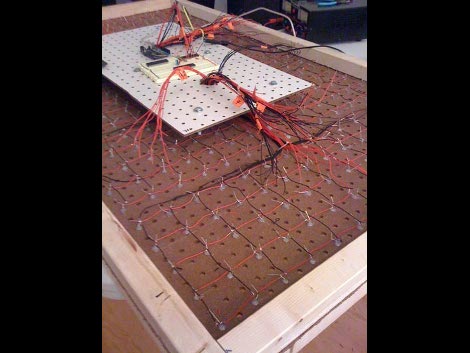
[Norm Santos] whipped up an LED light board that you can draw on through their web interface. We tried it out but unfortunately the live feed is currently offline. That doesn’t diminish our appreciation for the time-lapse build video after the break. Indeed it was a mountain of hot glueing and a couple of days of soldering. Our only beef is that for every LED on the board there are three empty peg holes. To us this is just begging to be augmented with blue, green, and white LEDs for a more spectacular result. What they have now encompases 350 LEDs managed by five microcontrollers, which took about two days to solder (for five people) and to hammer out some code. Continue reading “Web-enabled LED Pegboard”

Ikea LED Matrix

8x8

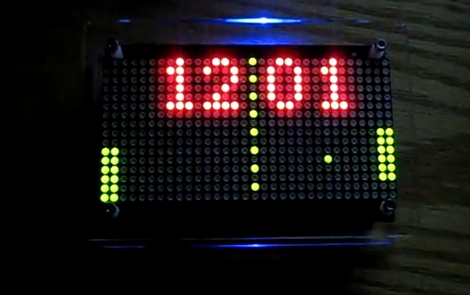
[Spikenzie] has created an 8×8 LED array that fits inside an ikea frame. He multiplexed the 64 red LEDs on a PCB with connections on the back. He then used a MAX7129, an LED multiplexer and driver, driven by a PIC over SPI to do animations and play pong. He then encased the array in laser-cut cardboard and white acrylic to get large dots. This entire assembly was then placed inside an Ikea RIBBA picture frame. The result is an aesthetic homebrew display that is easy to control.

Related: 64pixels are enough

64pixels Are Enough

64pixel

[Alex] put together this lovely minimal LED project. The square pixel matrix is soldered directly to the microcontroller in the same style as EMSL’s Micro-Readerboard. During the prototyping phase he used resistors to limit the current from the programming board. The final product doesn’t use resistors and manages the current draw by only turning on a single pixel line at a time. The illustrated assembly guide is very thorough and should help your create an equally compact device. Check out a video of it in motion below.

Continue reading “64pixels Are Enough”

Overhauling LED Marquees

led-sign

In a previous job, [sprite_tm] was responsible for wrangling many different LED text ad marquees. The hardware was fairly simple and he always figured they could be pushed much further with a little work. He recently acquired ten 32×16 LED displays a decided to see what he could do with them. By the end of the project, he had full motion video running on the display. This is a great project to read up on if you’ve ever wondered about LED matrix displays. He starts by reverse engineering the electronics on the board. He then attached an ATmega88 to drive the display module. Multiple display modules were daisy chained together over serial. The article covers PWM control and refresh timing as well. Check out one of a few demo videos below. Continue reading “Overhauling LED Marquees”

LED Life And Charlieplexing


Yesterday, we featured [Andrew]’s orientation aware camera. We want to highlight another one of his projects: LED Life. It’s a 6×5 LED matrix playing Conway’s Game of Life. He used the low power MSP430 like our e-paper clock. The best part of the writeup is his explanation of how Charlieplexing works. Microcontroller GPIO pins generally have three possible states: output high, output low, and input. This combined with the directional nature LEDs and some creative wiring means you can run a large matrix of individually addressable LEDs with just a few IO pins. Instead of just flipping the IO pins on and off you change their assigned state. Have a look at [Andrew]’s site for some great illustrations of how the system works. A video of his LED Life board is embedded below. Continue reading “LED Life And Charlieplexing”

Jar Of Fireflies

[Randomskk] has been attempting to make electronic fireflies for quite some time and finally settled on a design he liked. His jar of fireflies uses an ATtiny13 to control a set of 12 matrixed LEDs. The green SMD LEDs are each soldered to a pair of thin wires that hang down into the jar. The software picks an LED at random to flash and then flashes it 1-3 times. The random seed is incremented each time the jar is turned on, so you’ll get 255 different patterns. The power is just a standard coin cell. The project is fairly simple electrically, but the LED soldering could prove difficult. It was inspired by this firefly jar project. Check out [Alex]’s synchronizing fireflies too. A video of the jar is available below. Continue reading “Jar Of Fireflies”