32 LED POV Globe

[youtube=http://www.youtube.com/watch?v=bt1UEGD3BDk]

Here’s a slick version of a POV globe(google translated). Created by [Riko], this globe has 32 LEDs and is powered by a rotating coil. The layout looks fairly solid in operation, with the POV effect showing up very nicely on camera.  You can get the schematics and source code from the project page.

We found this project, just like the previous fantastic LED globe on HackedGadgets.com. Apparently someone linked to this project in the comments. That is fantastic, that is what the comments should be for. Please help keep our comments polite and helpful as well, even if you are just linking to a project that you think is better.

Laser Command Game Uses Laser For Control

[vimeo=http://vimeo.com/10819322]

[Eliji Hayashi’s] project for a class at Carnegie Mellon University is absolutely delightful! It is a game he calls Laser Command because a laser pointer is used as the gaming controller. An 8×8 LED matrix serves as the display, but is also used as an 8×8 light sensor, much the same way as the LED advent project did. The display is rapidly switched between producing light and sensing it. The laser is bright enough that it becomes easy to pick up the voltage generated within the matrix during the sensing periods. The game is programmed on an Arduino mini and the whole thing wraps up into an incredibly small package. Brilliant.

[Thanks Juan]

POV LED Sphere

[youtube=http://www.youtube.com/watch?v=VF2dI7RiMVQ]

[Csaba Bleuer] has built this really nice POV LED sphere.  Looking at the hand drawn schematic, it appears that he’s using an Atmega8 as the core. The resolution is pretty decent, and even shows fairly well on camera despite the refresh issues. Although much cleaner, it looks like a similar implementation to this one that we covered back in october of last year. He’s still got some polishing to do to match “the orb” though.

Report From ESC Silicon Valley 2010

Ah, the heady aroma of damp engineers! It’s raining in Silicon Valley, where the 2010 Embedded Systems Conference is getting off the ground at San Jose’s McEnery Convention Center.

ESC is primarily an industry event. In the past there’s been some lighter fare such as Parallax, Inc. representing the hobbyist market and giant robot giraffes walking the expo. With the economy now turned sour, the show floor lately is just a bit smaller and the focus more businesslike. Still, nestled between components intended to sell by the millions and oscilloscopes costing more than some cars, one can still find a few nifty technology products well within the budget of most Hack a Day readers, along with a few good classic hacks and tech demos…

Continue reading “Report From ESC Silicon Valley 2010”

Biosphere Lighting

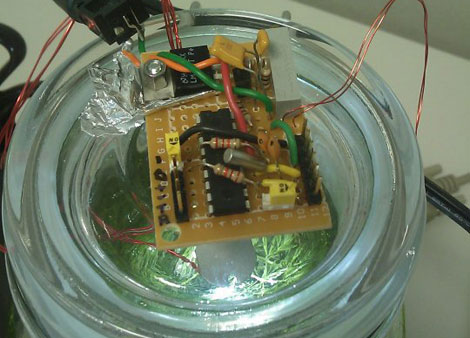
Sometimes, sitting in a windowless office can drive you crazy. Adding a little bit of life and color can really help. [Gripen40k] did this by building a biosphere. He didn’t have any windows though, so he made an LED light on a PIC based timer. What is interesting is what he did with a thermistor. The Cree LED bulb that he salvaged was going to be submerged in the water, so he had to do some workarounds to keep from over heating the biosphere. Read the project log for more details.

Spinning Ball Of LED Awesomeness

[youtube=http://www.youtube.com/watch?v=sO2-tqoyGik]

Take a few moments and watch this 3 axis rotating LED light display fire up.  The final effect of being an RGB glowing ball is nice, but we’re fascinated with the structure. There are tons of great detailed pictures of the assembly on the forum thread to feast your eyes on. Just getting power to the LEDs was a feat, he passes their power through 6 slip contacts. Parts were pulled from an old VCR and some old fans.

[via HackedGadgets]

USB VU-meter

[youtube http://www.youtube.com/watch?v=jsg24MGNpRc&feature=player_embedded%5D

WaitingForFriday’s [Simon Inns] is quite possibly the USB interface and PIC master. This week he let us know about his VU-meter repurposed as a computer performance monitor using a PIC18F2550 and his open source USB Generic HID communication class. With PWM the meter’s needles and RGB LED can be accurately set and even dampened for CPU usage, network usage, HDD utilization, and even memory usage. Oddly enough, in his software we didn’t find the ability to use the device as a VU-meter – go figure.