The Newest Graphing Calculator Game

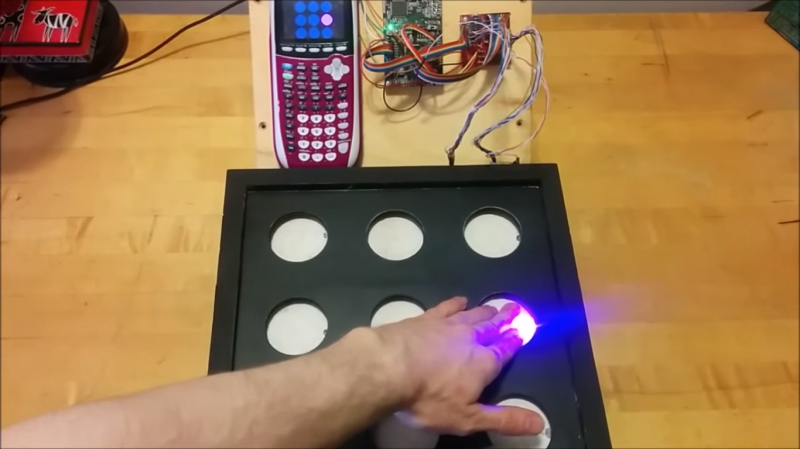
Certainly everyone remembers passing time in a boring high school class playing games on a graphing calculator. Whether it was a Mario-esque game, Tetris, or BlockDude, there are plenty of games out there for pretty much all of the graphing calculators that exist. [Christopher], [Tim], and their colleagues from Cemetech took their calculator game a little bit farther than we did, and built something that’ll almost surely disrupt whatever class you’re attempting to pay attention in: They built a graphing calculator whac-a-mole game.

This game isn’t the standard whac-a-mole game, though, and it isn’t played on the calculator’s screen. Instead of phyiscal “moles” the game uses LEDs and light sensors enclosed in a box to emulate the function of the moles. In order to whack a mole, the player only needs to interrupt the light beam which can be done with any physical object. The team made extensive use of the ArTICL library which allows graphing calculators to interface with microcontrollers like the MSP432 that they used, and drove the whole thing with a classic TI-84.

This project is a fun way to show what can be done with a graphing calculator and embedded electronics, and it was a big hit at this past year’s World Maker Faire. Calculators are versatile in other ways as well. We’ve seen them built with open hardware and free software, And we’ve even seen them get their own Wi-Fi.


Continue reading “The Newest Graphing Calculator Game” →

Cricket Scoreboard Is A Big Win For Novice Hackers

The game of cricket boggles most Americans in the same way our football perplexes the rest of the world. We won’t even pretend to understand what a “wicket” or an “over” is, but apparently it’s important enough to keep track of that so an English cricket club decided to build their own electronic scoreboard for their – pitch? Field? Help us out here.

This scoreboard build was undertaken by what team member [Ian] refers to as some “middle-aged blokes from Gloucestershire” with no previous electronics experience. That’s tough enough to deal with, but add to it virtually no budget, a huge physical size for the board, exposure to the elements, and a publicly visible project where failure would be embarrassingly obvious, and this was indeed an intimidating project to even consider. Yet despite the handicaps, they came up with a great rig, with a laser-cut acrylic cover for a professional look. A Raspberry Pi runs the LED segments and allows WiFi connections from a laptop or phone in the stands. They’ve even recently upgraded to solar power for the system.

And we’ll toot our own horn here, since this build was inspired at least in part by a Hackaday post. The builders have a long list of other links that inspired or instructed them, and we think that says something powerful about the hacker community that we’ve all been building – a group with no previous experience manages a major build with the guidance of seasoned hackers. That’s something to feel good about.

Hacker Welcomes Grandaughter With Web Enabled Frame

We all have different ways of expressing excitement about new family members. [viscomjim] expressed his joy at the arrival of his first grandchild by building a twitter-enabled mirror/mood light. While we’d like to rage that this Internet of Things “thing” that people are doing has gone too far, this isn’t the first time we’ve seen this happen.

For the brains of his device [viscomjim] used an ESP8266 module. [Viscomjim] etched his grandchild’s name into the mirror and put some Neopixels behind it. When one of his family members tweets to the light’s channel they can change the color of the light to interact with their newest family member. We’re not so certain the Internet won’t find this and turn it into baby’s first 24 hour rave.

If you’d like to get in on the ESP8266 action, you’ll find the Huzzah board a good start, and we’ve got a special Hackaday edition in the store. Just sayin’.

“Reverse engineering” a real candle

Reverse Engineering A Real Candle

[cpldcpu] just can’t leave the mysteries of candles alone. We’ve covered his explorations of candle flicker LEDs before, but this time he’s set his sensors on the real thing. [cpldcpu] hooked a photodiode to his oscilloscope, pointed it at a candle flame, and recorded the result.

The first interesting observation was the candle slowly changed brightness, whether it was interacted with or not. Next he measured the effect when the flame was disturbed by small gusts of air. This produced a bright flicker with an oscillation at 5Hz before returning to steady state, which as [stygiansonic] mentioned in a the Hacker News comment, is a known phenomenon used in flame detectors. Neat! There’s even an equation:

Under normal gravity conditions, the flames have a well defined oscillation frequency which is inversely proportional to the square root of the burner diameter, D, and to a good approximation can be written as f » 1.5/D½, with D given in meters.

[cpldcpu] then compiled his measurements into a series of graphs and ultimately an animated gif comparing the candle steady state, a real candle’s flicker, and the flicker he recorded from a candle flickr LED. It’s surprising how different the fake is from the real thing. You can look at his measurements and code at his github.

[via Hacker News]

Shark With Frickin’ LED Tells People Not To Bother You

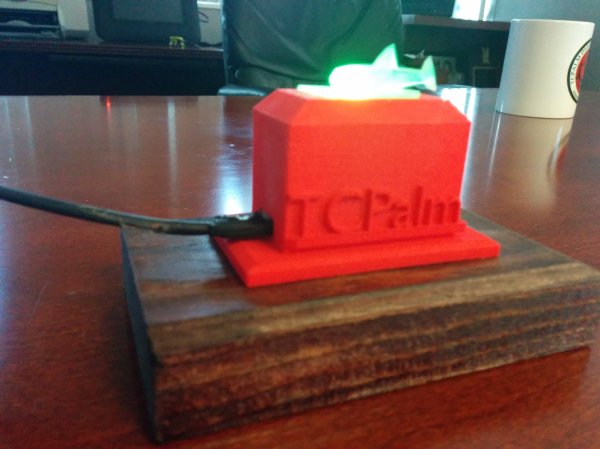
Everybody is busy these days, but sometimes it’s hard to tell. What with teleconferences being conducted over tiny Bluetooth headphones and Skype meetings where we seem to be dozing in front of the monitor, we’ve lost some of the visual cues that used to advertise our availability. So why not help your colleagues to know when to give you space with this shark themed WiFi-enabled meeting light?

Why a shark and not a mutated intemperate sea bass? Only [falldeaf] can answer that. But the particulars of the build are well-documented and pretty straightforward. A Photon runs the show, looking for an Outlook VFB file to parse. An RGB LED is used to change the color of the translucent 3D printed shark based on whether you’re in a meeting, about to step into one, or free. The case is 3D printed as well, although [falldeaf] farmed the prints out to a commercial printing outfit because of the size and intricacy of the parts. He did fabricate a nice looking wood base for the light, though.

There are plenty of ways to tell people to buzz off, but this is a pretty slick solution. For those in open floor plan workspaces, something like this IoT traffic light for you and your cube-mates might be in order.

Must-Have Overkill Christmas Tree Lights

The yuletide fire is out, so we’re starting to receive this year’s Christmas hacks. [Chris] sent us his awesome video-mapped tree lighting hack. His project made clever use of a bunch of cool tools, so even if you’re not thinking forward to next December, it’s worth a look. Still images don’t do it justice; check out the video below the break.

The end result is an addressable string of WS2812B LEDs connected up to a Raspberry Pi Zero that can display a video image even though it’s wrapped around a roughly cone-shaped (pine) object. But this is actually more impressive than you’d think at first; how would you map a flat image to a string of LEDs wrapped around a tree?

[Chris]’s solution was to write a routine that lit up the LEDs in a unique pattern and then detected them using OpenCV and a webcam, making the mapping directly. He then samples images from a video at exactly the points where the pixels are located on the tree, and sends this data out to the LEDs.

The basic framework here should transform fairly easily into a generic image-mapping procedure with randomly located LEDs, so we think it’s a hack that’ll outlast the season. And because it runs on the Pi Zero, everything is in Python so it’d be a good project for beginners to replicate. However, the code section on the project page still lists it as coming soon. We hope so!

Continue reading “Must-Have Overkill Christmas Tree Lights” →

Parts Bin Emergency Lights Deal With Tornado’s Aftermath

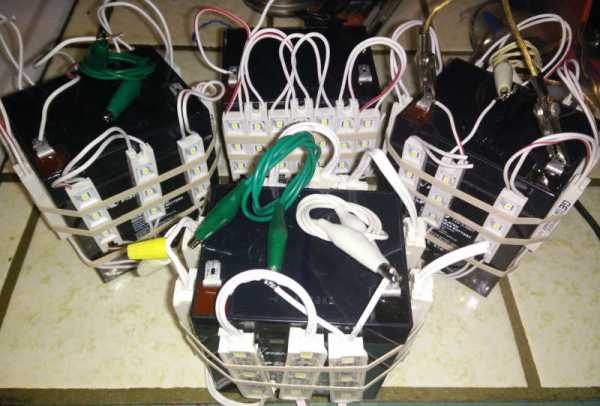
Sometimes having a deep inventory of parts in your shop is a pain – the clutter, the dust, the things you can’t rationally justify keeping but still can’t bear to part with. But sometimes the parts bin delivers and lets you cobble together some emergency lighting when a tornado knocks out your power.

It has been hard to avoid discussions of the weird weather in the US this winter. The eastern half of the country has had record warm temperatures, the west has been lashed by storms, and now December tornadoes have ripped through Texas and other parts of the south, with terrible loss of life and wide-ranging property damage. [TheTimmy] was close enough to one massive EF4 tornado to lose power on Saturday night, and after the charm of a candlelight Christmas evening wore off, he headed to the shop. He had a bunch of sealed lead acid batteries from old UPSs and a tangle of 12V LED modules, and with the help of some elastic bands and jumper clips he wired up a bunch of lights for around the house. Safer than candles by a long shot, and more omnidirectional than flashlights to boot.

The power came back before the batteries ran out of juice, so we don’t get to see any hacks for recharging batteries in a grid-down scenario. Still, it’s good to see how a deep parts bin and good mindset can make a positive impact on an uncomfortable situation. We’ve seen similar hacks before, like this hacked cordless tool battery pack or powering a TV with 18650 batteries. Be sure to share your story of epic power-outage hacks in the comments below.