Invisible 3D Printed Codes Make Objects Interactive

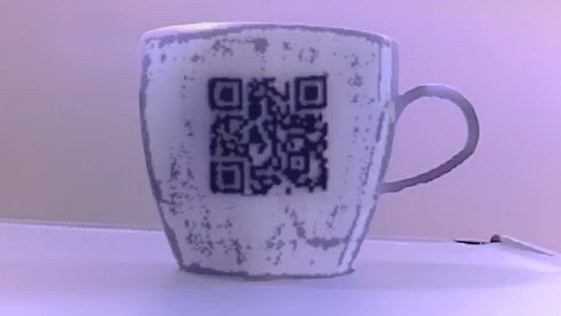
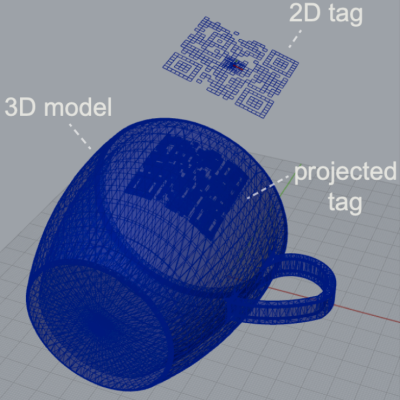
An interesting research project out of MIT shows that it’s possible to embed machine-readable labels into 3D printed objects using nothing more than an FDM printer and filament that is transparent to IR. The method is being called InfraredTags; by embedding something like a QR code or ArUco markers into an object’s structure, that label can be detected by a camera and interactive possibilities open up.

One simple proof of concept is a wireless router with its SSID embedded into the side of the device, and the password embedded into a different code on the bottom to ensure that physical access is required to obtain the password. Mundane objects can have metadata embedded into them, or provide markers for augmented reality functionality, like tracking the object in 3D.



How are the codes actually embedded? The process is straightforward with the right tools. The team used a specialty filament from vendor 3dk.berlin that looks nearly opaque in the visible spectrum, but transmits roughly 45% in IR.  The machine-readable label gets embedded within the walls of a printed object either by using a combination of IR PLA and air gaps to represent the geometry of the code, or by making a multi-material print using IR PLA and regular (non-IR transmitting) PLA. Both provide enough contrast for an IR-sensitive camera to detect the label, although the multi-material version works a little better overall. Sadly, the average mobile phone camera by itself isn’t sufficiently IR-sensitive to passively read these embedded tags, so the research used easily available cameras with no IR-blocking filters, like the Raspberry Pi NoIR.

The PDF has deeper details of the implementation for those of you who want to know more, and you can see a demonstration of a few different applications in the video, embedded below. Determining the provenance of 3D printed objects is a topic of some debate in the industry, and it’s not hard to see how technology like this could be used to covertly identify objects without compromising their appearance.

Continue reading “Invisible 3D Printed Codes Make Objects Interactive”

Robot with glowing eyes

Spatial AI And CV Hack Chat

Join us on Wednesday, December 1 at noon Pacific for the Spatial AI and CV Hack Chat with Erik Kokalj!

A lot of what we take for granted these days existed only in the realm of science fiction not all that long ago. And perhaps nowhere is this more true than in the field of machine vision. The little bounding box that pops up around everyone’s face when you go to take a picture with your cell phone is a perfect example; it seems so trivial now, but just think about what’s involved in putting that little yellow box on the screen, and how it would not have been plausible just 20 years ago.

Erik Kokalj

Perhaps even more exciting than the development of computer vision systems is their accessibility to anyone, as well as their move into the third dimension. No longer confined to flat images, spatial AI and CV systems seek to extract information from the position of objects relative to others in the scene. It’s a huge leap forward in making machines see like we see and make decisions based on that information.

To help us along the road to incorporating spatial AI into our projects, Erik Kokalj will stop by the Hack Chat. Erik does technical documentation and support at Luxonis, a company working on the edge of spatial AI and computer vision. Join us as we explore the depths of spatial AI.

join-hack-chatOur Hack Chats are live community events in the Hackaday.io Hack Chat group messaging. This week we’ll be sitting down on Wednesday, December 1st at 12:00 PM Pacific time. If time zones have you tied up, we have a handy time zone converter.

SLA printer rigged for time lapse

Silky Smooth Resin Printer Timelapses Thanks To Machine Vision

The fascination of watching a 3D printer go through its paces does tend to wear off after you spent a few hours doing it, in which case those cool time-lapse videos come in handy. Trouble is they tend to look choppy and unpleasant unless the exposures are synchronized to the motion of the gantry. That’s easy enough to do on FDM printers, but resin printers are another thing altogether.

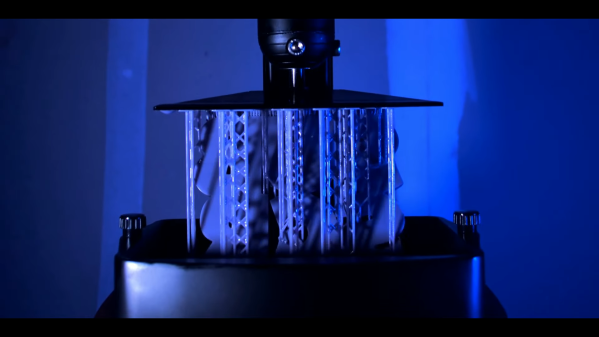
Or are they? [Alex] found a way to make gorgeous time-lapse videos of resin printers that have to be seen to be believed. The advantage of his method is that it’ll work with any camera and requires no hardware other than a little LED throwie attached to the build platform of the printer. The LED acts as a fiducial that OpenCV can easily find in each frame, one that indicates the Z-axis position of the stage when the photo was taken. A Python program then sorts the frames, so it looks like the resin print is being pulled out of the vat in one smooth pull.

To smooth things out further, [Alex] also used frame interpolation to fill in the gaps where the build platform appears to jump between frames using real-time intermediate flow estimation, or RIFE. The details of that technique alone were worth the price of admission, and the results are spectacular. Alex kindly provides his code if you want to give this a whack; it’s almost worth buying a resin printer just to try.

Is there a resin printer in your future? If so, you might want to look over [Donald Papp]’s guide to the pros and cons of SLA compared to FDM printers.

Continue reading “Silky Smooth Resin Printer Timelapses Thanks To Machine Vision”

Intel RealSense D435 Depth Camera

RealSense No Longer Makes Sense For Intel

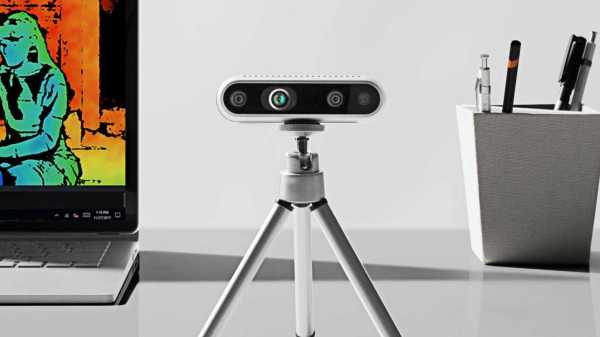
We love depth-sensing cameras and every neat hack they enabled, but this technological novelty has yet to break through to high volume commercial success. So it was sad but not surprising when CRN reported that Intel has decided to wind down their RealSense product line.

As of this writing, one of the better confirmations for this report can be found on the RealSense SDK GitHub repository README. The good news is that core depth-sensing RealSense products will continue business as usual for the foreseeable future, balanced by the bad news that some interesting offshoots (facial authentication, motion tracking) will be declared “End of Life” immediately and phased out over the next six months.

This information tells us while those living out on the bleeding edge will have to scramble, there is no immediate crisis for everyone else, whether they be researchers, hobbyists, or product planners. But this also means there will be no future RealSense cameras, kicking off many “What’s Next?” discussions in various communities. Like this thread on ROS (Robot Operating System) Discourse.

Three popular alternatives offer distinctly different tradeoffs. The “Been Around The Block” name is Occipital, with their more expensive Structure Pro sensor. The “Old Name, New Face” option is Microsoft Azure Kinect, the latest non-gaming-focused successor to the gaming peripheral that started it all. And let’s not forget OAK-D as the “New Kid On The Block” that started with a crowdfunding campaign and building an user community by doing things like holding contests. Each of these will appeal to a different niche, and we’ll keep our eye open in the future. Let’s see if any of them find the success that eluded the original Kinect, Google’s Tango, and now Intel’s RealSense.

[via Engadget]

Machine-Vision Archer Makes You The Target, If You Dare

We’ll state right up front that it’s a really, really bad idea to let a robotic archer shoot an apple off of your head. You absolutely should not repeat what you’ll see in the video below, and if you do, the results are all on you.

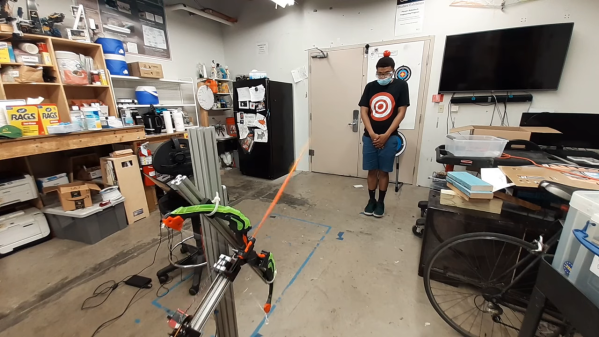
That said, [Kamal Carter]’s build is pretty darn cool. He wisely chose to use just about the weakest bows you can get, the kind with strings that are basically big, floppy elastic bands that shoot arrows with suction-cup tips and are so harmless that they’re intended for children to play with and you just know they’re going to shoot each other the minute you turn your back no matter what you told them. Target acquisition is the job of an Intel RealSense depth camera, which was used to find targets and calculate the distance to them. An aluminum extrusion frame holds the bow and adjusts its elevation, while a long leadscrew and a servo draw and release the string.

With the running gear sorted, [Kamal] turned to high school physics for calculations such as the spring constant of the bow to determine the arrow’s initial velocity, and the ballistics formula to determine the angle needed to hit the target. And hit it he does — mostly. We’re actually surprised how many on-target shots he got. And yes, he did eventually get it to pull a [William Tell] apple trick — although we couldn’t help but notice from his, ahem, hand posture that he wasn’t exactly filled with self-confidence about where the arrow would end up.

[Kamal] says he drew inspiration both from [Mark Rober]’s dart-catching dartboard and [Shane Wighton]’s self-dunking basketball hoop for this build. We’d say his results put in him good standing with the skill-optional sports community.

Continue reading “Machine-Vision Archer Makes You The Target, If You Dare”

Adding A Laser Blaster To Classic Atari 2600 Games With Machine Vision

Remember the pistol controller for the original Atari 2600? No? Perhaps that’s because it never existed. But now that we’re living in the future, adding a pistol to the classic games of the 2600 is actually possible.

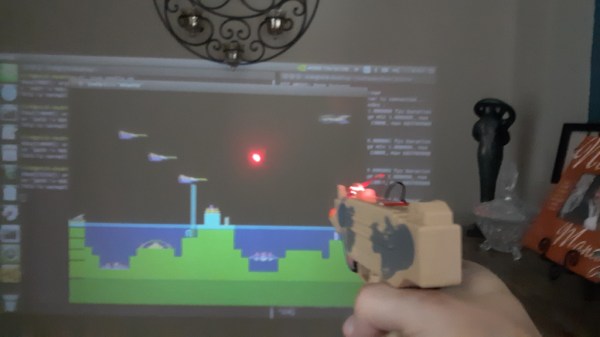
Possible, but not exactly easy. [Nick Bild]’s approach to the problem is based on machine vision, using an NVIDIA Xavier NX to run an Atari 2600 emulator. The game is projected on a wall, while a camera watches the game field. A toy pistol with a laser pointer attached to it blasts away at targets, while OpenCV is used to find the spots that have been hit by the laser. A Python program matches up the coordinates of the laser blasts with coordinates within the game, and then fires off a sequence of keyboard commands to fire the blasters in the game. Basically, the game plays itself based on where it sees the laser shots. You can check out the system in the video below.

[Nick Bild] had a busy weekend of hacking. This was the third project write-up he sent us, after his big-screen Arduboy build and his C64 smartwatch.

Continue reading “Adding A Laser Blaster To Classic Atari 2600 Games With Machine Vision”

An AI-Free Way To Catch Wildlife On Camera

Judging by the over-representation of the term “AI” in our news feeds these days, we’re clearly in the exponential phase of the artificial intelligence hype cycle, and very nearly at the dreaded “Peak of Inflated Expectations.” It seems like there’s nothing that AI can’t do, and nowhere that its principles can’t be applied to virtuous — and profitable — effect.

We don’t deny that AI has massive potential, but we strongly suspect that there will soon come a day when eyes will roll and stomachs will turn at yet another AI application that could have been addressed with something easier. An example of the simpler approach can be seen in this non-AI wildlife photo trap, cobbled together by [Sebastian] to capture pictures of some camera-shy squirrels. Rather than train an AI with gigabytes of squirrel images, he instead relies on his old Sony Alpha camera, which has a built-in WiFi. A Python script connects to the camera, which is trained on a feeder box and set to a very narrow depth of field. That makes a good percentage of the scene out of focus until a squirrel or other animal comes along looking for treats. The script detects the increased area of the scene that is now in-focus with a Laplace operator in OpenCV, and triggers the camera shutter. [Sebastian] ended up with some wonderful shots of the shy squirrels using this scheme; the video below describes the setup in more detail.

It’s not the first time we’ve seen Laplace transforms used to gauge image sharpness, of course, but we really like the approach [Sebastian] took here for its simplicity. The squirrels are cute too.

Continue reading “An AI-Free Way To Catch Wildlife On Camera”