Robot Vs. Superbug

Working in a university or research laboratory on interesting, complicated problems in the sciences has a romanticized, glorified position in our culture. While the end results are certainly worth celebrating, often the process of new scientific discovery is underwhelming, if not outright tedious. That’s especially true in biology and chemistry, where scaling up sample sizes isn’t easy without a lot of human labor. A research group from Reading University was able to modify a 3D printer to take some of that labor out of the equation, though.

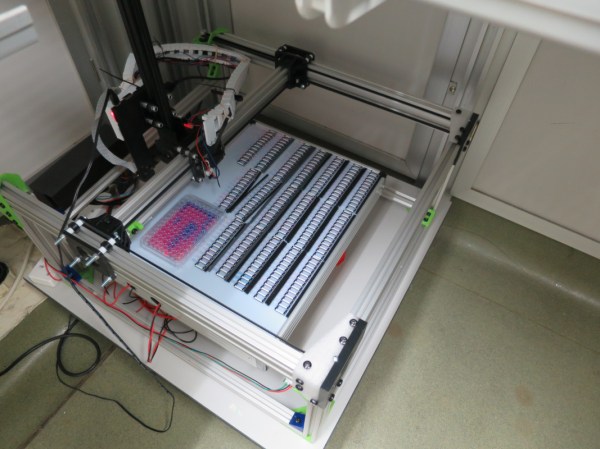
This 3D printer was used essentially as a base, with the printing head removed and replaced with a Raspberry Pi camera. The printer X/Y axes move the camera around to all of the different sample stored in the print bed, which allows the computer attached to the printer to do most of the work that a normal human would have had to do. This allows them to scale up massively and cheaply, presumably with less tedious inputs from a large number of graduate students.

While the group hopes that this method will have wide applicability for any research group handling large samples, their specific area of interest involves researching “superbugs” or microbes which have developed antibiotic resistance. Their recently-published paper states that any field which involves bacterial motility, colony growth, microtitre plates or microfluidic devices could benefit from this 3D printer modification.

Simplified AI On Microcontrollers

Artificial intelligence is taking the world by storm. Rather than a Terminator-style apocalypse, though, it seems to be more of a useful tool for getting computers to solve problems on their own. This isn’t just for supercomputers, either. You can load AI onto some of the smallest microcontrollers as well. Tensorflow Lite is a popular tool for this, but getting it to work on your particular microcontroller can be a pain, unless you’re using an Espruino.

This project adds support for Tensorflow to this class of microcontrollers without having to fuss around with obtuse build tools. Basically adding a single line of code creates an instance, all without having to compile anything or even reboot. Tensorflow is a powerful software tool for microcontrollers, and having it this accessible now is a great leap forward.

So, what can you do with this tool? The team behind this build is using Tensorflow on an open smart watch that can be used to detect hand gestures and many other things. They also opened up these tools for use in a browser, which allows use of the AI software and emulates an Espruino without needing a physical device. There’s a lot going on with this one, and it’s a bonus that it’s open source and ready to be turned into anything you might need, like turning yourself into a Street Fighter.

US Air Force Says They’re Developing An Open Source Jet Engine; We Say Show Us The Design

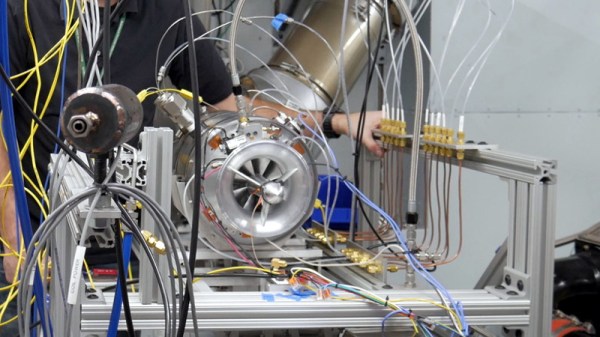
The economies of scale generally dictate that anything produced in large enough numbers will eventually become cheap. But despite the fact that a few thousand of them are tearing across the sky above our heads at any given moment, turbine jet engines are still expensive to produce compared to other forms of propulsion. The United States Air Force Research Laboratory is hoping to change that by developing their own in-house, open source turbine engine that they believe could reduce costs by as much as 75%.
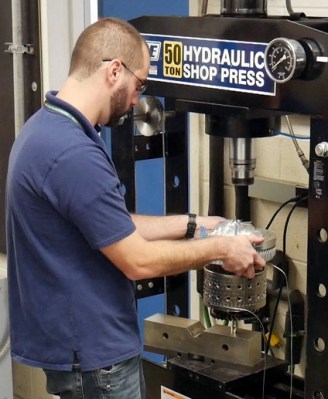
The Responsive Open Source Engine (ROSE) is designed to be cheap enough that it can be disposable, which has obvious military applications for the Air Force such as small jet-powered drones or even missiles. But even for the pacifists in the audience, it’s hard not to get excited about the idea of a low-cost open source turbine. Obviously an engine this small would have limited use to commercial aviation, but hackers and makers have always been obsessed with small jet engines, and getting one fired up and self-sustaining has traditionally been something of a badge of honor.

Since ROSE has been developed in-house by the Air Force, they have complete ownership of the engine’s intellectual property. This allows them to license the design to manufacturers for actual production rather than buying an existing engine from a single manufacturer and paying whatever their asking price is. The Air Force will be able to shop ROSE around to potential venders and get the best price for fabrication. Depending on how complex the engine is to manufacture, even smaller firms could get in on the action. The hope is that this competition will serve to not only improve the design, but also to keep costs down.

We know what you’re thinking. Where is the design, and what license is it released under? Unfortunately, that aspect of ROSE seems unclear. The engine is still in development so the Air Force isn’t ready to show off the design. But even when it’s complete, we’re fairly skeptical about who will actually have access to it. Open Source is in the name of the project and to live up to that the design needs to be available to the general public. From a purely tactical standpoint keeping the design of a cheap and reliable jet engine away from potential enemy states would seem to be a logical precaution, but is at cross purposes to what Open Source means. Don’t expect to be seeing it on GitHub anytime soon. Nuclear reactors are still fair game, though.

[Thanks to Polymath99 for the tip.]

Open Source Kitchen Helps You Watch What You Eat

Every appliance business wants to be the one that invents the patented, license-able, and profitable standard that all the other companies have to use. Open Source Kitchen wants to beat them to it. 

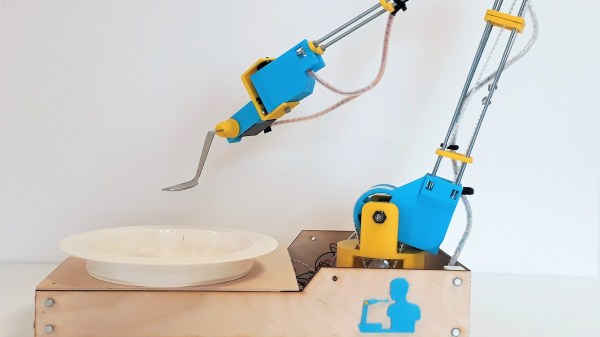
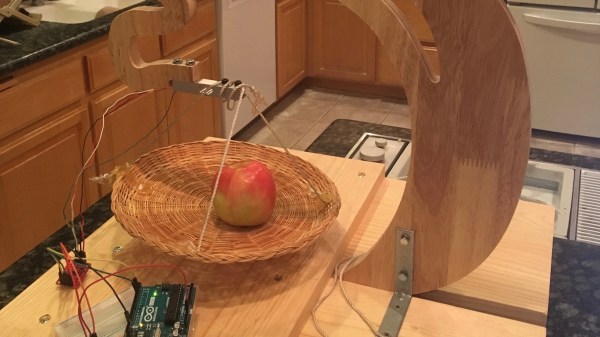
Every beginning standard needs a test case, and OSK’s is a simple one. A bowl that tracks what you eat. While a simple concept, the way in which the data is shared, tracked, logged, and communicated is the real goal.

The current demo uses a Nvidia Jetson Nano as its processing center. This $100 US board packs a bit of a punch in its weight class. It processes the video from a camera held above the bowl of fruit, suspended by a scale in a squirrel shaped hangar, determining the calories in and calories out.

It’s an interesting idea. One wonders how the IoT boom might have played out if there had been a widespread standard ready to go before people started walling their gardens.

Robot Joints Go Modular With This Actuator Project

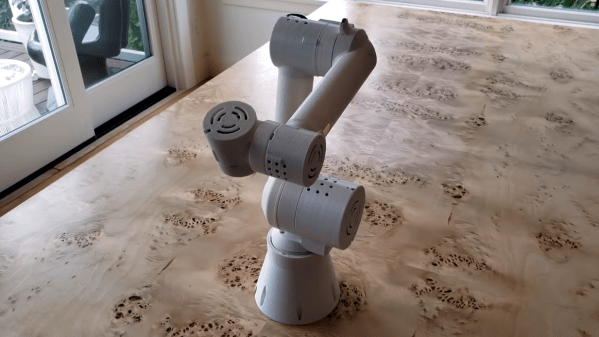
[John Lauer] has been hard at work re-thinking robot arms. His project to create modular, open source actuators that can be connected to one another to form an arm is inspiring, and boasts an impressively low parts cost as well. The actuators are each self-contained, with an ESP32 and a design that takes advantage of the form factors of inexpensive modules and parts from vendors like Aliexpress.

Flex spline in action, for reducing backlash

Each module has 3D printed gears (with an anti-backlash flex spline), an RGB LED for feedback, integrated homing, active cooling, a slip ring made from copper tape, and a touch sensor dial on the back for jogging and training input. The result is a low backlash, low cost actuator that keeps external wiring to an absolute minimum.

Originally inspired by a design named WE-R2.4, [John] has added his own twist in numerous ways, which are best summarized in the video embedded below. That video is number three in a series, and covers the most interesting developments and design changes while giving an excellent overview of the parts and operation (the video for part one is a basic overview and part two shows the prototyping process, during which [John] 3D printed the structural parts and gears and mills out a custom PCB.)

Continue reading “Robot Joints Go Modular With This Actuator Project”

Open Hardware Month Hack Chat

Join us on Wednesday, October 23 at noon Pacific for the Open Hardware Month Hack Chat with Michael Weinberg!

It seems like everything and everyone has a special day set aside on the calendar. You know the drill – a headline declaring it National Grilled Cheese Day (sorry, you missed it – April 12) or National Bundt Pan Day (not even kidding, November 15). It seems only fair with all these silly recognition days floating around that we in the hacking community should have a day of our own, too, or even a whole month. That’s why the Open Source Hardware Association declared the entire month of October to be Open Hardware Month.

Open hardware is all about accessible, collaborative processes that let everyone see and understand the hardware they’re using. The technological underpinnings of our lives are increasingly hidden from us, locked away as corporate secrets. Open hardware tries to turn that on its head and open up devices to everyone, giving them the freedom to not only use their devices but to truly understand what’s happening in them, and perhaps repair, extend, and even modify them to do something new and useful. Celebrating that and getting the message out to the general public is certainly something worth doing.

Michael Weinberg is a board member at OSHWA, and he’ll be joining the Hack Chat on October 23 (National Boston Cream Pie Day) to discuss Open Hardware Month and open-source hardware in general. We’ll learn about some of the events planned for Open Hardware Month, how open hardware is perceived beyond the hacker community, and what’s on tap for the 10th anniversary Open Hardware Summit in 2020.

join-hack-chatOur Hack Chats are live community events in the Hackaday.io Hack Chat group messaging. This week we’ll be sitting down on Wednesday, October 23 at 12:00 PM Pacific time. If time zones have got you down, we have a handy time zone converter.

Click that speech bubble to the right, and you’ll be taken directly to the Hack Chat group on Hackaday.io. You don’t have to wait until Wednesday; join whenever you want and you can see what the community is talking about.

What Better Than A Hexapod?

What’s more awesome than a normal hexapod robot? What about a MEGA hexapod?

Max the Megapod, a six-legged 3D-printed walking robot, is an open source, Arduino-based, Bluetooth controlled, Scratch programmable creation made possible by [Steven Pendergrast]. The design for Max was based on a previous hexapod project, Vorpal the Hexapod, which has since been built at hundreds of schools worldwide.

Max clocks in at two feet in diameter, expanding to three when sprawled out on the ground. In addition, the hexapod is able to dance, walk, and run as fast as the smaller version, covering ground at twice the speed due to its size.

The scaling for the project – about 200% from the original hexapod – required some creativity, as the goal was for the components to be printed on a modest-sized printer with an 8 inch cube bed. In addition, since Max weighs 9 pounds on average, real bearings (608 Skate bearings) needed to be used for the servo mounts.

The electrical system had to be changed to account for the larger currents drawn by the larger servos (MG958s). and the power distribution harness needed to be redesigned. The current harness take about two hours to build for the larger hexapod, compared to 15 minutes for the original design.

The results are both hilarious and adorable, especially given the endless modifications made to give Max a unique flair. Perhaps a GIGApod could be coming up next?

Continue reading “What Better Than A Hexapod?”