3D Printed Hovercraft Takes To The Air

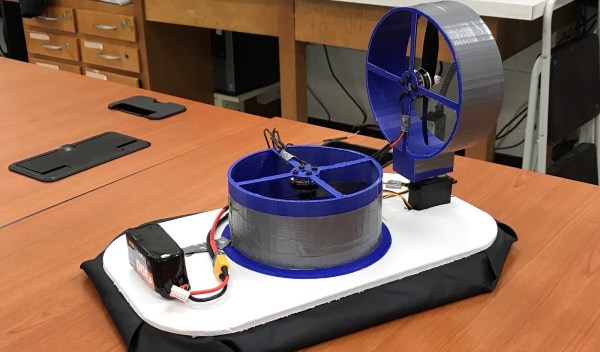
Instructables user [John_Hagy] and some classmates built an RC hovercraft as their final project in the Robotics Education Lab at NC State University. It’s a foam slab with a Hovership H2204X 2300Kv brushless motor inflating a skirt made out of ripstop nylon. Nylon is great here because it has a low friction coefficient and is nonporous to keep the air in. A second motor propels the craft, with a servo turning the whole motor assembly to steer. The team designed and 3D-printed fan holders which also help channel the air to where it’s supposed to go. Control is via a typical radio-control transmitter and receiver combo.

The project writeup includes a lot of fun detail like previous versions of the hovercraft as well as the research they undertook to learn how to configure the craft — clearly it’s their final paper put on the internet, and well done guys.

Needless to say, we at Hackaday can’t get enough of this sort of thing, as evidenced by this cool-looking hovercraft, this hovercraft made on a budget and this solar-powered ‘craft.

How To Build An Airplane In A Month And A Half

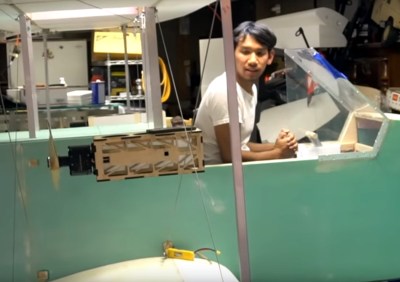
For the last few weeks, RC pilot extraordinaire [Peter Sripol] has been working on his biggest project to date. It’s effectively a manned RC plane, now legally a Part 103 ultralight. Now all that work is finally bearing fruit. [Peter] is flying this plane on some short hops down a grass runway. He’s flying it, and proving that you can build a plane in a basement, in under two months, constructed almost entirely out of insulation foam.

[Peter] has been documenting this build on his YouTube channel, and although the materials for this plane are mostly sourced from either Home Depot or Lowes, the construction is remarkably similar to what you would expect to find in other homebuilt aircraft. This thing has plywood gussets, the foam is wearing a thin layer of fiberglass, and the fasteners are from Aircraft Spruce.

The power system is another matter entirely. The engines (all two of them!) are electric and are designed for very large RC aircraft. These engines suck down power from a massive battery pack in the nose, and the twin throttles are really just linear potentiometers hacked onto servo testers. There’s a surprising amount of very important equipment on this plane that is just what [Peter] had sitting around the workshop.

As far as the legality of this ultralight experiment is concerned, [Peter] is pretty much above-board. This is a Part 103 ultralight, and legally any moron can jump in an ultralight and fly. There are some highly entertaining YouTube videos attesting this fact. However, in one of [Peter]’s livestreams, he flew well after sunset without any strobes on the plane. We’re going to call this a variant of go-fever, technically illegal, and something that could merit a call from the FAA. We’re going to give him a pass on this, though.

This build still isn’t done, though. The pitot tube is held onto the windshield with duct tape. The plane was slightly nose heavy, but shifting the batteries around helped with that. [Peter] is running the motors on 12S batteries, and the prop/motor combo should be run on 14S batteries — $1200 of batteries are on order. The entire plane needs a paint job, but there’s no indication that will ever be done. With all that said, this is a functional manned aircraft built in a basement in less than two months.

With the plane complete and ground tests quickly moving on to flight tests, it’s only fitting to mention [Peter]’s GoFundMe page for a parachute. [Peter] is going to fly this thing anyway, and this is a great way to deflect Internet concern trolls. [Peter]’s just short of the $2600 needed for a parachute, but if the funds received go over that amount by a few hundred, a ballistic parachute will save [Peter] and the plane.

Lithium Ion Versus LiPoly In An Aeronautical Context

When it comes to lithium batteries, you basically have two types. LiPoly batteries usually come in pouches wrapped in heat shrink, whereas lithium ion cells are best represented by the ubiquitous cylindrical 18650 cells. Are there exceptions? Yes. Is that nomenclature technically correct? No, LiPoly cells are technically, ‘lithium ion polymer cells’, but we’ll just ignore the ‘ion’ in that name for now.

Lithium ion cells are found in millions of ground-based modes of transportation, and LiPoly cells are the standard for drones and RC aircraft. [Tom Stanton] wondered why that was, so he decided to test the energy density per mass of these battery chemistries, and what he found was very interesting.

The goal of [Tom]’s experiment was to test LiPoly against lithium ion batteries in the context of a remote-controlled aircraft. Since weight is what determines flight time, cutting even a few grams from an airframe can vastly extend the capabilities of an aircraft. The test articles for this experiment come in the form of a standard 1800 mAh LiPoly battery and four 18650 cells wired together as a 3000 mAh battery. Here’s where things get interesting: the LiPoly battery weighs 216 grams for an energy density of 0.14 Watt-hours per gram. The lithium ion battery weighs 202 grams for an energy density of 0.25 Watt-hours per gram. If you just look at the math, all drones are doing it wrong. 18650 cells appear to have a much higher energy density per mass than the usual LiPoly cells. How does that hold up in a real-world test, though?

Using his neat plane with 3D printed wing ribs as the testbed, [Tom] plugged in the batteries and flew around a field for the better part of an afternoon. The LiPo flew for 41.5 minutes, whereas the much more energy dense lithium ion battery flew for 36.5 minutes. What’s going on here?

While the lithium ion battery has a much higher capacity, the problem here is the internal resistance of each battery chemistry. The end voltage for the LiPo was a bit lower than the lithium ion battery, suggesting the 18650 cells can be run down a bit further than [Tom]’s test protocol allowed. After recharging each of these batteries and doing a bit of math, [Tom] found the lithium ion batteries can fly for about twice as long as their LiPo counterparts. That means an incredibly long test of flying a plane in a circle over a field; not fun, but we are looking forward to other people replicating this experiment.

Continue reading “Lithium Ion Versus LiPoly In An Aeronautical Context”

3D Printed Tyres Let You Drive On Water

[Jesus] apparently walked on water, without any tools at all. But when you’ve got a 3D printer handy, it makes sense to use it. [Simon] decided to use his to 3D print some tyres for his R/C car – with awesome results.

[Simon] started this project with a goal of driving on water. Initial experiments were promising – the first design of paddle tyres gave great traction in the sand and were capable of climbing some impressive slopes. However, once aimed at the water, the car quickly sank below the surface.

Returning to the drawing board armed with the advice of commenters, [Simon] made some changes. The paddle tyres were reprinted with larger paddles, and a more powerful R/C car selected as the test bed. On the second attempt, the car deftly skipped along the surface and was remarkably controllable as well! [Simon] has provided the files so you can make your own at home.

It’s a great example of a practical use for a 3D printer. Parts can readily be made for all manner of RC purposes, such as making your own servo adapters.

Video Streaming Like Your Raspberry Pi Depended On It

The Raspberry Pi is an incredibly versatile computing platform, particularly when it comes to embedded applications. They’re used in all kinds of security and monitoring projects to take still shots over time, or record video footage for later review. It’s remarkably easy to do, and there’s a wide variety of tools available to get the job done.

However, if you need live video with as little latency as possible, things get more difficult. I was building a remotely controlled vehicle that uses the cellular data network for communication. Minimizing latency was key to making the vehicle easy to drive. Thus I set sail for the nearest search engine and begun researching my problem.

My first approach to the challenge was the venerable VLC Media Player. Initial experiments were sadly fraught with issues. Getting the software to recognize the webcam plugged into my Pi Zero took forever, and when I did get eventually get the stream up and running, it was far too laggy to be useful. Streaming over WiFi and waving my hands in front of the camera showed I had a delay of at least two or three seconds. While I could have possibly optimized it further, I decided to move on and try to find something a little more lightweight.

Continue reading “Video Streaming Like Your Raspberry Pi Depended On It”

3D Printed Ribs For Not 3D Printed Planes

A few months ago, [Tom] built a few RC planes. The first was completely 3D printed, but the resulting print — and plane — came in a bit overweight, making it a terrible plane. The second plane was a VTOL tilt rotor, using aluminum box section for the wing spar. This plane was a lot of fun to fly, but again, a bit overweight and the airfoil was never quite right.

Obviously, there are improvements to be made in the field of 3D printed aeronautics, and [Tom]’s recent experiments with 3D printed ribs hit it out of the park.

If you’re unfamiliar, a wing spar is a very long member that goes from wingtip to wingtip, or from the fuselage to each wingtip, and effectively supports the entire weight of the plane. The ribs run perpendicular to the spar and provide support for the wing covering, whether it’s aluminum, foam board, or monokote.

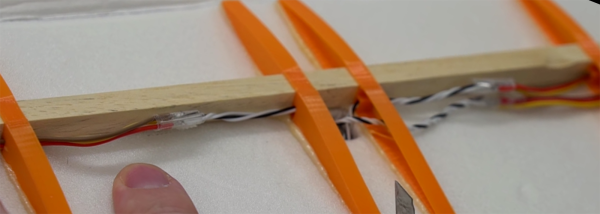
For this build, [Tom] is relying on the old standby, a square piece of balsa. The ribs, though, are 3D printed. They’re basically a single-wall vase in the shape of a wing rib, and are attached to the covering (foam board) with Gorilla glue.

Did the 3D printed ribs work? Yes, of course, you can strap a motor to a toaster and get it to fly. What’s interesting here is how good the resulting wing looked. It’s not quite up to the quality of fancy fiberglass wings, but it’s on par with any other foam board construction.

The takeaway, though, is how much lighter this construction was when compared to the completely 3D printed plane. With similar electronics, the plane with the 3D printed ribs weighed in at 312 grams. The completely 3D printed plane was a hefty 468 grams. That’s a lot of weight saved, and that translates into more flying time.

You can check out the build video below.

Continue reading “3D Printed Ribs For Not 3D Printed Planes”

Building An Ultralight Out Of Foam In A Basement

[Peter Sripol] is something of a legend in the DIY RC aircraft crowd. He’s friends with Flite Test, and there he built an enormous RC cargo plane that could easily carry a small child aloft. Now, [Peter] is aiming a bit higher. He’s building an ultralight — a manned ultralight — in his basement. It’s made out of insulation foam.

Yes, this ultralight is constructed out of insulation foam, but you can think of that as just a skin. The real structure here comes from a wooden frame that will be fiberglassed. The design of this aircraft is an electric, twin-engine biplane. The relevant calculations have already been done, and [Peter] is already flying an RC scale model of this craft. So far, everything is not as sketchy as it could be.

As with any, ‘guy builds an airplane in his basement’ story, there must be a significant amount of time dedicated to the legality, practicality, and engineering of said plane. First off, the legality. [Peter] is actually building an ultralight under Part 103. The certifications for a Part 103 ultralight are much more lenient than the next step up in FAA-certified aircraft, a light sport or experimental aircraft. An ultralight is not required to have an airworthiness certification, and pilots of ultralights are not required to pass any tests of aeronautical knowledge or hold a medical certificate. Yes, legally, any moron can jump in an ultralight and fly. Think about that the next time someone brings up the Part 107 ‘drone’ certification.

Next, the practicality and engineering. [Peter]’s plane can weigh a maximum of 254 pounds, and should not be capable of more than 55 knots in full power level flight, while having a stall speed that does not exceed 24 knots. This is slow for a Cessna, but just about right for the gigantic remote-controlled planes [Peter] has already built.  A few years ago, [Peter] built a gigantic remote-controlled cargo plane out of what is basically foam board and a few aluminum tubes. The construction of [Peter]’s ultralight will be a highly refined version of this. He’s using foam insulation sheets for the body of the fuselage, reinforced with plywood and poplar struts. This foam and wood build will be wrapped with carbon fiber and fiberglass sheet, epoxied, and hopefully painted with flames on the side.

The use of poplar is a bit curious for an ultralight aircraft. For the last hundred years, the default wood for aircraft has been either spruce or douglas fir. The reason for this choice is the strength to weight ratio; spruce and douglas fir have the highest strength to weight ratio of any other wood. Poplar, however, is ultimately stronger and available at his local home improvement store, even though it does weigh a bit more. If [Peter] can keep the weight down in other areas, poplar is an excellent choice due to cost and availability. The video (below) is unclear, but we can only hope [Peter] has read up on the strength of aircraft frames and the orientation of the grain of each structural member.

This is the first video in what will be an amazing build series, and [Peter] hopes to get this thing up in the air by September. If you’re concerned about [Peter]’s safety, he’s also put up a GoFundMe page for a parachute. [Peter]’s going to fly this thing if you complain or concern troll or not, so donate a dollar for the parachute if you’re that concerned.

Continue reading “Building An Ultralight Out Of Foam In A Basement”