Radio Control Buggy Gets V10 Power

Amongst the more difficult machining tasks in the world are those involved in the production of internal combustion engines. Thanks to the Internet, it’s now possible to watch detailed videos of master craftsmen assembling tiny desktop V8 and V12 engines in home workshops with barely a CNC in sight. However, up until now, most of these builds have been left on the test stand to bark and wail away. No longer – [Keith] has decided that needs to change.

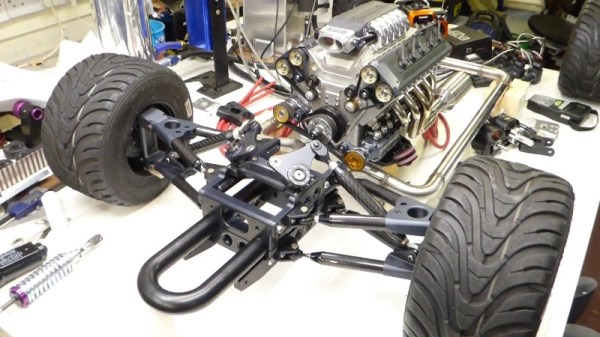
We’ve seen [Keith]’s work before – particularly, his 125cc V10 build, featuring fuel injection, dual overhead cams, and even a supercharger. With several micro engines under his belt now, it was time to put them to work – the V10 is getting a new home in a 1/3rd scale RC buggy.

We’re not sure [Keith] has heard the phrase “off the shelf” – even the suspension dampers on this build are custom machined. Currently up to part 5, the chassis is coming together and there are plans for a hybrid powertrain, too. Carbon fiber and anodized parts are in abundance – this build is truly a work of art.

We can’t wait to see this V10 monster tearing up the dirt – It’s an ambitious build, but if anyone can pull it off, it’s [Keith]. Video after the break.

Continue reading “Radio Control Buggy Gets V10 Power”

RC Controller Becomes XInput Controller

XInput is an API that is used by applications to interface with the Xbox 360 Controller for Windows. The 360 controller became somewhat of a “standard” PC gamepad, and thus many games and applications support the XInput standard.

[James] is working on an entry for a robotics competition, and wanted a controller to use with their PC that was more suited to their build. They took an RC controller, and converted it to work with XInput instead.

The controller in question is the JJRC Q35-01, a trigger-type RC controller available for under $20. The conversion is executed neatly, with the original STM microcontroller being removed from the board, and the PCB traces instead being connected to a Teensy 3.5 which takes over running the show.

The conversion is remarkably complete, with the team not stopping at just reading the buttons and steering potentiometer. A USB logic analyzer was used to figure out how to control the LCD, and a calibration mode implemented just in case.

[James] has shared the work on Github so it’s reproducible for the average maker. We’ve seen plenty of builds in this space, like this tilt controller from [Electronoobs]. Video after the break.

Continue reading “RC Controller Becomes XInput Controller”

Fail Of The Week: Hard Lessons In 3D-Printed Bushings For A Giant RC Car

Can you turn 47 pounds (21 kg) of PLA filament into a gigantic working 3D-printed RC car? No, no you can’t — at least not if you eschew proper bearings in favor of printed bushings.

That’s the hard lesson that [Joel Telling] learned with his scaled up version of the OpenRC F1 car, an RC car that can be mostly 3D-printed. The small version still has its share of non-printed parts, mainly screws and bearings. In his video series documenting the build of the upsized version, [Joel] elaborates on some of the reasons for going with printed bushings rather than bearings, which mainly boil down to hoping that the graphite lubricant powder he added would reduce friction enough to prevent the parts from welding themselves together.

The car came out looking great, and even managed to scoot about nicely for a few seconds before its predictably noisy and unhappy demise. But what was unexpected was the actual failure mode. The plastic-on-plastic running gear seemed to handle the rolling loads fine; it was the lateral force exerted on the axle by the tension of the drive belt that was too much for the printed bushing to bear.

As [Joel] rightly points out, it’s only a failure if you fail to learn something, so kudos to him for at least giving this a try. And all that PLA won’t go to waste, of course — everything else on the car worked fine, so adding one bearing should get it back on the road. He should check out our primer on bearings for a few tips on selecting the right one.

Continue reading “Fail Of The Week: Hard Lessons In 3D-Printed Bushings For A Giant RC Car”

Go Up A Creek Without A Paddle

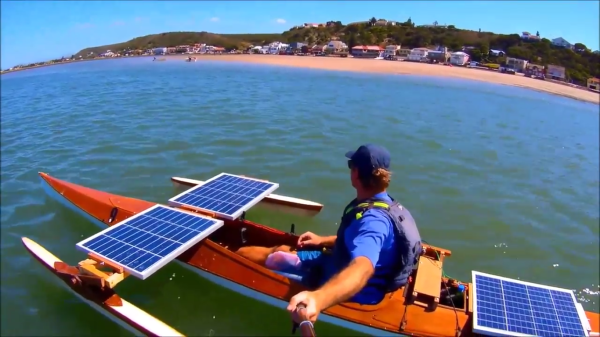
Kayaks are a some of the most versatile watercraft around. You can fish from them, go on backpacking trips, or just cruise around your local lake for a few hours. They’re inexpensive, lightweight, don’t require fuel, and typically don’t require a license or insurance to operate. They also make a great platform for a solar-powered boat like this one with only 150 watts of panels and a custom-built motor with parts from an RC airplane.

[William Frasier] built his solar-powered kayak using three solar panels, two mounted across the bow of the boat using pontoons to keep them from dipping into the water, and the other mounted aft. Separating the panels like this helps to prevent all three of them being shaded at once when passing under bridges. They’re all wired in parallel to a 12V custom-built motor which is an accomplishment in itself. It uses custom-turned parts from teak, a rot-resistant wood, is housed in an aluminum enclosure, and uses an RC airplane propeller for propulsion.

Without using the paddles and under full sun, the kayak can propel itself at about 4 knots (7 kmh) which is comparable to a kayak being propelled by a human with a paddle. With a battery, some of the shading problems could be eliminated, and adding an autopilot to it would make it almost 100% autonomous.

Continue reading “Go Up A Creek Without A Paddle”

Henry The Hoover Gets A Weapons Upgrade

In this day and age of unprecedented military expenditure, we’re used to seeing weapons upgrades across all manner of war fighting hardware – tanks, helicopters, attack aircraft, you name it. We’re somewhat less accustomed to seeing the same on a domestic appliance. Regardless, we now have Henry the Hoover packing some serious heat.

Originally a mere vacuum cleaner, Henry was given movement through two motors and gearboxes sourced from a children’s ride on vehicle. A tank was created out of copper pipe to store the flammable gas (which appears to be butane, as used in cigarette lighters), and discharge is controlled with a solenoid valve. Ignition is then handled by a pair of electric ignitors fired by relay. It’s all controlled over a standard hobby radio controller, so you can stand at a safe distance while flambeeing your rug.

It’s a dangerous project, but one that is particularly fun when Henry’s dazed and amused countenance is taken into account. But then again, you might like your flamethrowers wrist mounted, instead. Video after the break.

Continue reading “Henry The Hoover Gets A Weapons Upgrade”

9 Planes Combine To Make One Giant Flexible Flier

[Ran D. St. Clair] has created a unique flying machine in the Flex 9. It’s not every day that you see a completely new and unusual aircraft, but the Flex 9 definitely fits the bill. [Ran] took 9 radio controlled planes, connected them together, and made one giant plane — and with an 18-foot wingspan, giant isn’t a misnomer.

The planes that make up the Flex 9 are simple aircraft – foamboard wings, a boom, and a basic tail. The individual planes only have elevator control – no rudder, no ailerons. Power comes from a standard LiPo battery, ESC and brushless outrunner motor. The control system is interesting – every plane has a KK board flight controller running OpenAeroVTOL firmware. The center plane has a radio receiver and communicates to the other KK boards over standard servo wires. Rudder (yaw) and aileron (bank) control are achieved through mixing handled by flight controllers.

Even the couplings between the planes were carefully designed. [Ran] used an EPP foam core as a rubbery dampener, with plywood to strengthen the joint. Each joint is mounted at a 20-degree angle. As the planes bank relative to each other, the angle forces the airframe to twist, which should help the whole system stay level.

Check out the videos below for an explanation and a flight test. The Flex 9 launch isn’t exactly stable – there’s some crazy sinusoidal wobbling going on. But the mechanical and electronic dampeners quickly spring into action smoothing the flight out.

If you’d like to know more about the KK board, you can read about right here.

Continue reading “9 Planes Combine To Make One Giant Flexible Flier”

Foam Airboat Is Cheap RC Fun

Archer fans and residents of Louisiana will already be familiar with the concept of the airboat. Put a powerful engine running an aircraft prop on a flat-bottomed hull, and you’ve got an excellent way to traverse the marshes of the American South. While a fully-fledged airboat might run you the best part of $100,000, this no-frills radio-controlled version is great fun at a much lower price.

The hull is built on a sheet of foam, which is cheap, readily available, and suitably buoyant for the task. It’s then kitted out with a brushless motor to run the prop and a servo to control the rudder. Lace it up with a radio receiver and speed controller and you’re good to go.

The build could readily be completed in well under a couple of hours, and is a great one to tackle with kids due to its mechanical simplicity. There’s room for extra creativity too – you can always substitute a watermelon if you’re feeling peckish. Video after the break. Continue reading “Foam Airboat Is Cheap RC Fun”