AVR Controlled RGB LED Matrix Plays Tetris

[Stan] built this LED matrix using a 16×16 grid of RGB LEDs. He built the hardware and wrote some subroutines to randomize the colors. He’s not using PWM because frame buffering is not feasible for the 1k SRAM limit of the ATmega168 he used. Instead, shift registers drive the lights which can be mixed to achieve eight different colors (including off for black) reducing the framebuffer size to just 96 bytes. After he got done with the build he realized this is sized well for a game of Tetris. We’ve seen AVR tetris, PIC Tetris, and Tetris using composite video but it’s always a pleasure to see a new display build.

After the break we’ve embedded [Stan’s] demo video, several pictures, and a schematic. He’s using many of the same principles outlined in our How to Design an LED matrix tutorial.

Continue reading “AVR Controlled RGB LED Matrix Plays Tetris”

RGB Stroboscopic Guitar Tuning

This is [Michael Ossmann’s] RGB LED stroboscopic guitar tuner. If his name is familiar that’s because we mentioned he’d be giving a talk with [Travis Goodspeed] at ToorCon. But he went to DefCon as well and spent the weekend in his hotel room trying to win the badge hacking contest.

Despite adversity he did get his tuner working. It’s built into a toy guitar that he takes on road trips with him. By adding a row of RGB LEDs between two of the frets he can use the vibration frequency of an in-tune string to flash the three different colors. If the string is not in tune the three colors will dance around but matching it with the LED frequency produces a stable color. He then uses that big yellow button to advance to the next string. See his demonstration after the break.

This is basically a built-in plectrum tuner that uses one LED package instead of two.

Continue reading “RGB Stroboscopic Guitar Tuning”

Lightsaber Color Selector

[George Hadley] developed a nice setup to control the color of a replica Lightsaber. A small PCB houses a PIC 18F2221 and three switching transistors for the colors. A powerful LED resides in the tip of the handle, lighting up the diffuser that makes up the blade. But our favorite part is the control scheme. He’s embedded a small RGB LED in the handle, giving feedback as to which color of light can currently be adjusted (red, green, or blue). One button scrolls through the colors and a slide potentiometer adjusts that them.

We wouldn’t go as far as calling this a Halloween prop, we think it’s better suited for serious replica builds. But it would make an amazing addition to the little one’s costume. See it in action after the break.

Continue reading “Lightsaber Color Selector”

Disco Drumming With Piezo Sensitive Lighting

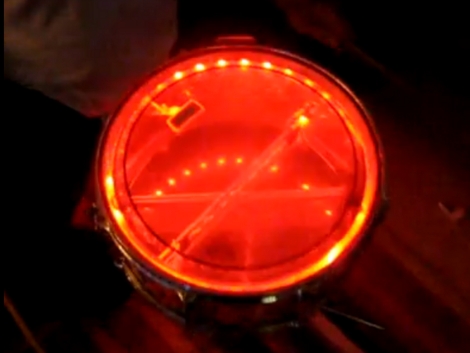
[Wilfred’s] brother outfitted a snare drum with LEDs for Dutch Carnival. They faded through different colors randomly and were a nice addition to the normal looking instrument, but [Wilfred] suggested that the LEDs change color with each drum stroke. He set out to design a controller circuit to provide the functionality and ended with a small package based around an ATtiny2313 microcontroller. A piezo buzzer is used to detect the vibrations inside the drum, each hit triggering a different color combination. The LEDs fade to off after each impact as if dying along with the sound, and when not struck for 30 seconds the system defaults to a red heartbeat pattern. See for yourself after the break.

We’d love to see this feature added to each drum in one of those robotic drumsets. Continue reading “Disco Drumming With Piezo Sensitive Lighting”

Dazzling Coat Sure To Be In Demand With Pimps Everywhere

This is the newest addition to [Arren Parker’s] Burning Man wardrobe. The full-length lighted faux-fur coats is completely his creation. He started with a pattern that he acquired from Ebay, adding side pockets and changing the hood to a collar. From there he added the 256 RGB LEDs that make it shimmer so appealingly.

For this to work, he designed and ordered 300 tiny PCBs on which a connector socket and the LED are soldered. These are driven by a set of six TLC5940 pulse-width modulation chips, and ultimately by an Arduino. The effect is spectacular (see for yourself after the break), and we’re sure it’ll be a hit at burning man. Continue reading “Dazzling Coat Sure To Be In Demand With Pimps Everywhere”

Equinox Clock

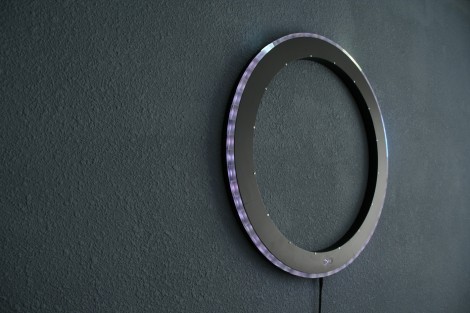
The Equinox clock is made up of simple parts but a combination of fine design and precision make it a gem of a timepiece. The guts are made up of an Arduino, a DS1307 real time clock, twelve LED drivers, and sixty RGB LEDs. These combine with a capacitive touch interface to tell the time using three lit blocks for the hours, one for the minutes, and a fading block for the seconds. See for yourself after the break.

To our delight, [Bram Knaapen] shared the specifics of the case. The black ring that makes up the body was laser cut and spray painted. He uses small blocks of acrylic that have been sandblasted to diffuse the light. This is also a great example of clean circuitry using interconnects between the different circuit boards.

We always enjoy seeing clocks no matter what level of finish is involved, but great design is something that makes us want to hang a project on the wall rather than stow it in a parts bin.

Continue reading “Equinox Clock”

LED Suit Lights Up The Night

When the tipline popped up with this LED suit, part two, by [Marc DeVidts] we were expecing a simple led version of the previously known EL coat.

Well we were right and wrong in the same instance. Correct in that like predictions, the outcome is stonking great. Wrong in that this suit far outpaces EL in abilities we weren’t expecting. Namely to start off, an iPhone app over WiFi dictates to some 200 Arduino multiplexed RGB LED modules to dance randomly or follow patterns; an accelerometer and microphone are also implanted to further some effects. And finally if the suit isn’t enough to make you giddy, his PCB and enclosure milling surely will. Catch a video of the entire setup after the break.

Continue reading “LED Suit Lights Up The Night”