Turbot Is A Beam/Picaxe Hybrid

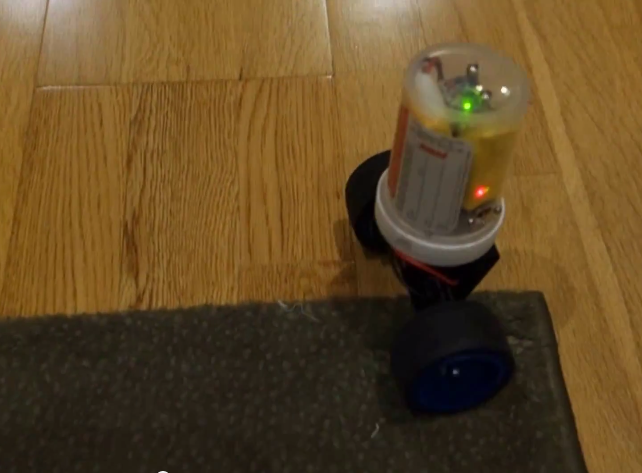
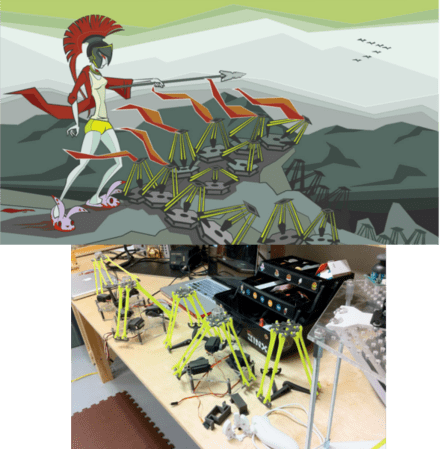
[James] wanted to build a BEAM turbot. He ran into some problems with the BEAM circuitry though, and ended up with a BEAM/Picaxe hybrid.
Beam robotics
are the brainchild of Mark Tilden. The acronym stands for Biology, Electronics, Aesthetics, and Mechanics. BEAM based bots were very popular with hobbyists in the 90’s and early 2000’s, but popularity has since died down. BEAM robots tend not to use microcontrollers, instead attempting to simplify things down to the lowest number of elements.

[James’] turbot uses a miller solar engine. The original design used the engine to drive a Solar Turbot Latch. [James’] problem was that the photodiode “eyes” of the robot were not properly enabling the 74AC245 to pass current to the motor. Since the robot was built in a tiny space, debugging the circuit was extremely hard. After struggling with the ‘245 for some time, [James] decided to swich out the BEAM circuit for a Picaxe microcontroller.

The Picaxe can only sink or source about 20ma per pin, which is slightly less than the no load current of [James’] motors. To make up for this, he ganged up four pins per motor. There was some risk in the motors blowing up the Picaxe. However between the lightly loaded gearmotors and low current solar panels it seems to be working just fine.  Overall the bot is a very clean, compact build. Jump past the break to check out its really smooth crablike walking action.

Continue reading “Turbot Is A Beam/Picaxe Hybrid”

Atlas Survives The Wrecking Ball

[Boston Dynamics] has been just full of videos over the last few days. They’ve dropped updates on Atlas and LS3 in addition to the WildCat update we already featured.

This video shows updates to the Atlas robot. This is to be a simplified version of the atlas, as compared to the robots sent off to competitors in the DARPA robotics challenge. Arms have been replaced with weights. It appears that this update focuses on Atlas’ balancing and handling on rough terrain. Atlas walks gingerly, over some crushed cinder blocks – possibly the same ones we saw BigDog throwing around recently. There are a few tense moments, but Atlas manages to get through unscathed.

The real scary part (for us) is watching Atlas get hit with a weighted ball. We’re assuming the 20 on the ball indicates pounds. Imagine getting hit from the side with a 20lb swinging weight. Would you be able to stand up? Did we mention Atlas did this all while standing on one foot? Atlas takes it in stride though – waving its arms to maintain balance in a very human manner.  Notable is the balance system. Atlas never lifts its foot off the ground. This is slightly different from the bouncing/hopping system of balance we’ve come to know and love in [Boston Dynamics’] other robots.  Continue reading “Atlas Survives The Wrecking Ball”

Boston Dynamics Takes WildCat Outside

wildcat

[Boston Dynamics] has released a video of their latest robot, which means it’s time to go hide in bed before this thing comes to get us. The new video features WildCat, which is apparently the evolution of the Cheetah robot we saw last year. Cheetah was an indoor cat, tethered by power, data, and hydraulic lines while running on a treadmill. WildCat has been released to terrorize people explore the great outdoors

Reminiscent of the early videos of BigDog, WildCat is currently powered by an internal combustion engine. The engine drives a hydraulic system, which then actuates the robot’s legs and front/rear pods. The beauty of a system like this is that switching to an electric motor is simple – just replace the IC engine. While we’re sure this would make a much more stealthy cat, weight and run time could be issues. Moving the power system onboard has also slowed down WildCat a bit. Cheetah was able to reach 28 MPH while WildCat can only muster 16 MPH.

WildCat is part of DARPA’s maximum mobility and manipulation program. The research appears to be focused on improving the gaits the robot uses to move at various speeds. The video highlights both bounding and galloping.  Slo-mo sections show all four of WildCat’s legs leaving the ground, which is the suspension phase of a classic gallop gait. Control isn’t perfect yet, as WildCat tumbles at one point in the video.  It gets right back up though – ready for more.

Continue reading “Boston Dynamics Takes WildCat Outside”

Step Into The Box

thebox

Take three industrial robots, two 4’ x 8’ canvases, and several powerful video projectors. Depending on who is doing the robot programming you may end up with a lot of broken glass and splinters, or you may end up with The Box.  The latest video released by the creators project, The Box features industrial robots and projection mapping. We recently featured Disarm from the same channel.

The Box is one of those cases of taking multiple existing technologies and putting them together with breathtaking results. We can’t help but think of the possibilities of systems such as CastAR while watching the video. The robots move two large canvases while projectors display a series of 3D images on them. A third robot moves the camera.

In the behind the scenes video, the creators revealed that the robots are programmed using a Maya plugin. The plugin allowed them to synchronize the robot’s movements along with the animation. The entire video is a complex choreographed dance – even the position of the actor was pre-programmed into Maya.

Continue reading “Step Into The Box”

Turn A Decommissioned Robot Into A CNC Machine

adeptRobot

Some of us may have been accused of living in Mom’s basement – [Benjamin] kicks it up a notch by keeping an industrial robot in his parent’s attic shed loft.
[Benjamin] was tasked with stripping down some retired equipment at work. It turns out the “retired equipment” was three Cartesian robots from Adept Robotics. These are large industrial XYZ platforms capable of high speed movements (3000 IPM rapids!).

Getting from a decommissioned machine to a working CNC is never a simple path. In this case [Ben] was able to make the transition relatively easily. Each axis of the robot has a 400 Watt Yaskawa servo with a 65k encoder and brake. The original Adept servo amps and control system was still working, so he kept it. The controllers were new enough that they communicate over a daisy chained IEEE1394 (Firewire) link. That is relatively modern compared to some of the conversions we’ve seen in the past.  The final piece of the puzzle was G-code creation Translating common G-code to a format his machine could recognize. Ben chose MeshCAM for the task.

One problem [Ben] ran into was stuttering on the X-axis. The original machines only had a single sided drive system on the X-axis. Single side is fine for an assembly machine that doesn’t see any tool load. However for a CNC machine that will see spindle loads, a single side drive creates a twisting force which threatens to rack the entire frame. He used one of the drive systems from his spare robot to convert his main machine to a double-sided drive, eliminating the issue.

Continue reading “Turn A Decommissioned Robot Into A CNC Machine”

RepRap Simpson Puts A New Spin On Delta RepRaps

Just when you think you’ve seen it all in the 3D printer world, something new pops up! [Nicholas Seward] posted a video of RepRap Simpson, his latest project.  Simpson is a delta robot – but unlike any delta we’ve seen before. Previous offerings vertical rails on which the arms travel. As you can see, this design mounts three articulated arms directly to the base of the printer, using steel cables as part of the joint mechanism.

Judging by [Nicholas’] posts on the RepRap forums, Simpson’s grounded delta design has already gone through a few revisions. The basic geometry though, has remained the same. [Nicholas] calls this edition a “Proportional Gear Drive Joint Simpson”. The name may not roll off the tongue, but the movements are incredibly smooth, organic, and fast.

As with any delta design inverse kinematics play a huge role in the software. [Nicholas] is trying to simplify this with an optical calibration system. For the adventurous, the equations are posted on the forums, and a python Gcode preprocessor is posted on Thingiverse.

Even Simpson’s base received special attention.  It’s built from a water jet cut piece of basalt.  We like the use of opposed helical gears on the large joints, as well as the guitar machine heads used to tension the cable drive. One thing we are not sure of is the longevity of system – will cable stretch play an issue? Will the printed parts suffer wear from the cables? Only time will tell.

Continue reading “RepRap Simpson Puts A New Spin On Delta RepRaps”

Fully Automated Watering Robot Takes A Big Leap Forward Toward Greenhouse Automation

aquarius_robot

Greenhouse owners might find [David Dorhout]’s latest invention a groundbreaking green revolution! [David]’s Aquarius robot automates the laborious process of precision watering 90,000 square feet of potted plants. Imagine a recliner sized Roomba with a 30 gallon water tank autonomously roaming around your greenhouse performing 24×7 watering chores with absolute perfection. The Aquarius robot can do it all with three easy setups; add lines up and down the aisles on the floor for the robot to follow, set its dial to the size of your pots and maybe add a few soil moisture sensors if you want the perfect amount of water dispensed in each pot. The options include adding soil moisture sensors only between different sized plants letting Aquarius repeat the dispensing level required by the first plant’s moisture sensor for a given series.

After also digging through a pair of forum posts we learned that the bot is controlled by two Parallax propeller chips and has enough autonomous coding to open and close doors, find charging stations, fill its 30 gal water tank when low, and remember exactly where it left off between pit stops. We think dialing in the pot size could easily be eliminated using RFID pot identification tags similar in fashion to the Science Fair Sorting Project. Adjusting for plant and pot size as well as location might easily be automated using a vision system such as the featured Pixy a few weeks back. Finally, here are some featured hardware hacks for soil moisture sensing that could be incorporated into Aquarius to help remotely monitor and attend to just the plants that need attention: [Andy’s] Garden sensors, [Clover’s] Moisture control for a DIY greenhouse, [Ken_S’s] GardenMon(itoring project)

[David Dorhout] has 14 years experience in the agriculture and biotech industry. He has a unique talent applying his mad scientist technology to save the future of mankind as seen with his earlier Prospero robot farmer. You can learn more about Aquarius’s features on Dorhout R&D website or watch the video embedded below.

Continue reading “Fully Automated Watering Robot Takes A Big Leap Forward Toward Greenhouse Automation”