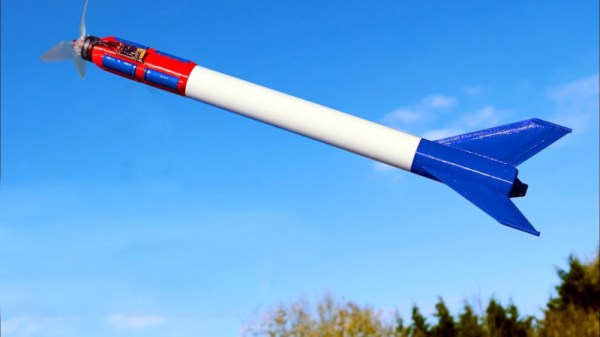
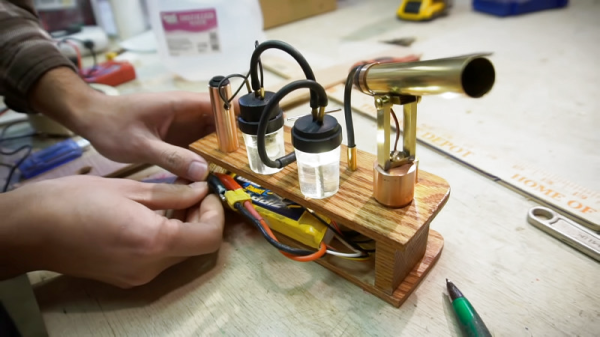
Rocketry is wild, and [Foaly] is sharing build and design details of the Cortex 2 mini rocket which is entirely 3D printed. Don’t let that fool you into thinking it is in any way a gimmick; the Cortex 2 is a serious piece of engineering with some fascinating development.
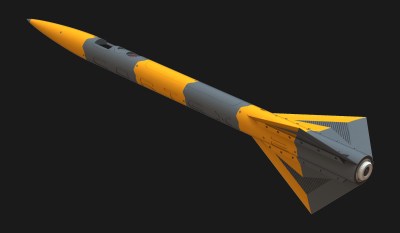 Cortex 1 was launched as part of C’Space, an event allowing students to launch experimental rockets. Stuffed with sensors and entirely 3D printed, Cortex 1 flew well, but the parachute failed to deploy mainly due to an imperfectly bonded assembly. The hatch was recovered, but the rocket was lost. Lessons were learned, and Cortex 2 was drafted up before the end of the event.
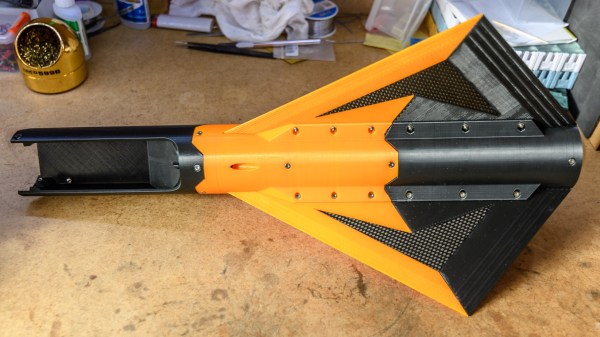
Some of the changes included tweaking the shape and reducing weight, and the refinements also led to reducing the number of fins from four to three. The fins for Cortex 2 are also reinforced with carbon fiber inserts and are bolted on to the main body.
Here’s an interesting details: apparently keeping the original fins would result in a rocket that was “overstable”. We didn’t really realize that was a thing. The results of overstabilizing are similar to a PID loop where gain is too high, and overcorrection results in oscillations instead of a nice stable trajectory.
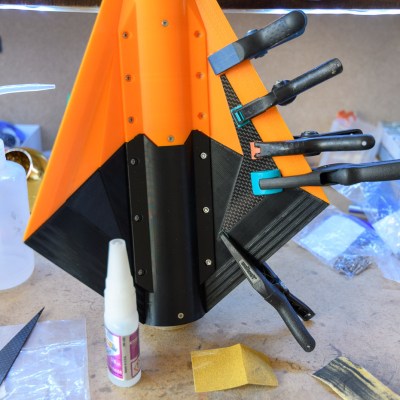 Cortex 2 uses a different rocket motor from its predecessor, which led to another interesting design issue. The new motor is similar to hobby solid rocket motors where a small explosive charge at the top of the motor blows some time after the fuel is gone. This charge is meant to eject a parachute, but the Cortex 2 is not designed to use this method, and so the gasses must be vented. [Foaly] was understandably not enthusiastic about venting hot gasses through the mostly-PLA rocket body. Instead, a cylindrical cartridge was designed that both encases the motor and redirects any gasses from the explosive charge out the rear of the rocket. That cartridge was SLA printed out of what looks to us like Formlabs’ High Tempurature Resin.
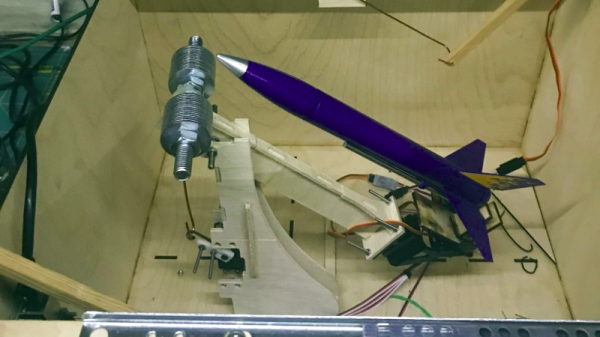
Finally, to address the reasons Cortex 1 crashed, the hatch and parachute were redesigned for better reliability. A servo takes care of activating the system, and a couple of reverse-polarity magnets assist in ensuring the hatch blows clear. There’s even a small servo that takes care of retracting the launch guide.
The rocket is only half built so far, but looks absolutely fantastic and we can’t wait to see more. It’s clear [Foaly] has a lot of experience and knowledge. After all, [Foaly] did convert a Makerbot printer into a CNC circuitboard engraver.