Autonomous Rover Navigates The House With LIDAR

For those wishing to explore robot autonomy, there’s no better way then to learn by doing. [Greg] was in that camp, and decided to build an autonomous rover to roam his house, and learned plenty along the way.

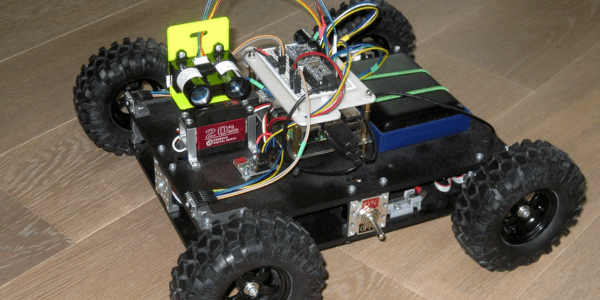
[Greg]’s aims with the project were to build a robot that was capable of navigating his home without external assistance. To do the job, a Raspberry Pi 3 was put in charge, and kitted out with a LIDAR for mapping. Pololu Roboclaw motor controllers are then used to allow the Raspberry Pi to drive the robot’s individual wheel motors, giving the four-wheeled bot skid steering capability.

[Greg] goes into immense detail on the project’s writeup, exploring the code and concepts behind its autonomous abilities. Creating a robot that can navigate using LIDAR is no easy task, but [Greg] does a great job of explaining how it all works, and why.

It’s not the first autonomous rover we’ve seen here, and we’re sure it won’t be the last. If you’ve got your own build coming together in the lab, be sure to let us know. Video after the break.

Continue reading “Autonomous Rover Navigates The House With LIDAR”

ExoMy Is A Miniature European Mars Rover With A Friendly Face

Over the past few weeks, a new season of Mars fever kicked off with launches of three interplanetary missions. And since there’s a sizable overlap between fans of spaceflight and those of electronics and 3D printing, the European Space Agency released the ExoMy rover for those who want to experience a little bit of Mars from home.

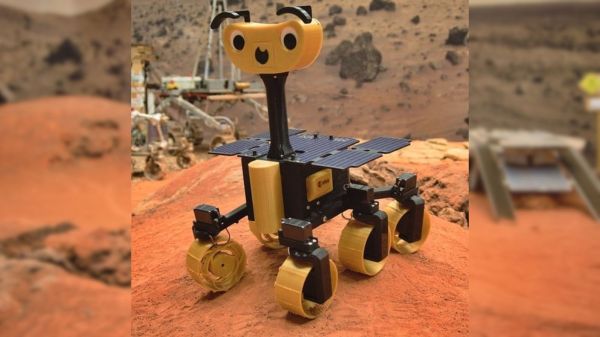
ExoMy’s smiling face and cartoonish proportions are an adaptation of ESA’s Rosalind Franklin (formerly the ExoMars) rover which, if 2020 hadn’t turned out to be 2020, would have been on its way to Mars as well. While Rosalind Franklin must wait for the next Mars launch window, we can launch ExoMy missions to our homes now. Like the real ESA rover, ExoMy has a triple bogie suspension design distinctly different from the rocker-bogie design used by NASA JPL’s rover family. Steering all six wheels rather than just four, ExoMy has maneuvering chops visible in a short Instagram video clip (also embedded after the break).

ExoMy’s quoted price of admission is in the range of 250-500€. Perusing instructions posted on GitHub, we see an electronics nervous system built around a Raspberry Pi. Its published software stack is configured for human remote control, but as it is already running ROS (Robot Operating System), it should be an easy on-ramp for ExoMars builders with the ambition of adding autonomy.

ExoMy joins the ranks of open source rover designs available to hackers with 3D printing, electronics, and software skills. We recently covered a much larger rover project modeled after Curiosity. Two years ago NASA JPL released an open source rover of their own targeting educators, inspiring this writer’s own Sawppy rover project, which is in turn just one of many projects tagged “Rover” on Hackaday.io. Hackers love rovers!


Autonomous Off-Road Food Delivery With Pixhawk

It should come as no surprise that the COVID-19 pandemic has sparked renewed interest in robotic deliveries. Amazon saying they would some day land Prime orders in your backyard with a drone sounded pretty fanciful a few years ago, but now that traditional delivery services are under enormous strain and people are looking to avoid as much human contact as possible, it’s starting to make a lot more sense.

Pro Tip: Avoid drifting while towing seafood.

Now to be clear, we don’t think you’ll be seeing this modified RC truck rolling up your driveway with a pizza in tow anytime soon. But the experiments that [Sean] has been doing with it are certainly interesting, and show just how far autonomous rover technology has progressed at the hobbyist level. Whether you need to move some sushi or a sensor package, his build is a great starting point for anyone interested in DIY robotic ground vehicles.

Especially if you want to take things off the beaten path once and awhile. By combining the Pixhawk autopilot system with an off-road RC truck by Traxxas, [Sean] has created a delivery bot that’s not afraid of a little mud. Or even the occasional jump, should the need arise. Just don’t expect your shrimp cocktail and champagne to arrive in one piece after they’ve been given the Dukes of Hazzard treatment.

In the video after the break [Sean] goes over some of the lessons learned on this build, including how he managed to keep the electronics from cooking themselves in the Texas heat. He also goes over the realities of building an autonomous driving system that doesn’t actually have a camera onboard; sure you can plan a route for it in advance, but all bets are off if an unexpected obstacle blocks the path. It’s a pretty serious shortcoming he’s looking to address in the future, as well as upgrading to a far more accurate RTK-GPS receiver.

Continue reading “Autonomous Off-Road Food Delivery With Pixhawk”

Student Rover Explores The Backyard In Tribute

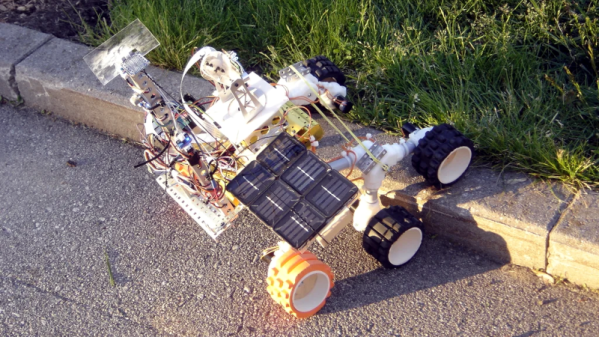
Three students were a little sad when NASA’s Opportunity rover went silent after 15 years on the Martian surface. So they decided to build their own rover inspired by Opportunity to roam their backyards using an off-the-shelf robot chassis, a Raspberry Pi, and the usual list of parts like motors, H-bridges, and batteries.

Like the real rover, the vehicle uses a rocker-bogie system, although it is a little less complex than the version NASA sent blasting off towards the Red Planet. The plucky vehicle comes complete with miniature solar panels to recharge its onboard battery, courtesy of some dollar-store garden lights. A pair of videos after the break show how the rover is controlled, as well as the view sent back from its onboard camera.

The rover ran a simulated Mars mission as part of a school project where it had to find an object and transmit an image of it back to home base, and by the looks of it, is was a rousing success. But the young explorers aren’t resting on their laurels, and are already working on a second version of their exploration vehicle that can operate in inclement weather and includes some new tools such as a robotic arm and infrared illumination for low-light imaging.

We’ve seen plenty of Mars rover clones in the past, but there’s always room for more. Of course, if you’re looking for something a bit easier to start with, you can always go the LEGO route.

Continue reading “Student Rover Explores The Backyard In Tribute”

Geocaching On Mars: How Perseverance Will Seal Martian Samples With A Return To Earth In Mind

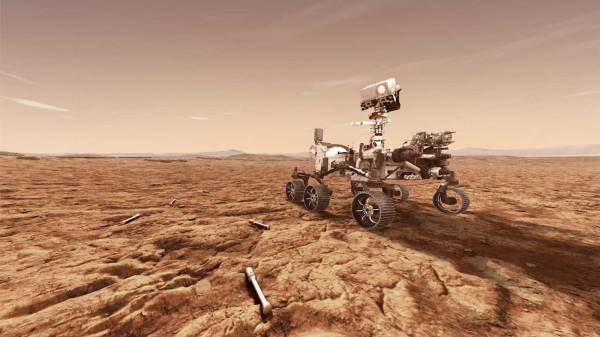
With the roughly 20-day wide launch window for the Mars 2020 mission rapidly approaching, the hype train for the next big mission to the Red Planet is really building up steam. And with good reason — the Mars 2020 mission has been in the works for a better part of a decade, and as we reported earlier this year, the rover it’s delivering to the Martian surface, since dubbed Perseverance, will be among the most complex such devices ever fielded.

“Percy” — come on, that nickname’s a natural — is a mobile laboratory, capable of exploring the Martian surface in search of evidence that life ever found a way there, and to do the groundwork needed if we’re ever to go there ourselves. The nuclear-powered rover bristles with scientific instruments, and assuming it survives the “Seven Minutes of Terror” as well as its fraternal twin Curiosity did in 2012, we should start seeing some amazing results come back.

No prior mission to Mars has been better equipped to answer the essential question: “Are we alone?” But no matter how capable Perseverance is, there’s a limit to how much science can be packed into something that costs millions of dollars a kilogram to get to Mars. And so NASA decided to equip Perseverance with the ability to not only collect geological samples, but to package them up and deposit them on the surface of the planet to await a future mission that will pick them up for a return trip to Earth for further study. It’s bold and forward-thinking, and it’s unlike anything that’s ever been tried before. In a lot of ways, Perseverance’s sample handling system is the rover’s raison d’être, and it’s the subject of this deep dive.

Continue reading “Geocaching On Mars: How Perseverance Will Seal Martian Samples With A Return To Earth In Mind”

The Open Source Mars Rover, One Year Later

As the name implies, here at Hackaday we strive to bring you interesting projects every single day. But that doesn’t necessarily mean a project only gets one day to grace these storied pages. Quite the opposite, in fact. We’re always happy to revisit a project and find out how far it’s evolved since we last crossed paths with it, especially when the creators themselves reach out to give us an update.

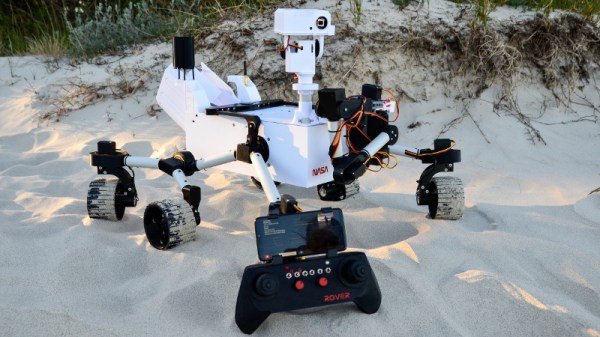
Which is exactly what happened when [Jakob Krantz] recently wrote in to get us up to speed on this incredible open source rover project. We first saw this 3D printed Curiosity inspired robot a little less than a year ago, and at that point it was essentially just a big box with the distinctive NASA rocker-bogie suspension bolted on. Now it not only looks a lot closer to the Martian rovers that inspired it, but it’s also learned a number of new tricks that really take this project to the next level.

The articulated head and grabber arm don’t just help sell the Curiosity look, they’re actually functional. [Jakob] notes that he doesn’t have kinematics integrated yet, so moving the arm around is more for show than practical application, but in the future it should be able to reach out and grab objects. With the new cameras in the head, he’ll even be able to get a first person view of what he’s picking up.

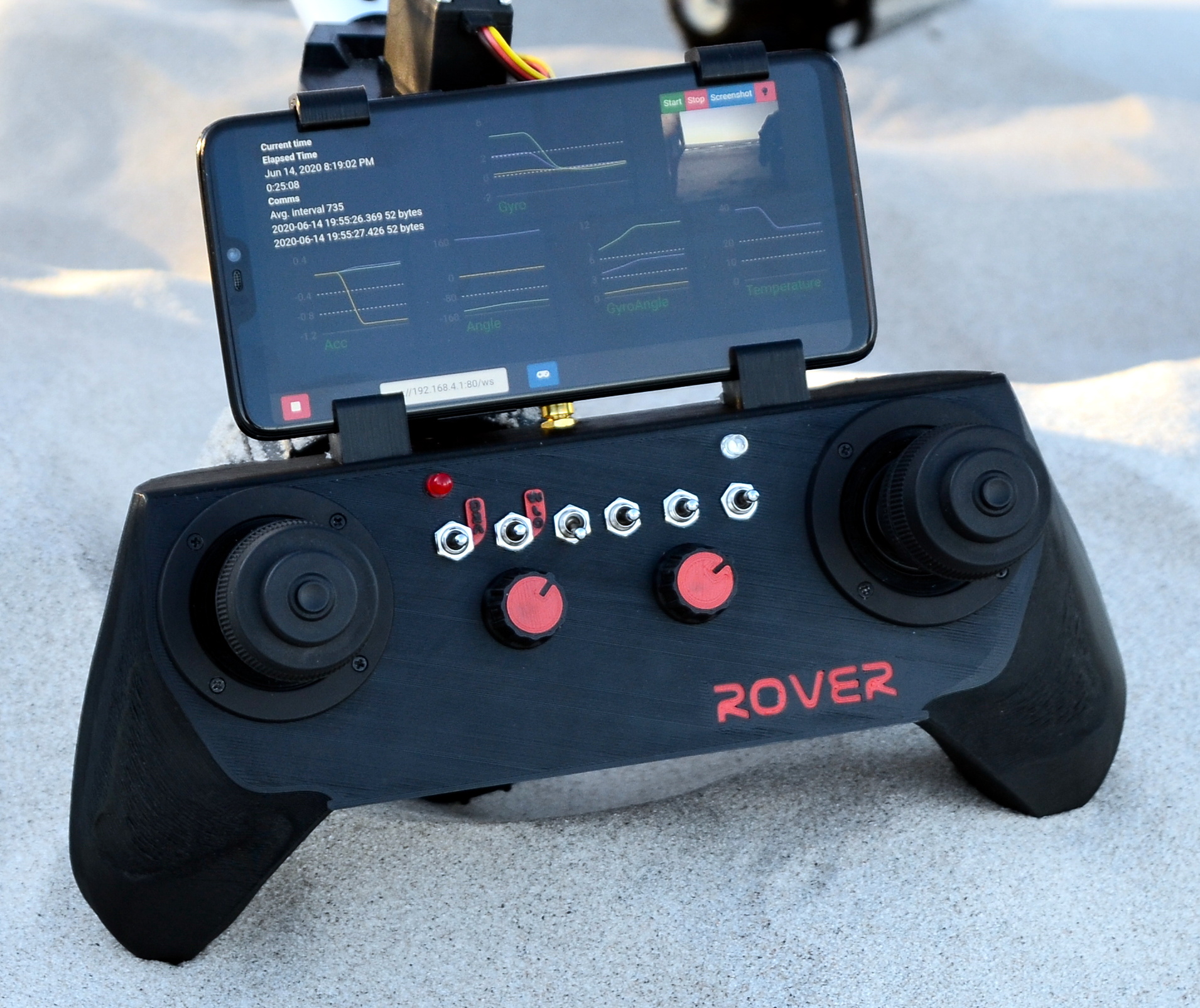
Last year [Jakob] was using a standard RC transmitter to drive the rover around, but he’s since put together a custom controller that’s truly a thing of beauty. It uses an ESP32 and LoRa module to communicate with matching hardware inside the rover, as well as a smartphone clipped onto the top that’s displaying telemetry and video over WiFi. The controller is actually its own separate project, so even if you aren’t in the market for a scaled down Mars rover, its controller could come in handy for your next robotics project.

Presumably the multi-mission radioisotope thermoelectric generator (MMRTG) on the back of the rover is just pretend….but with this guy, we’re not so sure. Give him another year, and who knows.

Autonomous 3D Rover With Tank Tracks Rules The Fields. Almost

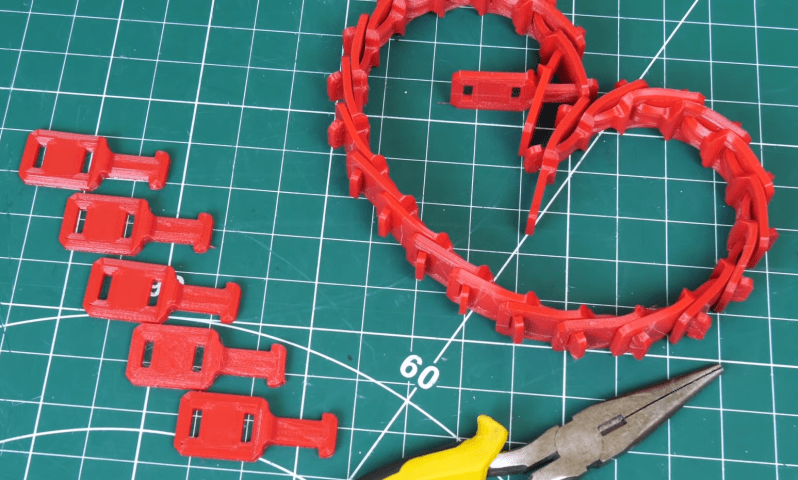
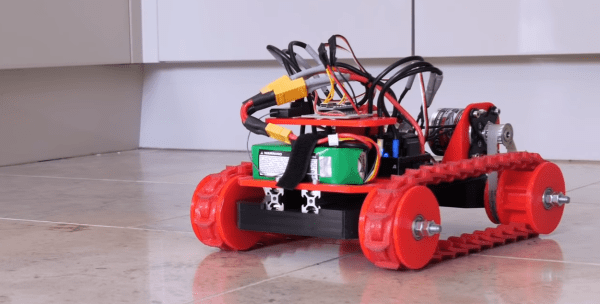
Scope creep is a real pain in the real world, but for projects of passion it can have some interesting consequences. [rctestflight] was playing around with 3D printed rover gearboxes, which morphed into a 3D printed tank build.

[rctestflight]’s previous autonomous rover project had problems with the cheap geared motors, and he started experimenting with his own gearbox designs to use with lower RPM / Kv brushless drone motors. The tank came about because he wanted a simple vehicle to test his design. “Simple” went out the window pretty quickly and the final product was completely 3D printed except for the fasteners, axles, bearings, and electronics.

The tracks and gears are noisy, but it works quite well. On outdoor tests [rctestflight] did find that the tracks were prone to hooking on vines and branches, which in one case caused it to throw a track after the aluminium shaft bent. An Ardurover navigation system was added and with a 32 Ah battery was able to run autonomously for an entire day and there was surprisingly little wear on 3D printed gearbox and tracks afterward. All the STL files are up on Thingiverse, but [rctestflight] recommends waiting for an upcoming update because he discovered flaws in the design after filming the video after the break.

For a slightly more complex and expensive rover, check out our coverage of Perseverance, NASA’s MARS 2020 Rover. Continue reading “Autonomous 3D Rover With Tank Tracks Rules The Fields. Almost”